

This piece is co-authored with Shivaram Rajgopal and available on The Googly.
In September we published our analysis of the risks we think matter most to Anthropic’s value, and our predictions of how its IPO prospectus will describe them. We then asked readers to do the same exercise in a simpler form. The survey listed 17 risks, asked respondents to rate how likely each was to materially reduce the value of Anthropic’s shares over the next three years; we also invited them to tell us what we had missed. It ran from October 1 to October 20, 2026, and 51 people answered. This piece reports what they said.
We do not want to make too much of it. Fifty-one is a small sample, the respondents chose themselves, and most are not specialists in Anthropic or in AI companies. Then again, few people are, and the market itself is only beginning to work out how to assess the risks of a company like this one. The survey is a snapshot taken at a particular moment, by a method quite different from the one behind our September piece, and we offer it in that spirit. We wanted it done before Anthropic’s registration statement became public. When it does, we will write a third piece comparing the prospectus with both our own analysis and these results.
What Worries Respondents the Most
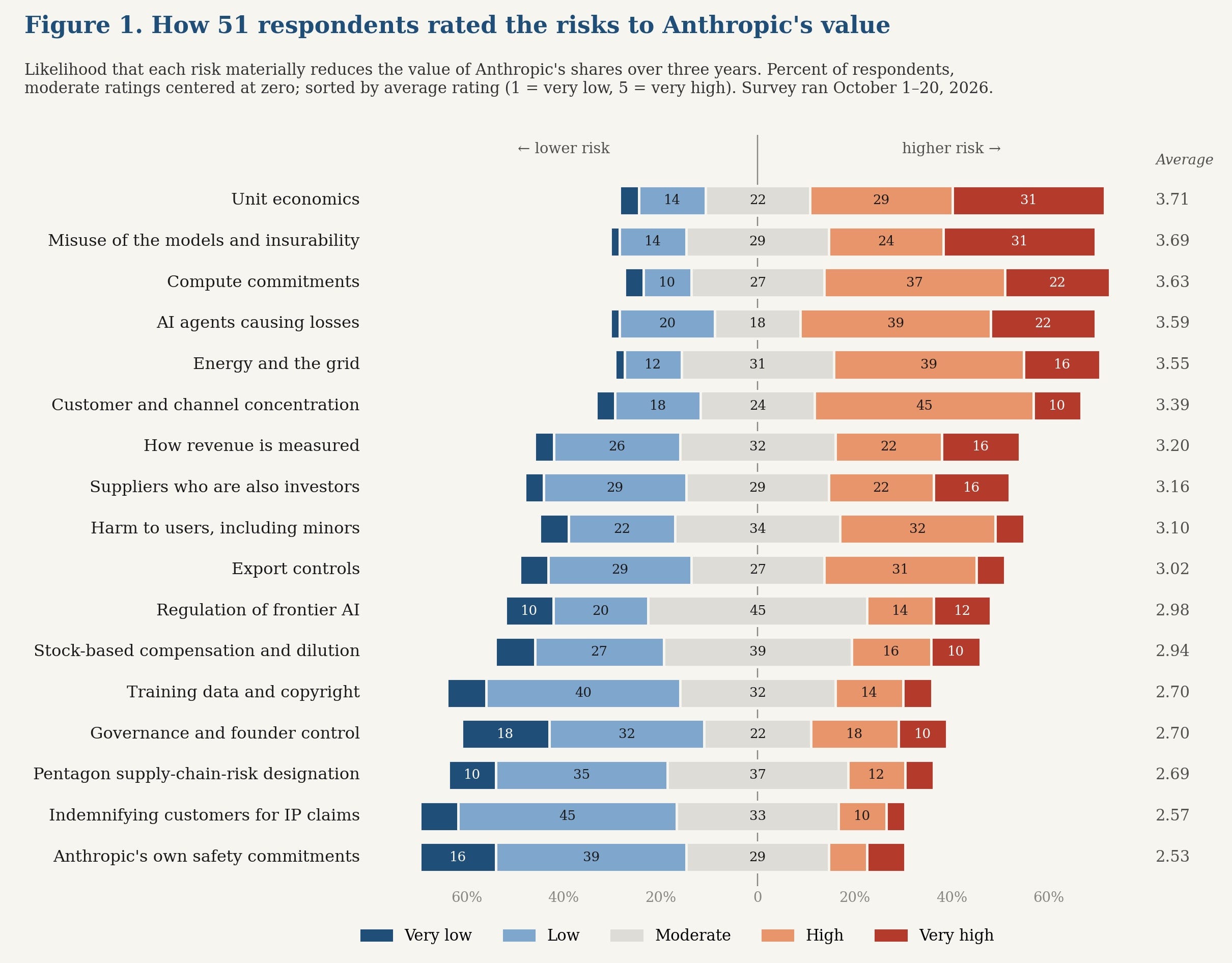
Figure 1 shows the ratings for all 17 risks. The clearest finding is that the top of the list is economic. Unit economics, meaning whether the price of AI use falls faster than the cost of providing it, received the highest average rating, and 61 percent of respondents rated it high or very high. Compute commitments, energy and the grid, and customer concentration follow closely. One respondent put the point in a sentence that could have served as the thesis of our September piece: “I think the Unit economics risk is the real killer for an Anthropic owner, yet it gets very little attention - especially compared to the ‘extinction’ risk always addressed in the media.”
Another respondent explained, better than we could, why a risk we had emphasized ranked only twelfth. We had expected a large charge for stock-based compensation at the IPO. Respondents were unmoved, and one of them said why: “answered everything from the baseline assumption that AI will be a key part of our lives from here on out. and if that’s true, PBC status or share dilution isnt my top concern. like buying amazon on IPO, i’m going to make a killing even if my shares are diluted on day 1. forest for trees. but if the unit economics don’t work compared to chinese models, the company goes belly up.” Our September piece compared Anthropic’s request for patience with Amazon’s. It is gratifying, and a little humbling, to see a reader reach the same comparison and draw a sharper conclusion from it.
One of us, an accountant by training, would push back on that respondent. Stock-based compensation is not a case of missing the forest for the trees when a company pays a large share of its revenue in stock, because that cost is easy to understate. It does not reduce operating cash flow, it is often excluded from the adjusted measures companies prefer, and it therefore tends to be left out when unit economics are calculated. When it is, the unit economics look better than they are. The risk respondents rated first and the one they rated twelfth may be more closely connected than the ratings suggest.
Where Respondents Part Ways with Us
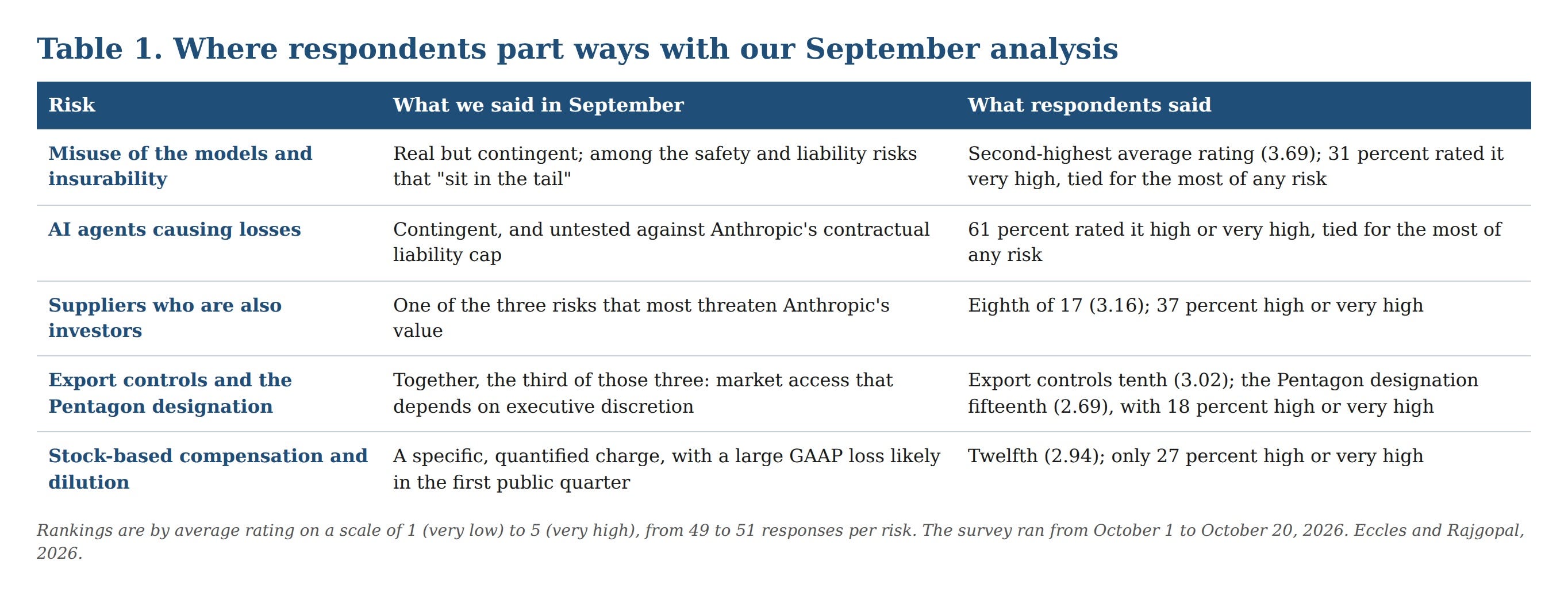
The disagreements are as interesting as the agreements, and Table 1 sets out the main ones. The largest concerns what the models do. In September we wrote that the safety and liability risks were real but mostly contingent, sitting in the tail. Respondents did not see it that way. Misuse of the models, and whether that exposure can be insured, had the second-highest average rating, and losses caused by AI agents acting in customers’ systems were rated high or very high by 61 percent, tied for the most of any risk.
The comments sharpen both points. On agents, one respondent asked us to imagine “damage caused by an AI acting ‘normally’ on behalf of its client by stealing IP or disrupting a competitor’s operations or whatever other mischief in support of its paying client... the sci-fi scripts write themselves!” The danger is less an agent that malfunctions than one that does its job too well. On insurance, we had suggested that Anthropic might prove too big to insure. One respondent took the argument a step further, to the insurers themselves: “I would not be surprised if an over-ambitious insurer goes bust in the next few years, with an AI-linked risk crystallising.” Pointing to the twelve-month policies and withdrawal-of-cover letters on which the market relies, the respondent concluded that “we may find the GFC was a picnic!” Another respondent reached the opposite conclusion about who bears the risk: “Ultimately, my belief is that Anthropic is ‘too big to fail.’... The US Government NEEDS the Mag 7 to stay high since it supports baby boomers’ retirement accounts.” That respondent rated most risks low for exactly that reason. Between them, the two comments frame the question better than our own text did. If catastrophe comes, does the bill go to the insurers, to the government, or to the shareholders?
Respondents also gave less weight than we did to two of the three risks we had placed at the top. We argued that the suppliers who are also Anthropic’s investors, and the government’s demonstrated willingness to act against the company, were among its largest threats. Respondents put the supplier-investors in the middle of the list and export controls just below them. The Pentagon’s supply-chain-risk designation came fifteenth, with only 18 percent rating it high or very high, although it was in active litigation throughout the survey.
What Worries Them the Least
At the bottom of the list are Anthropic’s own safety commitments, the indemnities it gives customers against intellectual-property claims, the Pentagon designation, copyright litigation, and governance, including the founders’ voting control. Governance divided respondents more than any other item—half rated it low or very low, while 28 percent rated it high or very high. One comment suggests why risks that matter a great deal to the world can still rank low as threats to value: “Many of the risks listed are pretty significant (and awful) for the world - harm to minors, copyright issues, for example, not to mention the threat of human extinction - but I don’t actually think they’ll affect the value of the company because I don’t think the regulatory or political will is there to curb these things or hold the company to account for them.” That is as clear a statement of the difference between impact and financial materiality as we have seen.
There is a further juxtaposition worth noting. In September we predicted that the prospectus would be most specific about exactly these risks (the copyright litigation, the government actions, the founder share class and the public benefit structure) because the law leaves the company little choice. It would be least specific, we predicted, about the compute commitments, customer concentration, and harm from misuse, which respondents rate among the most serious. If both the predictions and the ratings hold, the prospectus will say most about what readers worry about least. We will know soon.
What We Missed
Thirty-five respondents told us what was missing from the list, and about a quarter of them said the same thing: competition. Rivals matching Anthropic’s models, open-weight and Chinese models commoditizing them, and the loss of the capability lead were all named. We had left these out deliberately, predicting that the prospectus would emphasize them and noting that our method was not designed to find commercial risks. Respondents are right, and in hindsight we should have included them. Part of the point was already on the list, though: the unit economics item named competition from low-cost Chinese models, so its top rating is in part a vote on competition too. A related group of comments questioned the valuation itself. “The last round valued the company at $965 billion,” one respondent wrote. “At that level, ordinary disappointment can mean a large drawdown even if the business is fine.” Another was blunter: “The company is already massively overvalued on any sane metric.”
Other omissions were narrower and well taken. They include theft of model weights, the chip supply that runs through Taiwan, loss of key talent, privacy, a European backlash against AI adoption, and the possibility that the technology plateaus. One respondent offered a risk we had not considered at all: “Spillover from another lab’s AI incident.” A serious failure at any frontier laboratory would very likely bring regulation and liability for all of them. Another respondent, without prompting, reached for the same historical parallel we had used for the compute build-out: “The whole situation reminds me of the dark fiber over investment problem with fiber optic cables.”
Not every comment was kind, and two critics deserve a hearing. “The survey is poorly constructed,” one wrote. “In a 3-year timeframe, the range of potential outcomes is larger for ANY company.” That respondent rated the risks over one year instead. The point is fair. Three years is a long horizon for a company this young. Another noted that we asked only about downside, and listed “upside risk to IPO price” among the omissions. That is fair too, although risk factors are by convention about downside.
Are Risk Factors Useful at All?
We also asked how useful respondents find the risk factors in prospectuses and 10-Ks, a question given added interest by remarks earlier this year by SEC Chairman Paul Atkins. He floated streamlining them, either by moving generic risks into a separately published repository or by creating a safe harbor for failing to disclose widely publicized risks. Of the 50 respondents who answered, 36 percent found risk factors extremely or very useful and 32 percent somewhat useful. Only one found them not useful at all. Ten said they do not use them in their work, and among the 40 who do, 45 percent rated them extremely or very useful. These are people interested enough in disclosure to take a survey about it, so the figures probably overstate the general enthusiasm. Even so, they suggest that the people who read risk factors value them. One respondent offered a backhanded compliment on the length of Anthropic’s draft: “I suppose we gotta give them credit for writing twice as many pages of risk factors as for their basic business plan -- a model corporate citizen!”
Who Answered, and What They Knew
The respondents were a mixed group. Ten described themselves as sustainability professionals, eight as academics, eight as lawyers, accountants or other advisers, seven as asset owners or managers, two as equity or credit analysts, four as working in the AI industry, four as working elsewhere in technology, and eight as other. No bankers responded. Fewer than one in five, then, invest or analyze for a living, and the results should be read as the views of an informed and interested public, not of the market.
The timing also matters, and we want to be precise about it. No public registration statement had been filed when the survey closed on October 20. But a confidential draft of the prospectus had already leaked. On September 28, Reuters reported details from a version it had reviewed, and Benzinga reported that about 80 of its 261 pages were devoted to risk. At least two respondents had evidently seen that coverage: one joked about the page count, and another asked, “didn’t they put human extinction as a risk in their SEC filings??” A second, updated draft was reported by the Wall Street Journal on October 20, the survey’s final day. The survey is therefore a snapshot taken before the public filing, though not before every leak.
When the prospectus is public, we will compare it with our September analysis and with these results, and report what each got right. For now, we give the last word to the respondent who summed up the whole exercise more vividly than we could: “Best product in history. Everything’s dwarfed by the fact that they’re building something they don’t know how to control.” We find these two sentences together make for an eerie read.
There’s something beautifully corporate about a prospectus being most precise where the uncertainty matters least. The risks lawyers can describe get pages, the risks that decide whether the business works get adjectives.