The Seven Edge System
The Anti-ESG Ecosystem: Part II, Chapter 3


Part II: The Analytical Foundation
If Part I establishes what the anti-ESG ecosystem is and how pressure enters it, Part II explains how that pressure actually moves. This section provides the analytical architecture that makes the remainder of the book intelligible. It does not predict outcomes, rank actors, or defend particular policy positions. Its purpose is more demanding: to discipline causal reasoning in a domain where disagreement is persistent, evidence is partial, and attribution is routinely misplaced.
The core challenge this part addresses is not lack of information, but lack of structure. ESG conflict is commonly explained through single-domain stories—political backlash, market correction, legal overreach, or cultural polarization. Each captures a fragment of reality. None explains why pressure introduced in one arena often manifests elsewhere, long after the original trigger and in forms that appear disconnected from their source. Without a framework that accounts for interaction, translation, and delay, even careful observers end up arguing past one another while describing the same system.
Chapter 3 introduces the seven-edge system that organizes the rest of the book. It reframes ESG conflict as a multi-edge institutional system in which pressure moves directionally across domains rather than residing within any single one. The chapter defines each edge conceptually and explains why linear explanations fail—not because actors are irrational or dishonest, but because transmission is imperfect, lagged, and filtered by institutional constraints. The aim is not abstraction for its own sake, but descriptive clarity—to make visible the architecture through which influence propagates.
Chapter 4 then puts that architecture in motion. Rather than revisiting the edges as static categories, it traces how pressure is transmitted, accumulated, and manifested as it moves from narrative to law, from law to capital, from capital to governance, and onward through the real economy, macro conditions, and politics before re-entering the narrative domain. The chapter shows why downstream observers routinely misattribute cause, why upstream actors underestimate their own influence, and why visible outcomes often obscure the mechanisms that produced them.
Chapter 5 closes the foundation by making explicit what the analysis holds constant. These constants—about system architecture, institutional behavior, legal uncertainty, capital constraints, firm adaptation, macro conditions, and the nature of disagreement—are not empirical claims offered for agreement. They are methodological commitments that stabilize interpretation. By stating them explicitly, the book avoids retrospective redesign of the analytical frame and invites disagreement to surface where it belongs—at the level of assumptions rather than conclusions.
Together, these chapters do not resolve the ESG debate. They explain why it persists. They provide a shared analytical map that allows later chapters to explore scenarios without re-litigating first principles at every turn. What follows—baseline dynamics, climate shock scenarios, and political pathways—depends on this foundation. The reader who disagrees with later outcomes is therefore encouraged to return here, identify which constants they reject, and trace how different assumptions would generate different system behavior.
Part II is not a pause in the argument. It is the machinery that makes the argument possible.
Chapter 3: The Seven Edge System
This chapter introduces the system that organizes the rest of this book. It does not argue a position, advance a thesis about outcomes, or evaluate the merits of any particular approach to environmental, social, or governance questions. Its purpose is more foundational—to define the kind of system in which contemporary ESG conflict unfolds and to explain why that conflict resists simple explanation.
Readers often approach ESG disputes with expectations shaped by other policy debates. They look for a dominant cause, a decisive actor, or a single arena in which the real action occurs. Some assume the story begins and ends with politics. Others locate the driver in markets, corporate governance, cultural change, or macroeconomic conditions. Each of these perspectives captures something real. None is sufficient on its own.
The difficulty is not that these perspectives are wrong, but that each implicitly assumes one domain can be treated as primary and others as derivative. That assumption produces explanations that are neat but incomplete. ESG conflict does not unfold within a single institutional arena. It emerges from interactions among multiple arenas, each governed by its own logic, constraints, and temporal rhythms.
The central claim of this chapter is not that ESG is uniquely complex, but that it is embedded in a multi-edge system, a structure composed of distinct institutional domains connected by directional relationships. Pressure originates in one domain, propagates across others, and returns in altered form. Along the way it is delayed, filtered, amplified, dampened, or redirected.
This chapter defines that system. It explains why linear narratives fail, introduces the idea of interacting edges, describes each edge at a conceptual level, and outlines the system’s key properties. Nothing here depends on specific examples or presupposes agreement or disagreement with ESG itself. The goal is descriptive clarity—to make visible the architecture through which influence moves.
Why Linear Explanations Fail
Public debate tends to favor linear explanations. Linear stories are cognitively efficient. They move from cause to effect along a single path. They identify a trigger, a mechanism, and an outcome. They are easy to communicate and easy to contest. In complex institutional environments, however, linear explanations systematically mislead. A linear explanation assumes that causes are separable, that effects follow causes without significant delay, and that the relationship between cause and effect is stable across contexts. It assumes that influence flows in one direction and that the relevant domain can be isolated from others without losing explanatory power.
None of these assumptions hold in the ESG domain. ESG conflict spans narrative production, legal codification, capital allocation, firm governance, real economic activity, macroeconomic conditions, and political competition. Each of these domains operates under different rules, incentives, and time horizons. Yet they are coupled. Decisions made in one domain reshape constraints and opportunities in others.
Linear explanations fail because they collapse this structure. They treat one domain as causal and the rest as passive. They focus on visible moments of change while ignoring slow-moving transmissions. They attribute outcomes to proximate events rather than to accumulated pressures that have traveled across institutional boundaries.
This failure is reinforced by institutional incentives. Participants within each domain naturally emphasize their own relevance. Political actors highlight political causes. Market participants emphasize market logic. Legal analysts focus on doctrine. Each perspective is locally coherent and globally incomplete. The result is a proliferation of partial explanations that conflict with one another, even when describing the same underlying dynamics. What is missing is not information, but a framework that accounts for interaction.
From Domains to Edges
Most analyses begin by identifying domains—politics, law, markets, firms, the economy, or culture. Domains are useful descriptive categories, but they encourage static thinking. They ask what is happening within a domain rather than how change moves between domains.
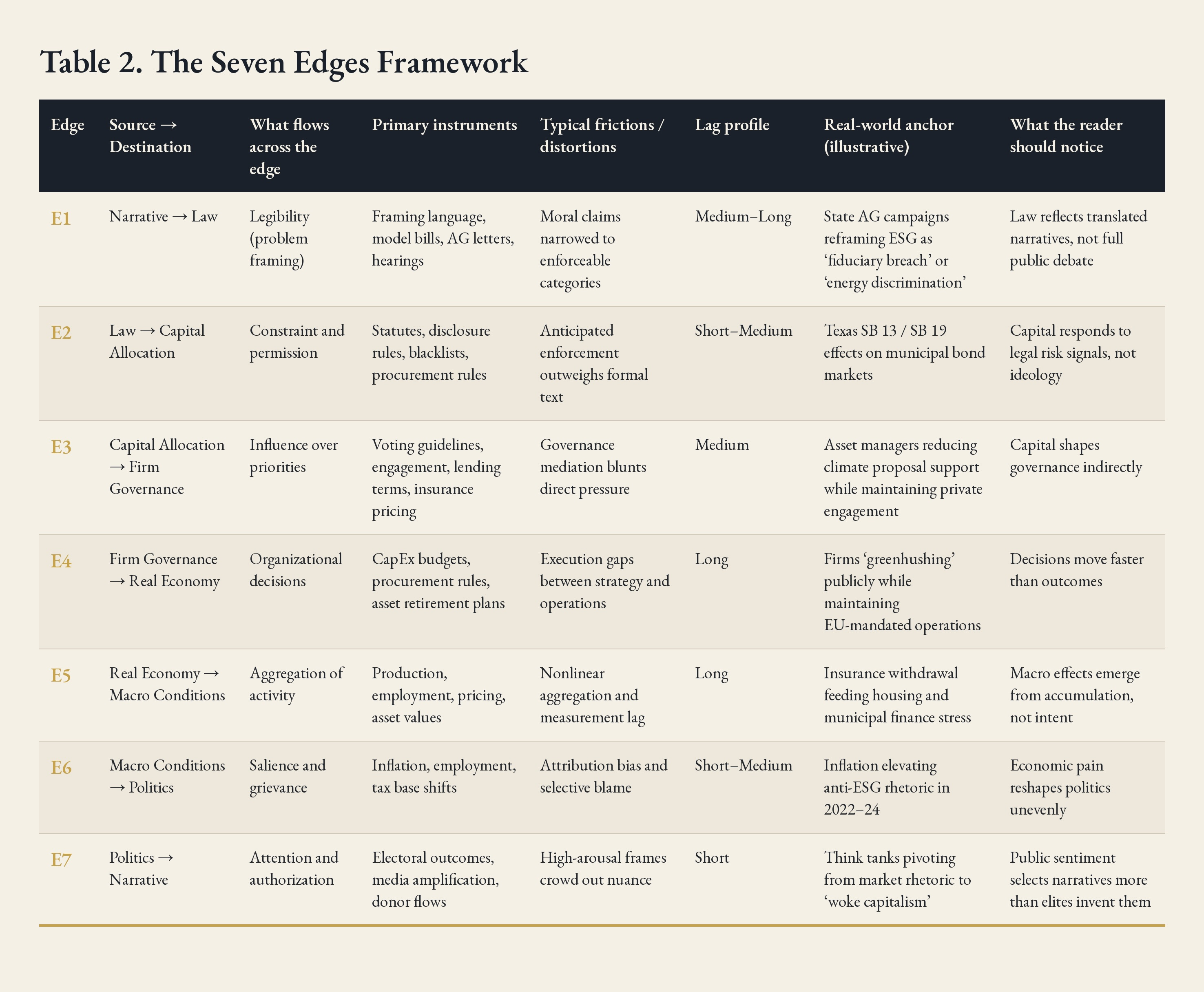
An edge shifts attention from position to transmission. An edge describes a directional relationship between two domains. It asks what flows from one to the other, how that flow is mediated, and why it is imperfect. Edges foreground process rather than location. They focus on translation, interpretation, and friction. In a multi-edge system, no domain is fully sovereign. Each domain both shapes and is shaped by others, but not symmetrically and not simultaneously. Influence moves through institutional filters. It encounters uncertainty and resistance. It arrives transformed. Thinking in edges also clarifies why actors often talk past one another. Each domain observes the system from a different vantage point. What appears decisive from one side of an edge may look marginal from the other. What feels like a clear signal to its sender may register as noise to its receiver.
The seven-edge system described here is not exhaustive in an abstract sense. One could imagine alternative decompositions or finer distinctions. Its value lies in explanatory discipline. It identifies the major transmission pathways through which ESG-related pressure moves over time. The edges are ordered for clarity, but they do not form a simple loop. Pressure introduced at one edge may dissipate before reaching another. Pressure may enter the system at multiple points simultaneously. Feedback exists, but it is delayed and indirect.
Before describing the system’s properties, it is necessary to define each edge carefully.
Edge One: Narrative → Law (E1)
The first edge links narrative production to legal codification. What flows across this edge is not policy itself, but legibility. Narratives—stories about risk, responsibility, harm, or obligation—shape how problems are named and framed. They establish categories, suggest causal relationships, and define what counts as relevant evidence or acceptable justification.
For a narrative to exert pressure on law, it must stabilize sufficiently to be translated into legal language. Legal systems require abstraction, generality, and enforceability. They operate through rules, standards, and procedures rather than stories. This translation process is selective. Legal institutions do not absorb narratives wholesale. They extract elements that can be operationalized within existing doctrinal structures. Ambiguity is reduced. Moral claims are reframed as duties or prohibitions. Contextual detail is sacrificed for general applicability.
Pressure travels imperfectly across this edge for structural reasons. Narrative dynamics are fast and pluralistic; legal change is slow and constrained. Legal institutions privilege continuity and coherence. Narrative resonance does not guarantee legal viability. As a result, law reflects only a narrow slice of narrative pressure, often simplified or distorted relative to its origins. This gap is not accidental. It is a defining feature of the edge.
One observable instance of this transmission can be seen in the recent reframing of ESG from a discretionary risk-management practice into a purported legal violation. Narratives originating in advocacy organizations and political media recharacterized ESG integration as “ideological discrimination,” “boycotts of lawful industries,” or breaches of fiduciary duty. FN These claims did not enter law as moral arguments. Instead, they were selectively translated into legally legible categories—such as “pecuniary factors,” “financial materiality,” and “anticompetitive coordination”—that could be embedded in statutory language or formal investigatory authority.
That translation was enabled by intermediary organizations such as American Legislative Exchange Council and State Financial Officers Foundation, which reduced the cost of codification by converting narrative claims into model legislative text and standardized definitions. State officials in jurisdictions such as Texas and Florida were then able to adopt these abstractions with limited modification. In this process, much of the narrative’s original context was stripped away. What entered law was not a full account of ESG practice, but a narrowed operational proxy capable of being enforced through rules, prohibitions, or investigatory tools. This illustrates the defining feature of the narrative-to-law edge. Only those elements of a narrative that can be rendered abstract, general, and enforceable survive the crossing, and they do so in altered form.
Edge Two: Law → Capital Allocation (E2)
The second edge connects legal structures to capital allocation. What flows across this edge is constraint and permission. Law shapes the environment in which capital moves by defining what is allowed, what must be disclosed, what carries liability, and what constitutes acceptable conduct. It alters the background conditions against which investment decisions are made. Pressure travels imperfectly across this edge for structural reasons. Legal signals must be interpreted through enforcement expectations, professional norms, and heterogeneous institutional mandates, and the result is uneven, delayed, and often anticipatory adjustment rather than uniform compliance.
Capital allocation systems attend closely to legal signals, but they do not respond mechanically. Legal texts are interpreted through guidance, enforcement patterns, and professional norms. Investors and intermediaries infer how rules will be applied and how risk will be priced. Pressure travels imperfectly because capital is heterogeneous. Some pools of capital are tightly constrained; others are agile. Time horizons differ. Risk tolerance varies. Anticipated enforcement may matter as much as formal rules, while formally significant changes may have limited impact if perceived as unlikely to be enforced. This edge transmits signals, not instructions.
One observable instance of this transmission can be seen in the use of state financial statutes and procurement rules to alter capital access rather than to regulate investment behavior directly. Several states, including Texas, West Virginia, and Oklahoma, enacted laws prohibiting public entities from contracting with or investing through financial institutions deemed to be “boycotting” designated industries. These statutes did not instruct banks or asset managers how to allocate capital in general. Instead, they redefined eligibility for participation in specific state markets—such as municipal bond underwriting or state pension management—thereby converting legal definitions into economic constraints.
The effect of this legal intervention was transmitted through institutional risk assessment rather than command. Financial institutions evaluated the potential loss of state business, exposure to investigatory action, and reputational signaling embedded in published restriction lists. In response, some firms adjusted their participation in particular state markets, altered disclosures, or modified contractual representations to preserve access. What traveled across this edge was not a mandate to change investment philosophy, but a reconfiguration of incentives and permissions that reshaped capital allocation at the margin. This illustrates the defining feature of the law-to-capital edge. Legal rules influence capital flows indirectly by altering the conditions under which market participation remains viable.
Edge Three: Capital Allocation → Firm Governance (E3)
The third edge links capital allocation to firm governance. What flows across this edge is influence over control and priorities. Capital allocation determines who holds claims on firms, under what conditions, and with what rights. These claims shape governance through voting power, board dynamics, managerial incentives, and accountability structures.
Governance is not a simple reflection of ownership. Firms are institutional entities with histories, routines, and internal hierarchies. Governance frameworks translate external financial pressure into internal decision-making processes. Pressure travels imperfectly because governance is layered and contested. Different capital providers exert different forms of influence. Formal mechanisms coexist with informal norms. Similar capital allocation patterns can produce divergent governance outcomes. This edge transmits influence, not commands.
One observable instance of this transmission can be seen in the way shifts in capital allocator behavior altered internal governance signals at publicly listed firms without direct regulatory mandate. Large asset managers and lenders—including firms such as BlackRock, Vanguard, and State Street—adjusted stewardship guidelines, proxy voting practices, and engagement priorities in response to evolving legal, political, and fiduciary interpretations. These changes did not instruct companies how to operate. Instead, they modified the expectations attached to capital access, voting support, and long-term investor alignment.
Corporate boards encountered these shifts through governance channels rather than market prices alone. Changes in proxy support, engagement posture, and lending or insurance conditions were translated internally into board-level risk assessments concerning disclosure strategy, executive incentives, and reputational exposure. In response, some firms altered how ESG considerations were reflected in governance processes—such as adjusting executive compensation metrics, reframing sustainability oversight, or reducing the public salience of ESG commitments—while leaving underlying operations largely intact. What traveled across this edge was not an operational directive, but a reweighting of governance priorities mediated through capital relationships. This illustrates the defining feature of the capital-to-governance edge. Financial signals influence firm behavior indirectly, by reshaping how boards interpret fiduciary risk, stakeholder conflict, and managerial accountability.
Edge Four: Firm Governance → Real Economy (E4)
The fourth edge connects firm governance to real economic activity. What flows across this edge is organizational decision-making. Governance priorities influence investment choices, production processes, labor relations, and supply chain configurations. Over time, these decisions shape economic outcomes.
The real economy is not a passive recipient of governance intent. Firms operate within technological, competitive, and regulatory constraints. Execution introduces friction. Strategic decisions encounter coordination challenges, resistance to change, and external shocks. Pressure travels imperfectly because governance intent does not guarantee operational change. Translation from governance to economic reality is partial, delayed, and uneven. This edge transmits decisions, not outcomes.
One observable instance of this transmission can be seen in the way changes in board-level priorities altered operational decision-making without any change in underlying law or market demand. Following shifts in governance posture—often framed as heightened sensitivity to legal, political, or fiduciary risk—some firms reassessed how sustainability objectives were embedded in capital budgeting, procurement standards, and asset-lifecycle planning. These reassessments did not announce new operational mandates. Instead, they adjusted internal criteria for evaluating projects, suppliers, and performance.
The effects of these governance signals appeared at the operational level through budget allocations and policy filters rather than directives. Divisional managers and procurement teams encountered revised thresholds for capital expenditures, altered key performance indicators, or relaxed requirements for supplier standards previously justified on sustainability grounds. In sectors such as energy, transportation, and manufacturing, this translated into delayed retrofits, extended asset lifespans, or reprioritization of near-term financial returns over longer-horizon transition investments. What traveled across this edge was not an ideological instruction, but a recalibration of decision rules that shaped how physical assets were deployed. This illustrates the defining feature of the governance-to-real-economy edge. Changes in governance intent influence economic activity indirectly, by modifying the internal constraints under which operational choices are made.
Edge Five: Real Economy → Macro Conditions (E5)
The fifth edge links real economic activity to macroeconomic conditions. What flows across this edge is aggregation. Firm-level and sector-level decisions accumulate into broader patterns affecting employment, investment, productivity, prices, and income distribution. These aggregates define macroeconomic conditions. Macro conditions are emergent. They arise from countless interactions and feedback loops. Pressure travels imperfectly because aggregation is nonlinear. Measurement lag obscures real-time understanding. Policy responses further mediate outcomes. The edge translates patterns into indicators, not intentions into outcomes.
One observable instance of this transmission can be seen in how localized operational constraints scale into macro indicators through aggregation and fiscal feedback. When insurers reduce coverage or sharply reprice risk in high-exposure regions—such as recent strains observed in Florida and California property insurance markets—firm- and household-level decisions adjust quickly. Projects are delayed, rebuilding timelines change, financing becomes harder to secure, and certain categories of development slow or relocate. None of these decisions is macroeconomic on its own. But in aggregate they alter asset values, investment patterns, and labor mobility in ways that become visible in broader measures of growth, prices, and credit conditions.
The transmission occurs through market and fiscal conduits rather than direct intent. Property valuation shifts affect municipal tax bases, reduced investment and higher operating costs propagate through local supply chains, and credit markets translate changing local fundamentals into borrowing costs for public entities. Over time, these accumulated changes can register as regional divergence, pressure on municipal finance, or inflationary pass-through from higher operating costs. What travels across this edge is not a policy signal but an arithmetic transformation. Many real-economy adjustments, when aggregated and filtered through financial and fiscal channels, become macroeconomic conditions. This illustrates the defining feature of the real-economy-to-macro edge. The macroeconomy is not a separate arena, but an emergent layer produced by the accumulation and interaction of micro-level operational decisions.
Edge Six: Macro Conditions → Politics (E6)
The sixth edge connects macroeconomic conditions to political dynamics. What flows across this edge is salience. Macro conditions influence voter priorities, elite agendas, and institutional stress. They shape which issues command attention and how coalitions form. Pressure travels imperfectly because macro conditions are experienced unevenly. Aggregate indicators mask distributional effects. Political actors frame conditions strategically. Institutional inertia slows response. In this edge, economic pressure reshapes political landscapes over time, but not proportionally or predictably.
One observable instance of this transmission can be seen in the way inflationary pressure and insurance strain altered political salience and voter priorities independent of detailed policy understanding. Periods of elevated inflation—such as the recent post-pandemic cycle—and highly visible affordability shocks, including rising property insurance stress in states such as Florida and California, changed what citizens and elected officials treated as urgent. Even when the underlying macro causes were diffuse, the lived experience of cost increases or asset insecurity compressed time horizons and shifted attention toward short-term economic protection.
The transmission across this edge occurred through salience and attribution rather than technical diagnosis. Political entrepreneurs and partisan media frames translated broad macro stress into actionable political narratives about blame, competence, and legitimacy—often attaching complex outcomes to a small number of visible policy targets. In this environment, governance proposals associated with longer-horizon risk management became easier to portray as optional costs, while commitments to immediate affordability became politically dominant. What traveled across this edge was not a precise causal account of macroeconomic conditions, but a shift in political incentives and coalition behavior driven by how macro stress is experienced and interpreted. This illustrates the defining feature of the macro-to-politics edge. Macro conditions reshape politics indirectly, by reordering priorities, intensifying blame competition, and determining which messages become electorally viable.
Edge Seven: Politics → Narrative Entrepreneurs (E7)
The seventh edge links political dynamics back to narrative production. What flows across this edge is attention and authorization. Political contestation elevates certain themes, legitimizes certain frames, and provides resources to narrative entrepreneurs who shape public discourse. Narrative production is competitive and decentralized. Political endorsement can amplify narratives, but it does not guarantee dominance. Resonance depends on broader cultural and social conditions. This edge reintroduces pressure into the narrative domain in altered form. The system evolves rather than returning to a baseline.
Pressure travels imperfectly across this edge because political validation reshapes narrative incentives without determining narrative content. Electoral outcomes and engagement signals operate through competitive selection rather than authoritative resolution, amplifying some frames while simplifying, distorting, or crowding out others rather than producing convergence.
One observable instance of this transmission can be seen in how shifts in voter sentiment and electoral validation altered the supply of narratives offered by ideological producers. As economic stress and political polarization intensified, patterns in polling, primary election outcomes, and audience engagement signaled which frames resonated most strongly with activated constituencies. These signals did not instruct narrative actors what to believe. They indicated which explanations, emphases, and vocabularies were rewarded with attention, funding, and political access.
Narrative entrepreneurs and affiliated institutions—such as policy organizations including Heritage Foundation and America First Policy Institute, alongside aligned media ecosystems—responded by reallocating effort toward frames that had demonstrated electoral or engagement success. Over time, this selective pressure favored simplified, high-salience explanations that linked complex institutional outcomes to a small number of identifiable causes. What traveled across this edge was not factual correction or policy instruction, but demand-side feedback about which narratives were politically viable. This illustrates the defining feature of the politics-to-narrative edge: Political outcomes and mass engagement do not merely reflect prevailing narratives; they actively shape which narratives are produced, refined, and amplified in the next cycle.
Properties of the Seven-Edge System
With the edges defined, the system’s key properties become clear.
Non-linearity. Effects are not proportional to causes. Pressure may accumulate quietly and appear suddenly or dissipate without lasting impact.
Lag. Time delays obscure causality. Effects are often attributed to recent events rather than earlier transmissions.
Asymmetry. Influence flows unevenly. Changes are easier to introduce than to reverse.
Partial observability. No actor sees the whole system. Local signals are mistaken for comprehensive explanations.
Path dependence. History matters. Past transmissions shape current constraints and limit future possibilities.
These properties explain why outcomes are difficult to predict and why simplistic explanations persist.
Descriptive, Not Ideological
The seven-edge system is a descriptive framework. (See Table 2.) It does not assume that ESG is beneficial or harmful. It does not privilege any actor or domain. It does not imply inevitability or prescribe intervention. Its value lies in orientation. It provides a map of the terrain on which conflict unfolds. It clarifies why debates recur, why misunderstandings persist, and why interventions often have unintended effects.
Understanding the system does not resolve disagreement. It clarifies the structure within which disagreement occurs. Before any analysis of specific dynamics can proceed, it is necessary to understand what kind of system is being observed. This chapter has aimed to provide that understanding—a patient definition of a multi-edge system in which pressure moves, transforms, and returns.