


Laurence Sterne by Joshua Reynolds, 1760. © National Portrait Gallery, London. Pubic domain via Wikimedia Commons.
Laurence Sterne’s The Life and Opinions of Tristram Shandy, Gentleman, published in nine volumes between 1759 and 1767, is the story of a man who sets out to tell the story of his life and cannot manage to get himself born. His father’s theories, his uncle’s hobby-horse, and a long series of digressions intervene. The hero does not arrive until the third volume. When he does, the arrival goes badly. The forceps of Dr. Slop, the man-midwife, flatten his nose, and the name his father chose with great care, Trismegistus, is garbled on the way to the christening into Tristram, the one name his father thought worst of all. No one in the household means him harm. Everyone is trying to help.
I have been thinking about Tristram because I have been trying to understand ESRS-40a, the sustainability reporting standard the European Union is preparing for large non-EU companies that do business in Europe. EFRAG’s public consultation on it closes on October 31—three days from today. The questions I set out to answer seemed simple. What is this standard? Who is making it? What will it require, and of whom? And once it exists, how firmly will it hold? Each answer turned out to depend on something that happened earlier, in a different piece of legislation, for a different reason. So, in the Shandean manner, this piece proceeds by digression. Readers who know their way around EU law can skip the digressions. Everyone else may find them the most useful part.
A Digression on Directives, Regulations, Articles and Recitals
Digressions, incontestably, are the sunshine;—they are the life, the soul of reading!
— Laurence Sterne, Tristram Shandy
For American readers, a rough analogy helps. Think of the European Parliament, whose 720 members are elected directly by voters in the 27 member states, and the Council of the European Union, where ministers from the 27 national governments sit, as the two houses of Congress. Because both must agree before a law is passed, they are called the “co-legislators.” Think of the European Commission, the EU’s executive, as something like a federal agency, with one important difference. Only the Commission can propose legislation; the co-legislators amend it and adopt or reject it.
What Congress does with statutes, the European Union does with directives and regulations. A regulation applies directly in every member state. A directive sets out what must be achieved and leaves each member state to write it into its own law, a process called transposition. The rules on corporate reporting live in a directive, the Accounting Directive of 2013, which has since been amended many times. In European shorthand, the directive is “Level 1.”
Directives can delegate rulemaking power to the Commission, much as a statute delegates it to the SEC. The rules the Commission adopts under that power are called delegated acts, and they are “Level 2.” A delegated act may supplement the directive but may not override it, and the Parliament and the Council each have two months to veto it, much as Congress can under the Congressional Review Act. The European Sustainability Reporting Standards, or ESRS, are delegated acts. So will ESRS-40a be.
Directives and delegated acts are divided into numbered articles, which are the law, and preceded by numbered recitals, which are not. Recitals explain what the legislators were trying to do. Courts read them when the articles are unclear, and they are often the most candid part of the text.
Finally, because a directive amended many times becomes very hard to read, the EU’s Publications Office produces a “consolidated version” that stitches the amendments into the original. The current one, dated March 18, 2026, opens with a warning: “This text is meant purely as a documentation tool and has no legal effect.” The warning matters more than it appears to, as we shall see.

Title page of the first volume of Tristram Shandy, printed by Ann Ward, York, 1760. The epigraph, from Epictetus, reads: “Men are disturbed not by things, but by their opinions about things.” Public domain, via Wikimedia Commons.
Conception: The CSRD and Article 40a
I wish either my father or my mother, or indeed both of them, as they were in duty both equally bound to it, had minded what they were about when they begot me.
— Laurence Sterne, Tristram Shandy
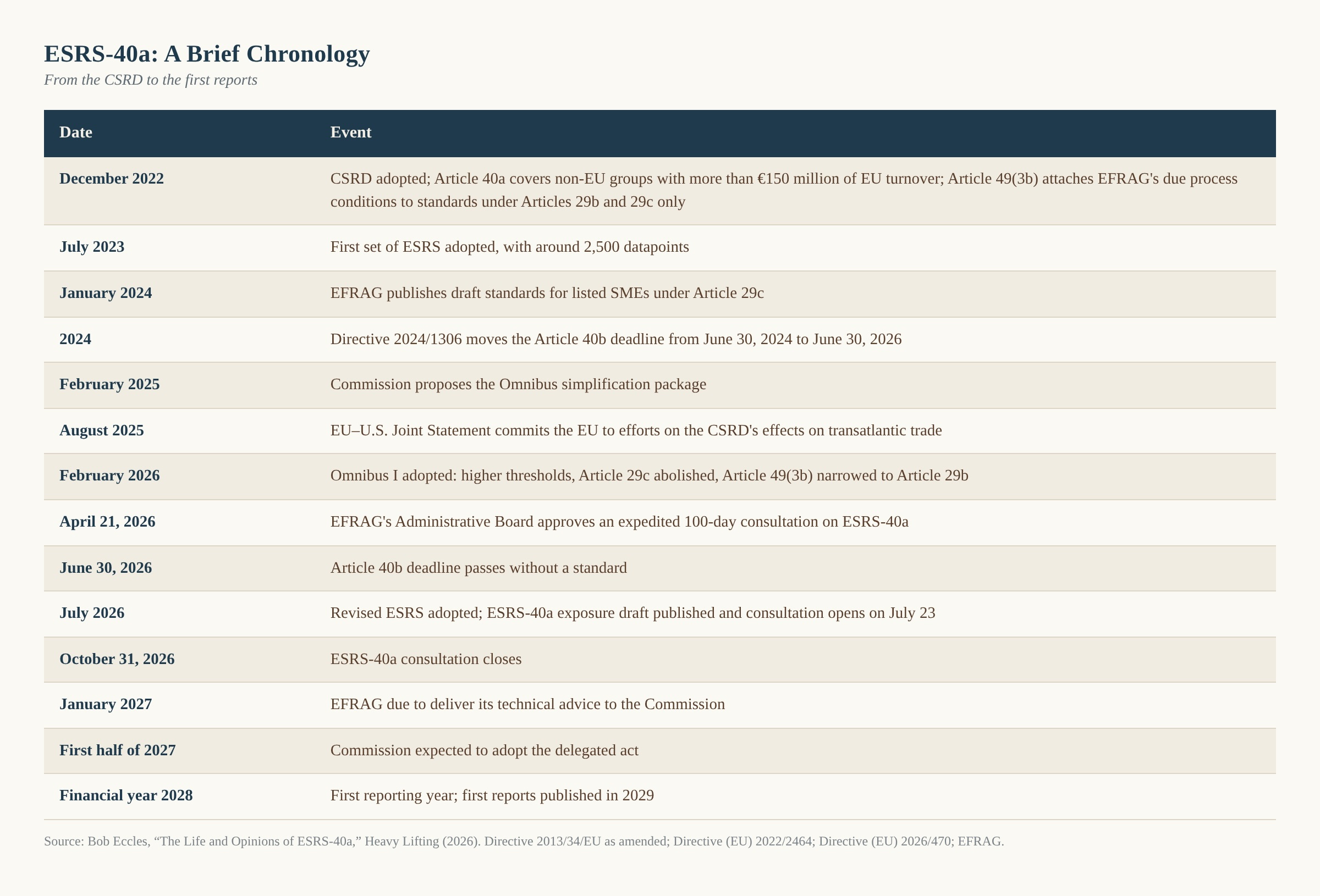
The Corporate Sustainability Reporting Directive, or CSRD, was adopted in December 2022 as a set of amendments to the Accounting Directive. It was conceived in a spirit of great ambition. It would cover, by the Commission’s estimate, some 50,000 companies, including all large companies and listed small and medium-sized ones, public or private. It would require “double materiality,” meaning reporting both on how sustainability matters affect a company and on how the company affects people and the environment. And the first set of standards adopted under it, in 2023, contained around 1,200 datapoints, already cut from some 2,500 in EFRAG’s 2022 drafts. Many in the NGO community saw it as the moment corporate reporting would finally be enlisted in changing the world.
The CSRD also reached beyond Europe. It inserted a new Article 40a into the Accounting Directive for groups headquartered outside the EU with significant business inside it. Recital 20 of the CSRD explained the purpose: to ensure that such groups “are accountable for their impacts on people and the environment and that there is a level playing field for companies operating in the internal market.” As enacted, Article 40a applied to non-EU groups with more than €150 million of EU turnover and an EU subsidiary or branch of a certain size.
The mechanism was ingenious, and it is the first thing to understand about ESRS-40a. The EU cannot impose obligations on a company in Ohio. It can impose them on that company’s subsidiary in Ireland. So Article 40a requires the EU subsidiary (or, if there is none, the branch) to “publish and make accessible a sustainability report... at the group level of that ultimate third-country parent undertaking.” The legal duty falls on the European child; the report covers the whole family. The content is confined to impacts, with no reporting on the financial risks and opportunities that sustainability matters create for the group, but it covers every sustainability topic, from climate to workforce conditions to governance, and includes the group’s transition plan and targets.
Article 40a sets out who must report and, in broad terms, what the report must cover. It leaves the detail to a companion provision, Article 40b, which told the Commission to adopt a delegated act, by June 30, 2024, setting out standards that specify exactly what information the report must contain. That standard is what EFRAG is now drafting. It is called ESRS-40a after Article 40a, which creates the obligation, although it will be adopted under Article 40b, which creates the power to write it. Keep both numbers in mind; a third, Article 49(3b), is about to join them.
A Digression on EFRAG and DG FISMA
The Commission does not write sustainability reporting standards itself. It relies on EFRAG, the European Financial Reporting Advisory Group, which the CSRD, in its recitals, describes as “a non-profit association established under Belgian law.” EFRAG began life advising the Commission on international accounting standards and added a sustainability reporting pillar in 2022, governed by a Sustainability Reporting Board and supported by a technical expert group and a secretariat. EFRAG’s Administrative Board oversees its governance and due process. Its sustainability reporting work is co-financed by the EU budget, which covers up to 90 percent of the eligible costs, and by its member organizations.
On the Commission’s side, the responsible department is the Directorate-General for Financial Stability, Financial Services and Capital Markets Union, known as DG FISMA, which reports to the Commissioner for Financial Services and the Savings and Investments Union, Maria Luís Albuquerque. In practice the relationship works like this. DG FISMA asks EFRAG for technical advice, EFRAG develops it through its own consultations and board deliberations, and DG FISMA turns that advice, with whatever changes the Commission decides to make, into a delegated act that the Commission adopts. EFRAG advises; the Commission decides.

The marbled page from Volume III of Tristram Shandy, 1761, which Sterne called “the motly emblem of my work.” Public domain, via Wikimedia Commons.
A Digression on Article 49(3b) and a Missing Sibling
How much weight must the Commission give EFRAG’s advice? The CSRD answered that question in a provision it inserted as Article 49(3b) of the Accounting Directive. As enacted in 2022, it read:
“When adopting delegated acts pursuant to Articles 29b and 29c, the Commission shall take into consideration technical advice from EFRAG, provided that: (a) such advice has been developed with proper due process, public oversight and transparency, with the expertise and balanced participation of relevant stakeholders, and with sufficient public funding to ensure its independence…”
Further conditions follow, on cost-benefit analysis and on who may take part in EFRAG’s work, along with a requirement that the Commission seek the opinions of the European supervisory authorities and consult several other EU bodies.
Article 29b is the Commission’s power to adopt the main ESRS. Article 29c was its power to adopt a separate, lighter set of standards for listed small and medium-sized companies, which EFRAG duly drafted and published for consultation in January 2024. Article 40b, the power to adopt standards for non-EU groups, is not mentioned. The co-legislators wrote EFRAG’s advisory role, and the conditions attached to it, into the law for the main standards and for their small-company sibling. They never wrote them in for the non-EU standards. Article 40b itself says only that the Commission shall adopt “a delegated act... to provide for sustainability reporting standards for third-country undertakings that specify the information that is to be included in the sustainability reports referred to in Article 40a.” It does not mention EFRAG at all.
EFRAG nonetheless went on to draft standards under all three powers, because the Commission asked it to. The listed-company standards under Article 29c never made it into law. In 2026, the Omnibus I Directive, the law that carried out the EU’s simplification of the CSRD (described below), deleted Article 29c altogether. Since that power no longer existed, Omnibus I also removed it from Article 49(3b), whose opening now reads “When adopting delegated acts pursuant to Article 29b.” So the sentence that once covered two sets of standards now covers one, and it never covered the non-EU standards at all. A reader of today’s consolidated text sees “Article 29b” standing alone, marked as amended, with no trace of the sibling that once stood beside it. It would be natural to assume that a provision guaranteeing due process for EFRAG’s advice governs every standard EFRAG writes. It governs one.
The consequence is that, as a matter of law, EFRAG’s advice on ESRS-40a has no special standing. The Commission may adopt it unchanged, change it as it likes, or, in principle, write the standard without it. Its legal constraints are the general ones. It must stay within what Articles 40a and 40b permit, consult experts designated by the member states, give reasons, and survive the two-month window in which the Parliament or the Council may object. EFRAG is drafting ESRS-40a by invitation, not by statute.

Dr. Slop, the man-midwife, slumped at left, with Walter Shandy, Uncle Toby and Corporal Trim, who reads a sermon. Engraving after William Hogarth’s frontispiece to Tristram Shandy, 1760. Wellcome Collection, CC BY 4.0.
The Forceps
…thy new-invented forceps,—thy crotchet,—thy squirt, and all thy instruments of salvation and deliverance…
— Laurence Sterne, Tristram Shandy
The ESRS-40a that EFRAG is now drafting is not the standard the CSRD’s authors imagined, because the law around it changed shape several times before it could be born.
The first change was simply time. In 2024, Directive (EU) 2024/1306 pushed the Article 40b deadline back two years, to June 30, 2026, to give EFRAG and companies more room. The second was politics. By 2025 the European mood had shifted from ambition to competitiveness. The Commission proposed its “Omnibus” simplification package in February 2025, the co-legislators passed a “stop-the-clock” directive that April to delay reporting for many companies, and the Omnibus I Directive, Directive (EU) 2026/470, was adopted in February 2026. It confined the CSRD to EU companies with more than 1,000 employees and €450 million of turnover, removing roughly 90 percent of the companies previously covered. For non-EU groups it tripled the EU turnover threshold to €450 million in each of the last two years, raised the size test for the EU subsidiary or branch to €200 million of turnover, and let groups headed by certain financial holding companies opt out entirely. EFRAG estimates that about 1,200 non-EU groups remain in scope, against some 10,000 under the original rules. In July 2026 the Commission adopted the revised ESRS for EU companies, with about 60 percent fewer mandatory datapoints.
The third pressure came from across the Atlantic. In the Joint Statement on the EU–U.S. trade framework of August 2025, the European Union committed “to undertake efforts to ensure that the Corporate Sustainability Due Diligence Directive (CSDDD) and the Corporate Sustainability Reporting Directive (CSRD) do not pose undue restrictions on transatlantic trade.” The United States has since made clear that it does not think the Omnibus went far enough. I will return to that in a separate piece.
Like Dr. Slop’s forceps, each intervention was well meant, and each left its mark on the shape of what was eventually delivered.
I am this month one whole year older than I was this time twelve-month; and having got, as you perceive, almost into the middle of my third volume…—and no farther than to my first day’s life…
— Laurence Sterne, Tristram Shandy
The Child Takes Shape
The exposure draft for ESRS-40a follows the architecture of the revised ESRS but, as Article 40a requires, deals only with impacts. It offers a company three choices: report on all its material impacts globally; apply the full ESRS voluntarily; or use a “mixed approach,” under which climate impacts are always reported globally but, for other topics, reporting may be confined to impacts connected with the EU, where these can be meaningfully separated from the rest.
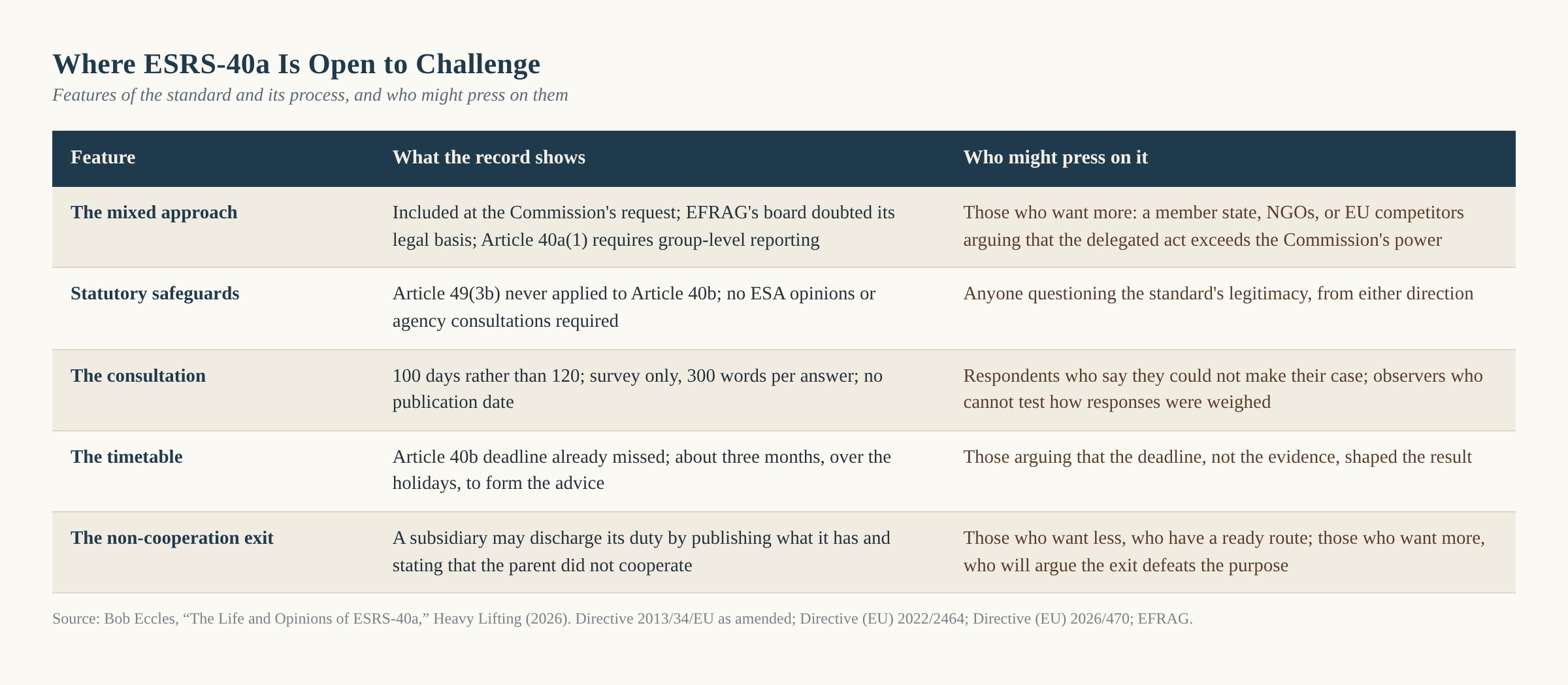
The mixed approach has an unusual parentage. EFRAG has said that it was included at the Commission’s request, and its Sustainability Reporting Board approved the draft with reservations about the level playing field, comparability, and the feasibility of assurance, and, according to Ropes & Gray, about “whether there is a legal basis for the mixed approach.” That doubt is easy to understand once the two articles are set side by side. Article 40a(1) requires a report “at the group level” of the non-EU parent. Article 40b empowers the Commission to “specify the information that is to be included” in that report. The Directive itself decides whose activities the report covers: the whole group’s. The Commission’s power is only to decide what information goes into it. Allowing a group to confine most of its reporting to its EU-related impacts looks less like deciding what information to include than like shrinking the group the report covers, which the Directive has already defined.
The consultation through which EFRAG is gathering views is also distinctive. It runs for 100 days rather than the 120-day minimum in EFRAG’s own due process procedures, under an expedited process the Administrative Board approved in April without recording its reasons. Responses are accepted only through an online questionnaire, with a 300-word limit per answer and no provision for comment letters, although EFRAG accepted letters when it consulted on the revised ESRS a year earlier. Publication of the responses depends on each respondent’s consent, and no date has been set.
By comparison, the International Accounting Standards Board and the International Sustainability Standards Board normally allow at least 120 days, accept comment letters and post them as they arrive. This week the ISSB opened a consultation on a nature-related practice statement, which companies need not even apply, with 120 days and two channels for comment. ESRS-40a, which will be binding EU law, has 100 days and one. As it happens, EFRAG’s consultation on its own agenda for 2027 to 2029, opened on October 16, accepts comment letters, publishes them, and promises a feedback statement explaining how the responses shaped its priorities. ESRS-40a gets none of these.
Time wastes too fast: every letter I trace tells me with what rapidity Life follows my pen…
— Laurence Sterne, Tristram Shandy
Each of these features is within EFRAG’s procedures. But because Article 49(3b) does not apply, EFRAG’s consultation is the only substantial due process ESRS-40a will receive before it reaches the Commission, and it is the one that has been compressed. What happens next is harder still to see. Between October 31 and January, EFRAG will analyze the responses and finalize its advice. Its board meets in public and posts its papers, but what those papers will reveal about the responses, and whether and when the responses themselves will be published, no one outside EFRAG knows. At the IASB and the ISSB, comment letters are posted as they arrive, so anyone can read them while a consultation is still open. For ESRS-40a, if the responses appear at all, they will appear all at once, possibly after the advice they informed has already been delivered. The Commission’s part in that period is informal and unrecorded. After January, DG FISMA will draft the delegated act. EFRAG has said that the Commission “will subsequently launch its own public consultation before adopting the delegated act” (EFRAG Update, July 2026), as the Commission’s own Better Regulation practice provides, but nothing in the Directive obliges it to, or to explain how EFRAG’s advice, or the responses behind it, shaped the result.

The christening of Tristram: Walter Shandy arrives in his nightgown, too late to stop the curate from giving his son the wrong name. Engraving after William Hogarth’s frontispiece to Volume IV of Tristram Shandy, 1761. The Metropolitan Museum of Art, public domain.
A Digression on the Name
How many Caesars and Pompeys, he would say, by mere inspiration of the names, have been rendered worthy of them?
— Laurence Sterne, Tristram Shandy
Tristram’s father believed that names shape destinies, and lost his son’s to a maid who could not carry two long words down a corridor. ESRS-40a’s name, as noted earlier, comes from Article 40a, although the standard will be adopted under Article 40b. That is perfectly sensible, and it is also a small emblem of the whole story: a standard whose identity is borrowed from one article (40a), whose legal footing lies in another (40b), and whose governance was settled, or rather left unsettled, in a third (49(3b)).
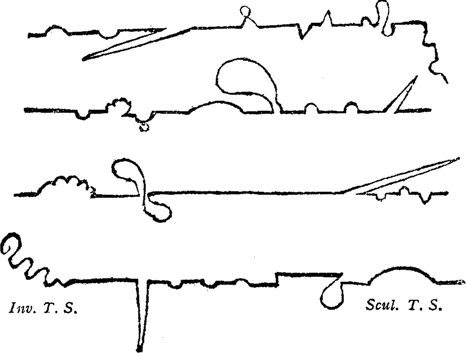
Sterne’s diagram of the plot lines of the first four volumes of Tristram Shandy, from Volume VI, chapter 40, 1762, “invented” and “engraved” by Tristram himself. Having charted his digressions, he resolves to do better: “by the help of a vegetable diet, with a few of the cold seeds, I make no doubt but I shall be able to go on with my uncle Toby’s story, and my own, in a tolerable straight line.” Public domain, via Wikimedia Commons.
What Will It Be?
Suppose ESRS-40a is born on schedule. How firmly will it hold? Here the text of Article 40a holds a surprise, and the co-legislators themselves describe it.
The EU subsidiary must ask its non-EU parent for the information it needs. If “not all the required information is provided,” it must publish “all information in its possession, obtained or acquired,” together with “a statement indicating that the third-country undertaking did not make the necessary information available.” The report must carry an assurance opinion, but if the parent does not provide one, the subsidiary again issues a statement saying so. Its directors are responsible for the report “to the best of their knowledge and ability.” The reports themselves are filed nationally, in each member state’s business register, not with any EU authority. Member states “may,” not must, tell the Commission which subsidiaries published a report and which used the non-cooperation statement, and the Commission publishes on its website a list of the non-EU groups that do report. Enforcement is therefore a national matter, and member states vary considerably in how promptly and how vigorously they apply EU law. Six of them, including Germany and the Netherlands, have still not fully transposed the original CSRD into national law, more than two years after the deadline (Gibson Dunn). Recital 20 of the CSRD framed all of this as what follows “despite the best efforts of the subsidiary.” Recital 26 of Omnibus I is blunter: the subsidiary “is only required to publish and make available the sustainability report provided by the third-country undertaking, whereas undertakings subject to Articles 19a and 29a are required to report on their own behalf.”
In other words, the legal duty falls on a conduit. The non-EU parent is never bound, and a parent that declines to cooperate exposes its subsidiary not to a penalty but to a public statement. That is not nothing. The statement is filed in a public register, the Commission’s list is public, and a subsidiary that already holds much of the group’s information, through shared systems or the parent’s own sustainability reporting, may find “in its possession, obtained or acquired” a more demanding phrase than it sounds. But ESRS-40a’s force will be largely reputational.
The firmer obligations lie elsewhere. A non-EU group’s EU subsidiaries that are large enough in their own right, with more than 1,000 employees and €450 million of turnover, must report on their own behalf under the full ESRS, double materiality included, and there is no non-cooperation exit for them. A transitional provision, Article 48i, lets such subsidiaries report together in one EU-level report until January 6, 2030. After that, each reports separately unless they sit under a single EU holding company or the parent reports for the whole group under the full ESRS or an equivalent standard. A report under ESRS-40a does not qualify.
The post-2030 rule deserves a moment’s reflection. EU subsidiaries already publish their own financial statements, so separate reporting as such is not new. But financial statements work at the level of the legal entity because transactions are booked entity by entity; there is a ledger, and its boundary is clear. Sustainability impacts do not respect those boundaries. Supply chains are managed centrally, and procurement, product design and climate strategy are decided at group level. Financial reporting has long recognized that legal entities can be a poor guide to how a business is actually run: segment reporting under IFRS 8 and its US equivalent follows management’s organization, not the corporate chart. The post-2030 rules do the reverse, asking each large subsidiary to report as if it were self-contained on impacts that are largely decided and managed elsewhere in the group. Faced with a separate report for each, many groups may find it simpler to report globally under the full ESRS, which may prove a more effective form of extraterritorial reach than Article 40a itself.

Uncle Toby, under his map of the fortifications of Dunkirk, peers into the Widow Wadman’s eye for a speck that isn’t there. She is laying siege to him; his hobby-horse is the art of siege itself. Charles Robert Leslie, My Uncle Toby and the Widow Wadman, 1831. Victoria and Albert Museum, London. Public domain, via Wikimedia Commons.
Who Should Worry?
…so long as a man rides his Hobby-Horse peaceably and quietly along the King’s highway, and neither compels you or me to get up behind him,—pray, Sir, what have either you or I to do with it?
— Laurence Sterne, Tristram Shandy
The answer, curiously, is that both sides of the long argument over the CSRD may have less at stake in ESRS-40a than they think.
Non-EU companies, many of them American, have treated Article 40a as a sweeping assertion of extraterritorial authority. On paper it reaches the global group. In practice the legal duty rests on a subsidiary that must try, and a parent that declines faces disclosure rather than compulsion. The law binds the subsidiary, but it cannot bind the parent, so whether the information flows is in practice the parent’s decision. The mixed approach reduces the burden mainly for groups whose parents decide to supply it. The obligations with real force are the ones on their large EU subsidiaries, under the main ESRS, and those are not what ESRS-40a is about.
NGOs, who saw in Article 40a a way to hold the world’s largest companies “accountable for their impacts on people and the environment,” have already watched the threshold triple, the population of covered groups fall by nearly nine-tenths and a holding-company exemption appear. They are now looking at a standard developed without the statutory due process that governs the main ESRS, with a mixed approach that would let groups confine most of their reporting to Europe, and with a legal mechanism that allows a parent to decline. Many of them are already dismayed by Omnibus I. ESRS-40a may disappoint them further, and most have not yet noticed.
What the standard will be, therefore, depends less on its text than on who chooses to test it, and both sides have reasons to.

Laurence Sterne, a version of Joshua Reynolds’s 1760 portrait attributed to William Etty, with the papers of a manuscript at his elbow. Art UK, public domain, via Wikimedia Commons.
An Unfinished Book
L—d! said my mother, what is all this story about?——A Cock and a Bull, said Yorick——And one of the best of its kind, I ever heard.
— Laurence Sterne, Tristram Shandy
Sterne published the ninth and last volume of Tristram Shandy in 1767 and died the following year. The book ends without its hero having told us much of his life at all; the opinions crowd out the life. ESRS-40a is in a similar condition. It was conceived in ambition, delayed by necessity, reshaped by politics, governed by a provision that turns out not to apply to it, and endowed with a legal mechanism its own legislators describe as publication of what someone else provides. It is due to be delivered in January, to be adopted by an institution that may change it as it likes, and to apply to companies that may, in law, decline to help.
None of this is anyone’s villainy. It is what happens when a standard is shaped by successive acts of legislation, each written for its own reasons, by people who were not always looking at what the others had done. The result is a standard whose purpose, content, process and force are all, for now, open questions. The consultation closes on October 31. What EFRAG makes of the responses, what the Commission makes of EFRAG’s advice, and what anyone will be able to see of either, will tell us a good deal more about what ESRS-40a is. Whether the European Union will still want it to be anything at all is a question I take up in the next piece, on the CSRD and the trade negotiations with the United States.