


Portrait of Luca Pacioli, attributed to Jacopo de' Barbari, 1495. Museo di Capodimonte, Naples. Via Wikimedia Commons.
I recently read The Carbon Accounting Landscape Review, published by the International Chamber of Commerce (ICC) and prepared by the Secretariat of the Technical Expert Panel on Carbon Accounting, which ICC co-leads with Carbon Measures. It is a detailed and careful account of the current state of product-level carbon accounting, a field roughly 15 years old.
For whatever reason it reminded me of three pieces I wrote about four years ago with my colleague Kazbi Soonawalla at Saïd Business School, University of Oxford, published in the Harvard Law School Forum on Corporate Governance: The Long and Winding Road to Financial Reporting Standards, The Complex, Contentious, and Changing Nature of Financial Reporting Standards, and Putting Financial Reporting Standards Into Practical Perspective. These pieces set the formation of the International Sustainability Standards Board (ISSB) against the history of financial reporting:I went back and re-read them. Doing so took me back more than 800 years. What follows uses that lens.
This is not an assessment of the six approaches the Landscape Review examines, or of its technical conclusions. It is an assessment of what the history of standard setting suggests about the situation the report describes.
What the Landscape Review Says
The Panel was appointed jointly by ICC and Carbon Measures and is co-chaired by Amy Brachio and Karthik Ramanna. The report is careful about its own standing: a foundational resource for the Panel’s future deliberations rather than the Panel’s conclusions, a qualitative documentary analysis rather than quantitative testing, and a point-in-time assessment of a field it expects to keep moving.
It states its premise openly. The initiative behind it was founded on the conviction that ledger discipline is what product-level carbon accounting requires. The review therefore does not ask whether existing frameworks are any good on their own terms; it says plainly that they were built for other purposes and succeed at them. It asks what each contributes toward a ledger-based architecture, and what remains open.
The problem it identifies is framed in accounting rather than measurement terms, and the framing is the report’s rather than mine. A product carbon footprint, it argues, is not a directly measurable property of a product. Unlike sulfur content, you cannot test for it. It is “an informed accounting calculation” built from activity data, emission factors, supplier information, boundary choices, and allocation rules. So a procurement officer looking at two figures for two shipments of steel cannot tell from the product whether the difference reflects better carbon performance or different calculation choices. That is a contestable way to describe a life-cycle assessment, and a practitioner might answer that a footprint is a modelled physical quantity with uncertainty bounds rather than a construct. But it is the premise everything else rests on, and the report’s shorthand for what is missing follows from it: the equivalent of U.S. GAAP or IFRS for carbon.
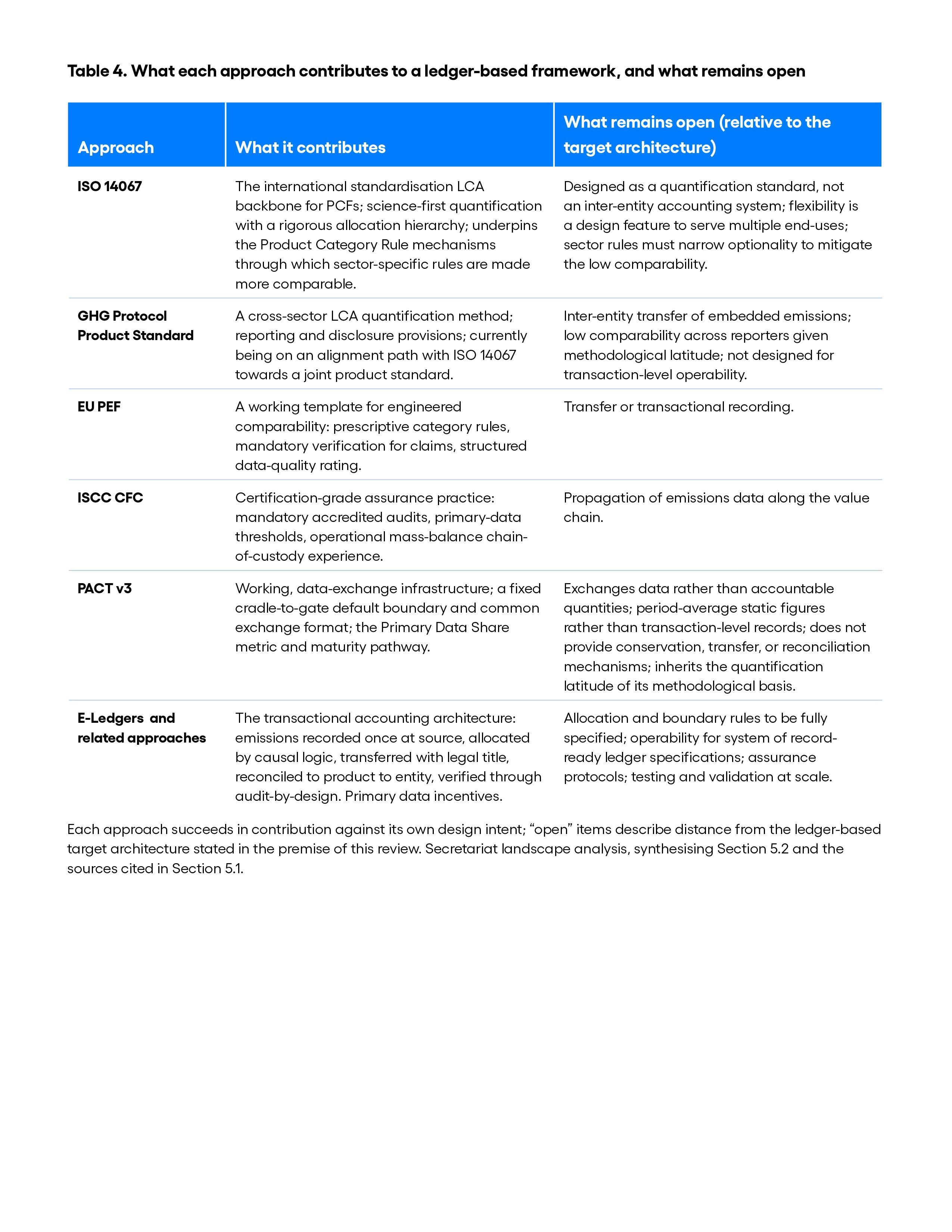
The review examines six approaches: (1) ISO 14067, (2) the GHG Protocol Product Standard, (3) PACT v3, (4) the EU’s Product Environmental Footprint, (5) ISCC’s Carbon Footprint Certification, and (6) the E-Ledgers proto-standards with related work from the EFI Foundation and the Carbon Accounting Standards Initiative (CASI). It finds that the landscape is a strong starting point rather than a blank slate including mature life-cycle science, a shared allocation hierarchy, and working data-exchange infrastructure. It finds two things missing. The first is quantification—comparability strong enough to hold up between competing producers, a tightened allocation rulebook, and consistent treatment of the hard cases such as removals, biogenic carbon, capital goods, and circular flows. The second is architecture—formal transfer of embedded emissions between entities, an unresolved choice among chain-of-custody models, assurance at the level financial accounts are held to, and operability at the level of the transaction.
Two features of the report matter for the historical comparison. It is markedly more conciliatory than the surrounding public argument about competition between the two organizations and the motives attributed to them, especially Carbon Measures. The report acknowledges that ledger accounting is not the answer to everything the disclosure ecosystem addresses and, in setting the GHG Protocol Corporate Standard aside from the product-level assessment, that the Corporate Standard is the accepted foundation of entity-level climate reporting and that its value there is not in question. It is also candid about its own favored candidate. The approach it identifies as supplying the missing architecture is also the one it calls least proven, needing allocation and boundary rules, ledger specifications for enterprise systems, assurance protocols, and testing at scale. Table 4 from the report identifies what each approach contributes and what remains open.
The Standard-Setting Comparison
Those three pieces with Kazbi were written because the ISSB had just been established, EFRAG was drafting for the CSRD, and many people were asking whether a confusion of NGOs writing sustainability standards was simply being replaced by a confusion of government-backed bodies writing the same ones. The answer we gave was to set the preceding two years against a hundred and fifty years of financial reporting.
One distinction has to be made first. Entity-level carbon reporting and product-level carbon accounting are not the same enterprise at different magnifications. Their primary users differ. Entity-level disclosure exists for investors and regulators, and the GHG Protocol Corporate Standard has spent a quarter of a century becoming the accepted foundation for that. Product-level data is for a buyer choosing between two shipments of steel and a customs authority pricing an import. It is a continuum rather than a wall—entity-level Scope 3 figures are built from product data aggregating up the chain. But the institutions that confer authority at the two levels are not the same, and the GHG Protocol Product Standard dates from 2011. So does very nearly everything else in this field.
Six Lessons about Standard Setting
The features now being treated as peculiar to carbon (e.g., multiple bodies, methodological disagreement, and disputes over standing) recur throughout the history of standard setting. What follows is six things the history shows.
Lesson 1: Standards are Social Constructs
Kazbi and I put it this way in 2022, when the subject was the ISSB rather than carbon: “standards are social constructs, not something grounded in the laws of physics.” There may be technically worse answers. There is never a single scientifically correct one.
That determines what kind of disagreement this is. If a standard were a discoverable fact, two bodies working the same subject would be a contest, one would be right, and evidence would settle it. Standards are not discoverable facts. They are agreements about how to represent something, chosen from defensible alternatives, for a purpose. Two bodies working the same subject are therefore not a race but two attempts at an agreement.
Lesson 2: Product-level Carbon Accounting Has No Inherited Conceptual Base
Luca Pacioli published his Summa de arithmetica, geometria, proportioni et proportionalità in 1494, a compendium of Renaissance mathematics whose section on bookkeeping, Particularis de Computis et Scripturis, is the first printed description of double entry bookkeeping. He is routinely called the father of double-entry bookkeeping.
That title is misleading if taken to mean that he invented the practice. Italian double-entry methods are conventionally dated to at least 1211, and the direction of scholarship has been to push the date earlier rather than later. Genoa’s public accounts of 1340 were long treated as the earliest undisputed example, until a Florentine ledger from the Champagne fairs of 1296 and the Farolfi company’s books of 1299–1300 displaced them. A recent analysis in the Economic History Review argues that the 1211 ledger of Florentine moneychanger-bankers is itself in double entry. On any of these datings the practice preceded Pacioli by centuries.
It was six centuries after 1211 before professional accountancy bodies existed at all, first the Society of Accountants in Edinburgh in 1854 and followed by the Institute of Chartered Accountants in England and Wales in 1880. By 1926 more than 90 percent of industrial companies listed on the New York Stock Exchange were audited, though no law required it and the Exchange itself did not require audited statements from newly listed companies until 1933. As the accounting historian Stephen Zeff has documented, there was at the time no authoritative body of accounting standards to audit against. Each company chose its methods and each auditor applied its own. Nor was disclosure complete. Large listed firms including Westinghouse, Singer, and National Biscuit published no balance sheet, no income statement, or neither, and many withheld sales figures on the argument that competitors would use them.
Then came the crash of 1929, the Securities Acts of 1933 and 1934, the creation of the Securities and Exchange Commission, and only then, in 1939 after the regulatory demand existed rather than before it, the profession’s first standard-setting body: the Committee on Accounting Procedure. It issued 51 Accounting Research Bulletins before being replaced by the Accounting Principles Board 20 years later and, in 1973, by the Financial Accounting Standards Board (FASB). That same year, professional bodies from nine countries founded the International Accounting Standards Committee (IASC), which became the International Accounting Standards Board (IASB) in 2001. Four hundred and forty years separate Pacioli from the SEC. Across that history practice and institutions preceded any formal conceptual framework, and the standard setting that followed worked from an inherited bookkeeping architecture rather than devising one from scratch.
Product-level carbon accounting has no such inheritance. There is no equivalent of double entry to build on—no settled architecture for recording an emission once, attaching it to a product, and carrying it between the firms that handle that product; nothing in the six approaches the report examines yet supplies one. It is being asked to settle the conceptual base and write the standard on top of it at the same time, with CBAM’s definitive regime already running. The episodes described here offer no close precedent for settling both questions at once under an active regulatory deadline. The Landscape Review says as much about itself; its whole premise is that the accounting architecture is the missing piece.
There are candidates for that base, and at least one claims the double-entry lineage directly. That claim is not assessed here. The inheritance supplies bookkeeping mechanics; it does not by itself settle the allocation logic on which the six approaches the report examines still differ.
The diagram below shows product-level carbon accounting in historical context to financial accounting and reporting.
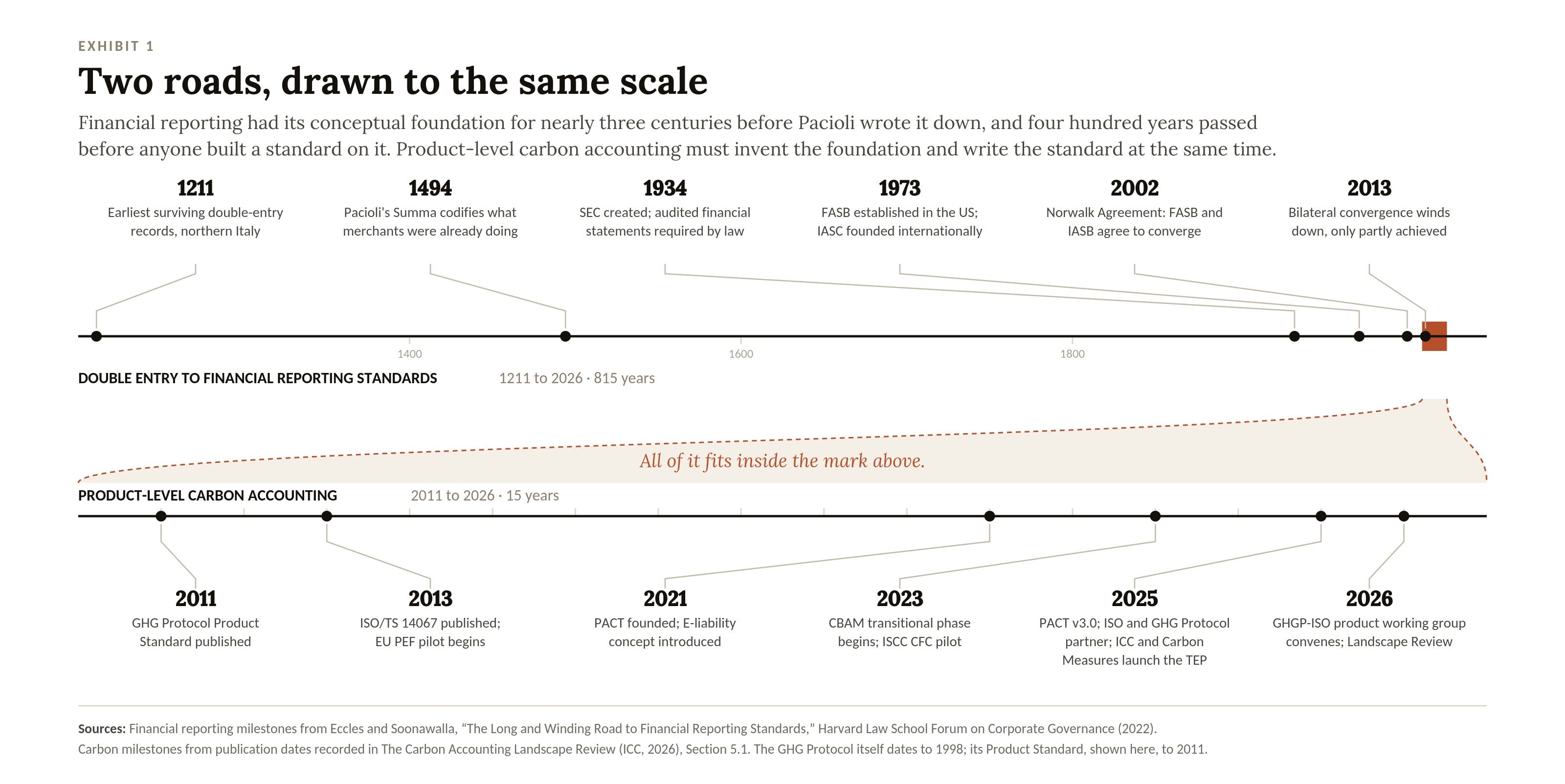
Two roads, drawn to the same scale. Financial reporting milestones from Eccles and Soonawalla (2022); carbon milestones from publication dates recorded in The Carbon Accounting Landscape Review, Section 5.1.
Lesson 3: The Hard Parts Are Hard because Interests Differ
Some disagreement reflects immaturity where the field is young and the data imperfect. Other disagreements persist because constituencies prefer different outcomes, and technical progress does not remove that conflict.
The cleanest illustration is other comprehensive income. Ninety years into mandatory financial reporting there is still no settled principle governing which gains and losses bypass the income statement, and recycling rules differ between IFRS and U.S. GAAP. This is not an obscure corner; it determines reported earnings. The FASB and the IASB worked on the conceptual framework that was supposed to resolve it and did not, because what belongs in earnings is a question about what earnings are for, and preparers, investors, auditors and regulators do not agree. Carbon has its own versions, which The Landscape Review names: allocation across co-products, the treatment of removals and biogenic carbon, and the choice among chain-of-custody models. Better data alone will not resolve those choices. As Kazbi and I put it, it is worth being “realistic about the effort, difficulties, and time it will take.”
Lesson 4: Standards Never Stop Changing
Major standards are routinely revised as transactions, practices, and policy needs change. A standard that never changed would eventually cease to fit what it was intended to describe. The accounting standards at issue here also do not themselves determine the policy targets to which the resulting measures may be applied. Whatever either body publishes will not be the last word, and treating a first standard as a final settlement misunderstands what a standard is.
Lesson 5: Companies Use Standards and then Report Around Them
In the third of our 2022 pieces we looked at what companies actually do with a mandated standard, and the answer is that they supplement it. Govindarajan, Srivastava and Zhao put the figure at roughly 95 percent of S&P 500 companies reporting non-GAAP earnings alongside their GAAP ones. The SEC’s response was not to forbid the practice but to govern it. Regulation G bars materially misleading non-GAAP presentations and requires reconciliation to the most directly comparable GAAP measure. A mandatory standard did not end the argument about measurement. It gave the argument a common reference point.
Lesson 6: Convergence Is Desirable, Hard, and Usually Ends in Interoperability
The FASB and the IASB signed the Norwalk Agreement in 2002, committing to converge U.S. GAAP and IFRS. The response was not unanimously positive even then. Critics worried about a one-size-fits-all approach and about the very different starting points of prospective adopters, and there was real apprehension that harmonization, a word denoting flexibility and coming together, would be quietly replaced by standardization, a word denoting something rather more rigid.
In 2004 the boards added the conceptual framework to the convergence agenda on the assumption it would be relatively straightforward, being the most abstract and least commercially contested part of the job. It proved the reverse. By 2010, on completing the first phase, both boards published their own conceptual frameworks and gave up on a common one. Some of the concrete projects fared better than the abstract one. Revenue recognition converged and has held. Financial instruments did not; leases produced two standards issued in the same year that still differ in structure; impairment produced expected credit losses on one side of the Atlantic and current expected credit losses on the other.
The wind-down produced public recrimination. In June 2014 the former SEC Chairman Christopher Cox blamed the IASB for the divergence, and the IASB chair Hans Hoogervorst responded that convergence had always been a limited-scope project with successes on revenue recognition and challenges on financial instruments.
In this history, success has meant not one text but texts close enough that the differences can be bridged. That is also where the present positions sit. The Landscape Review says its architecture is designed to be interoperable with existing systems rather than to replace them. Asked about fragmentation in an interview I did with Amy Brachio, she said she believes it can be addressed through a focus on interoperability. The GHG Protocol and ISO are going further still, consolidating two corporate standards into one. The disagreement is about how, not whether.
One factual difference between then and now is worth noting without drawing a moral from it. Norwalk was attempted after both bodies of standards had hardened. Here, neither product standard exists yet. The GHG Protocol and ISO have set an integrated public consultation on their consolidated corporate standard for the second quarter of 2027 and publication in the fourth quarter of 2028. Their product-level joint working group convened in July. Carbon Measures, through the Technical Expert Panel, has delivered its landscape report on schedule, with a model standard to follow. Nobody sees a draft product standard from either body before 2027.
How Standards Actually Acquire Authority
Underneath all of this sits the question of who is entitled to write a standard. That is the wrong question, because the historical answer to it is nobody in particular. The better question is how a written standard acquires authority, and there are at least six routes, all of which have worked. There is also an external benchmark for the process. In 2000 the WTO’s Committee on Technical Barriers to Trade adopted six principles for developing international standards—transparency, openness, impartiality and consensus, effectiveness and relevance, coherence, and the development dimension. Written for trade rather than carbon, they provide a benchmark for comparing standard-setting processes.
The first route is delegated statutory authority. A regulator keeps the legal power and hands over the drafting. The SEC delegates to the FASB, which is funded by mandatory accounting support fees rather than voluntary contributions from the companies it regulates or the accounting firms who do the audits. This is the entire point, because the two predecessor bodies, the Committee on Accounting Procedure and the Accounting Principles Board, were each displaced amid persistent doubts about their independence from the professional body that sponsored them. In this lineage, perceived sponsor dependence was sufficient to undermine institutional legitimacy.
The second is endorsement and jurisdictional adoption. Where no single regulator has jurisdiction, an international regulators’ body endorses and governments adopt. IOSCO endorsed the international standards in 2000; the EU mandated them in 2002 with effect from 2005, They are now required in more than 140 jurisdictions. That is roughly 30 years from the founding of the IASC to the point where the standards had force. And legal force came through regulators’ endorsement and legislative adoption rather than from the standard setter acting alone.
The third is de facto adoption through the ecosystem, and it involves no mandate at all. The GHG Protocol was founded in 1998 by an NGO and a business membership organization, explicitly to head off a proliferation of incompatible corporate inventory methods. No government created it and none has ever been required to approve it. Its authority grew as CDP, then the SBTi, then regulators and eventually the drafters of the CSRD pointed at it, and the ISSB wrote it into IFRS S2 as the required basis for measuring emissions. Its formal governance arrived afterwards and is now substantial: a Steering Committee that appoints and oversees an Independent Standards Board, Technical Working Groups, a written development and revision procedure, and public consultations weighed against published criteria rather than counted as votes. Legitimacy through use first, procedural formalization second.
The fourth is less familiar outside the technology world. Here an industry consortium writes a specification, the market adopts it, and a formal standards body transposes it into an international standard. ISO/IEC’s Joint Technical Committee 1 (JTC1) runs a Publicly Available Specification process for exactly this. Note the order. JTC1 first vets the submitting body against openness criteria, and only then accepts its specifications which enter at Draft International Standard stage for national ballot. More than 115 ISO/IEC standards have come this way. It is not a rubber stamp, and it is not immune to capture either. Office Open XML, approved in 2006 by Ecma International, the industry consortium behind the JavaScript and C# specifications, and pushed through the JTC1 fast track in 2007 and 2008, produced one of the most contested ballots in the organization’s history, with formal appeals lodged by four national bodies. The safeguard in this route is the transposing body’s own due process rather than reliance on the consortium’s.
The fifth is codification of established practice, which is where this piece started. Use comes first, someone writes it down, and authority follows from the demonstrated fact that it worked. Pacioli.
The sixth is the one operating right now, which is why it is odd that it features so little in the argument. A regulator writes its own methodology and waits for nobody. CBAM does not adopt ISO 14067 or the GHG Protocol Product Standard; it prescribes its own. California’s Low Carbon Fuel Standard runs on CA-GREET4.0. China builds on ISO 14067 through a national standard and its own emission-factor database. The Landscape Review’s explanation is worth taking seriously; no existing standard has been consistently referenced to underpin product-level compliance, so policymakers are defining bespoke approaches of their own. Its conclusion is that what needs harmonizing is the data layer underneath the regimes rather than the regulatory designs on top of it.
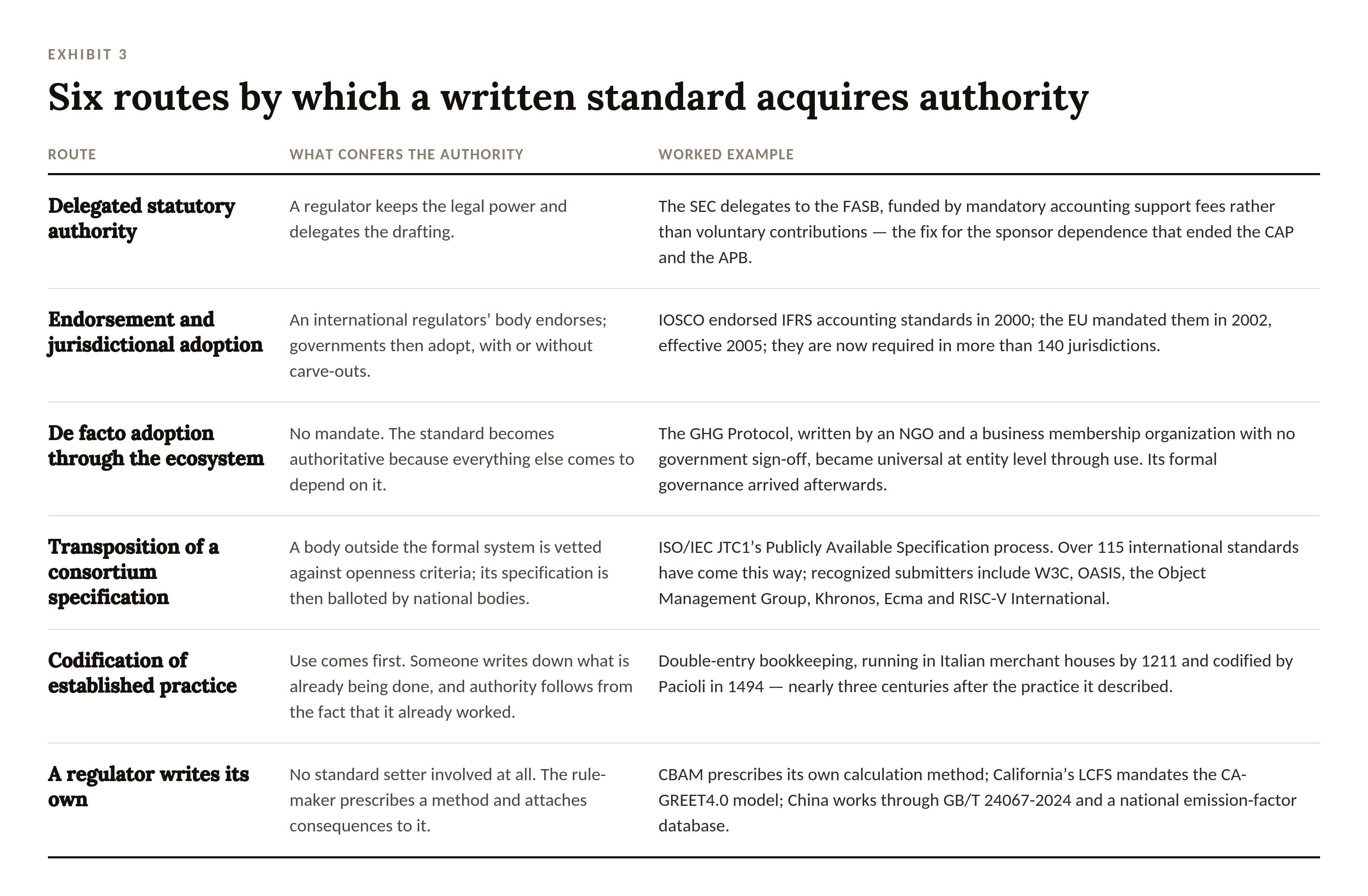
Routes three, four and five share one feature: use precedes or contributes to formal authority. They remain distinct in what follows—ecosystem dependence in the third, transposition by a standards body in the fourth, and codification of established practice in the fifth. The GHG Protocol’s own history is the nearest example of the first, and the proposition that a standard is only legitimate if a government commissioned it does not survive contact with the record. Existing use is itself one source of authority, and at entity level the GHG Protocol has long since established it. That is not what product-level accounting is about.
Neither body has yet published the process by which this particular standard will be developed, consulted on, and approved. The GHG Protocol has a written development and revision procedure, a published governance structure, and, since July, a published development plan for the consolidated corporate standard. It has published no equivalent for the product-level work, which is run jointly with ISO under a partnership less than a year old, and how that joint process will handle technical disagreement is not yet public. Carbon Measures has a Panel whose composition and mandate are public and whose first report is out, but the process for developing a model standard has not been described. Without those process descriptions, judgments about comparative procedural legitimacy remain premature.
What Makes This Case Different from the Analogies
The principal institutional comparisons used so far involve bodies built for continuing roles. That is not the situation here. Carbon Measures has said publicly that it expects to exist for five to seven years and then close. In my interview with Amy Brachio she described success as a framework adopted globally and carbon intensity standards in place in multiple markets; the organization’s mission is policy, and product-level accounting is the instrument. When I interviewed Karthik Ramanna he said the E-Ledgers Institute would be delighted to dissolve itself once competitive differentiation on carbon becomes mainstream.
That changes the shape of the problem. One of the two organizations is not bidding to become the permanent standard setter and has put a clock on itself. The other is a permanent institution which, by its constitution, cannot advocate for the product regulation, border measures, or intensity standards that would give product-level accounting its bite. It also clarifies who Carbon Measures is addressing, which is not the audience most commentary assumes: not investors, and not in the first instance companies, but the bodies capable of setting carbon intensity standards. Brachio has been explicit that Carbon Measures advocates for governments to regulate using product intensity standards, and that each country would set its own on the products that matter to its industries.
It also raises a design question that is largely absent from the current argument. If an organization builds an accounting architecture and then dissolves, who maintains it? Standards require continuous revision, as everything above suggests, and somebody has to do the revising. A self-liquidating body therefore has to solve not only adoption but succession, and no public account of how that would work yet exists.
If two materially different product-level carbon standards emerge and stay different, the cost will be borne by procurement officers trying to compare quotations, customs authorities trying to verify declarations, and producers running parallel accounting systems to sell into different markets. Those are the parties that bear the operational cost of persistent divergence.
What Happens Next?
Here are three things I don’t know. I don’t know the extent to which the GHG Protocol, ISO, and Carbon Measures will collaborate with each other in developing a product-level standard for carbon accounting. I don’t know how similar or different the draft standards they issue will be. I don’t know which route each set of standards will be taking for gaining social legitimacy.
Here are three things I do know. I know that the GHG Protocol and ISO are standard setting organizations and that Carbon Measures is not. I know that each standard setting process will be difficult and contentious. I know that if we get to one global set of standards, which I hope we will, they will not be locked down but will continue to evolve for years and decades to come.