
Making Sustainability Financially Relevant
A Man/Machine Collaboration

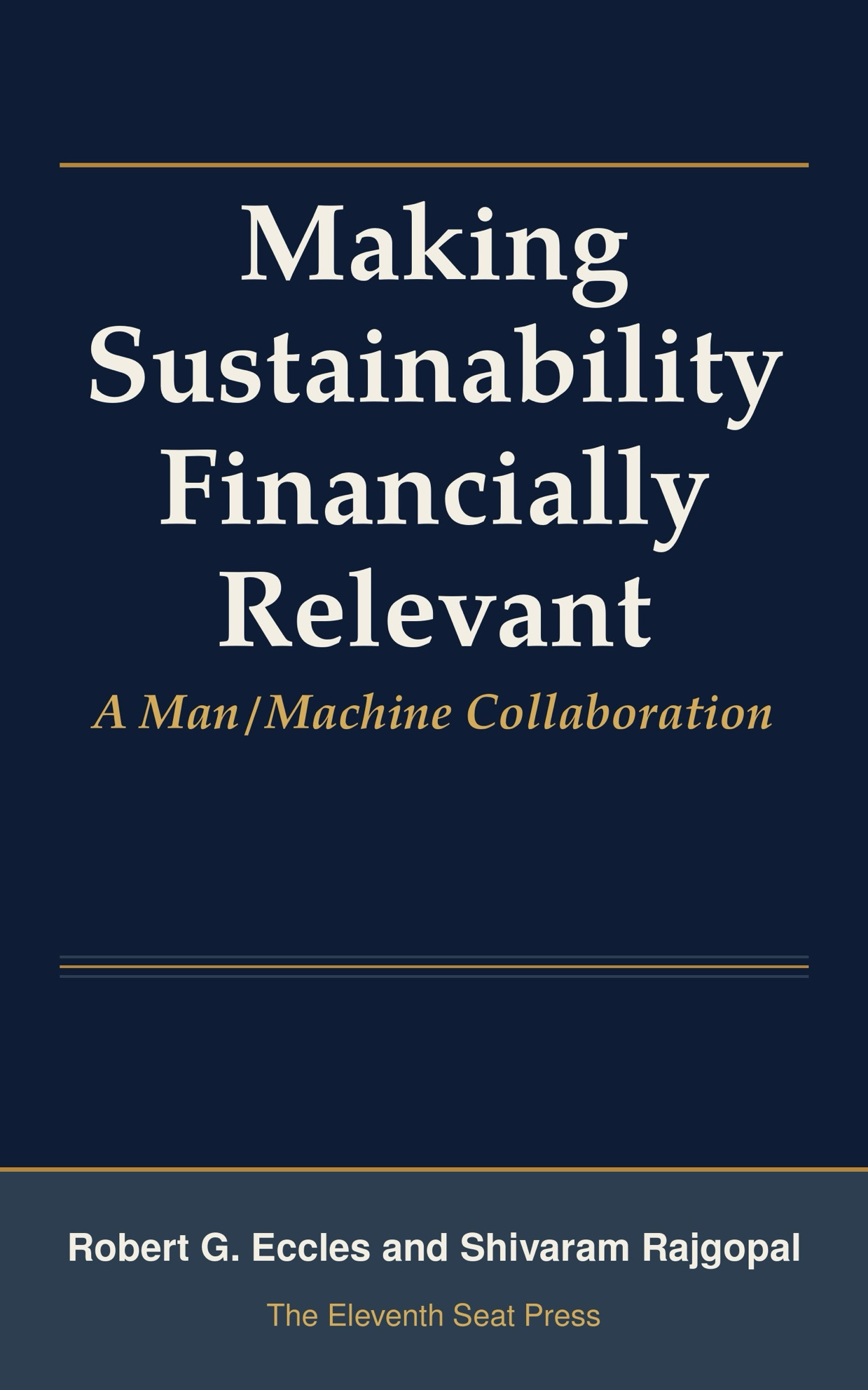
Last week Professor Shiva Rajgopal and I published our book “Making Sustainability Financially Relevant: A Man/Machine Collaboration.” We think it’s a timely and much needed book. Over the past five years, “sustainability” and the acronym “ESG” have become politicized at both ends of the spectrum. On the left, critics argue these ideas have been captured by shareholder value and that the real work belongs at the level of whole systems. We respect that view, but companies don’t exist to save the world. They exist to solve problems for their customers and make money without making the world worse, inside the constraints of resources, laws, and regulation. On the right, sustainability has been framed as a progressive liberal agenda that interferes with value creation. Much of that critique is politically motivated, although we’ll concede that companies have too often overpromised on doing well while doing good.
We didn’t write this book to win that argument. We wrote it to change the subject.
Our claim is simple, almost boring. And the boringness is the point. A company can go on offense about sustainability; not with slogans, but with analysis. Understand the business model. Identify the material risks (we start with SASB, but other frameworks work too) disclosed in the 10-K or 20-F. Ask how well the company actually explains the link between those risks and value creation. Map each risk to specific line items on the income statement, balance sheet, and cash flow statement. Then estimate the financial impact. Done properly, the result isn’t a narrative or a score. It’s the kind of analysis companies can use to explain the link between good sustainability performance on material issues and financial performance.
Someone could have had this idea 20 years ago. What’s new is that AI has made it practical. A skilled analyst used to be able to trace a handful of material risks through one company’s disclosures and defend the numbers to a skeptical investment committee. Doing it across 10 companies was heroic. Across 100, impossible. AI breaks that constraint, not by replacing the analyst, but by expanding what one analyst can do. This book shows how, and it shows our work, including the prompts.
We chose ExxonMobil as our test case because it is about as hard a case as we could think of. Sustainability analysis there is actively contested, the numbers are enormous, the scrutiny is intense, and every assumption gets challenged. If the method survives ExxonMobil, it survives anywhere. ExxonMobil isn’t a convenient example. It’s a stress test.
The method survived. But it also broke and that turned out to be the most important findings in the book. When we pushed an expanded framework beyond SASB’s established standards, it produced a large, internally coherent, technically defensible estimate of transition-related demand destruction, running well into the billions. The number was wrong. Not because the mechanism was flawed, but because the policy world it assumed had just moved decisively in the opposite direction. We caught it. We traced the error to three specific design failures and built four targeted fixes. The corrected framework is now stronger than either the original or the broken version.
That episode is the book’s central argument in miniature. AI makes the analysis possible; human judgment makes it trustworthy. Better AI does not reduce the need for human judgment. It raises the bar for what the human has to do. The only thing standing between a credible-looking wrong number and a misled investor is domain expertise applied at exactly the right moment. We came to think of ourselves, throughout, as the human coherence anchors.
Because we were watching the machine the whole time, the book also doubles as an informal field report on AI itself. Where it succeeded, where it failed, and what the humans had to do. We ran the analysis through several systems, and we tell you by name which agent produced what. When two independently trained systems agreed on the central findings but diverged on the tail risks, the disagreement was itself the signal. It pointed straight at the assumptions that most deserved human scrutiny.
Part 1 is the case study—the method, built and tested. Part 2 is the operating manual--what to actually do, on Monday, if you hold one of the roles this work touches. We wrote for the board director, the CEO, the CFO, and the CSO; for the long-term investor, the activist investor, the ESG and impact investor, and the private-equity and private-credit investor; for the buy-side analyst and the sell-side analyst; and for the NGO seeking constructive engagement. The through-line is that the gap this method closes is usually organizational, not analytical. In most companies, the sustainability team owns the sustainability report, and the finance team owns the financial report, and no one owns the relationship integrating the two. Which is true integrated reporting. This book makes that gap hard to leave unaddressed and makes possible the original vision for integrated reporting.
A few words on what the book is not. It is not a claim that AI can replace financial judgment. It is not a verdict on what ExxonMobil is worth or what anyone’s allocation to fossil fuels should be. And it does not address negative externalities that don’t affect value creation which are obviously deeply important and must be addressed. Our honest view is that more of that burden belongs to public policy than to companies and investors, who can only do so much.
We self-published this book, fast, through our own imprint, because AI is moving quickly and we didn’t want to wait out a traditional book production cycle. We don’t think of the methodology as definitive, and we expect to revise it as the tools improve. What we do think is eternal is the underlying idea—the granular mapping of material sustainability issues to the drivers of financial performance and valuation. There is a price on the book, and on the related IP we’ll be releasing, because it reflects two decades of work and because, candidly, people tend to use what they’ve paid for. We’re academics. We’re not going to get rich from a book. This isn’t our goal. Our goal is to help companies make more rigorous the link between sustainability performance and financial performance. This will improve internal capital allocation and decision making. It will also improve communications to shareholders and other stakeholders.
Finally, we want the arguments here challenged. Both of us are at the point in our careers where critical feedback is the most useful thing a reader can give us. We have no career anxiety about hearing it. So, tell us where we’re wrong.
Each Monday from here, we’ll take up one theme from the book. We start next week with the gap at the heart of it: companies disclose their sustainability risks to satisfy securities law, then price them at zero in the financial models that actually drive decisions. We hope you’ll come argue with us.