


Professor Kerstin Lopatta became Chair of EFRAG’s Sustainability Reporting Board on May 1, 2026, for what was supposed to be a three-year term. Five months later, on September 30, 2026, she resigned. Corporate Disclosures reported on October 1, citing Börsen-Zeitung, that disagreements over EFRAG governance—and specifically tensions between the Sustainability Reporting Board and the Sustainability Reporting Technical Expert Group over authority in the standard-setting process—were decisive in her departure.
That account remains reported rather than independently established, and it should be treated as such. Nor is Lopatta a detached witness to the history criticized in this essay. She joined the SRB in 2022, served as Acting Chair during completion of the first set of draft ESRS, and then spent years as Vice-Chair before becoming Chair. That makes her position more complicated, not less relevant. The governance question is why someone who helped carry the original process through, remained inside the institution and later became the accountable Board chair left after five months amid a reported dispute over authority.
Overview
The resignation of Lopatta on September 30—and the accompanying reports of deep governance failures and unapproved board records—has fractured the consensus surrounding Europe’s sustainability reporting regime. What is frequently dismissed in Brussels as a dispute over technical standard-setting has instead escalated into a structural crisis for the European Commission and the operability of its flagship Corporate Sustainability Reporting Directive (CSRD).
This essay is admittedly long and deeply technical, but that complexity is necessary to unpack a regulatory architecture that was hardwired to prevent legislative correction. Because the mechanics of that architecture matter, the primary arguments can be summarized as follows:
First, Lopatta’s departure is not a localized personality conflict. It exposes a fundamental breakdown in the corporate governance of EFRAG, an institution whose technical apparatus has consistently bypassed or overpowered its own board oversight.
Second, this internal governance failure carries immediate legal consequences. Article 49(3b) of the Accounting Directive does not merely suggest good behavior. It makes EFRAG’s “proper due process, public oversight and transparency” a strict statutory condition of the advice the Commission relies upon. Procedural failures at EFRAG therefore render the resulting delegated acts legally vulnerable to challenge by member states.
Finally, the crisis shifts the ultimate burden of accountability directly to the European Commission. The Directorate-General for Financial Stability, Financial Services and Capital Markets Union (DG FISMA) provides roughly 90 percent of EFRAG’s funding, yet it has failed to exercise institutional oversight commensurate with the systemic, cross-border regulatory risks that EFRAG’s standard-setting architecture created.
The Bigger Picture
The stakes are larger than one resignation or even EFRAG itself. Mario Draghi’s competitiveness report put regulatory burden squarely inside Europe’s growth problem, and an economically stagnant Europe whose corporate champions divert managerial attention and capital from innovation to administrative compliance is an acute strategic liability for the democratic alliance. The capital market numbers tell the real story. The European Commission itself notes that EU stock-market capitalization was only 73 percent of GDP in 2024, compared with 270 percent in the United States. Across more than 300 fragmented exchanges, the combined capitalization of the entire European Union sits around $12 trillion—roughly one-fifth the market capitalization of the two largest U.S. exchanges alone.
Europe is now trying to reconcile two policy eras: one that built an extraordinarily ambitious sustainability-reporting architecture to support the European Green Deal and its goal of achieving net-zero emissions by 2050, and another that is explicitly charged with simplification, productivity, and reducing reporting burdens. Valdis Dombrovskis now serves as the European Commissioner for Economy and Productivity, Implementation and Simplification, working alongside the Directorate-General for Economic and Financial Affairs (DG ECFIN). Maria Luís Albuquerque serves as the European Commissioner for Financial Services and the Savings and Investments Union, overseeing the Directorate-General for Financial Stability, Financial Services and Capital Markets Union (DG FISMA), whose portfolio includes the sustainability-reporting file. She has in fairness demanded simplification, usability, and proportionality from EFRAG. The institutional tension is therefore not a morality play between reformers and obstructionists. It is a test of whether a regulatory system built under one set of assumptions can be governed credibly when the political and economic assumptions change.
In my July 2022 piece “The Credibility of EFRAG’s Sustainability Reporting Standards Is At Risk” I raised concerns about EFRAG’s process where participants described a “hot mess” of compressed timetables, obscured disagreement, and people being steamrollered. Last week in “The Missing Whistleblower, the Ghosted Chair, and Wired Mice” I raised the governance issue again and asked the central question of whether this institution has governance machinery strong enough to surface and adjudicate disagreement before a resignation becomes the mechanism of disclosure. Four years later, that is no longer a retrospective complaint about the difficult birth of European Sustainability Reporting Standards (ESRS). It is a present-tense institutional question: whether ESRS can survive EFRAG.
EFRAG and ESRS: Key Institutional Facts
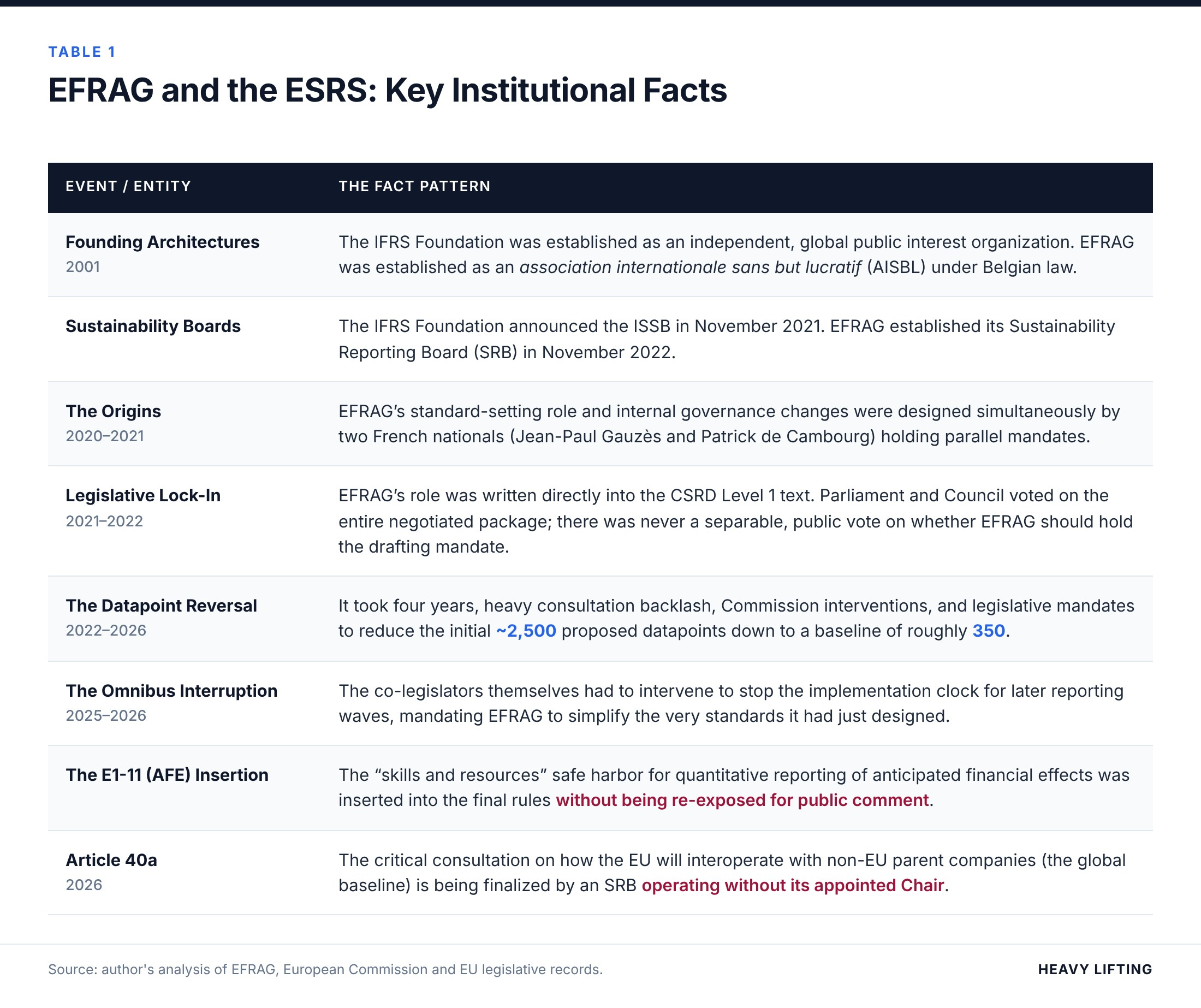
The story is a complicated one, so Table 1 summarizes the key issues I’ll be discussing.
How EFRAG Got the Pen
The policy problem that produced the Corporate Sustainability Reporting Directive (CSRD), passed in November 2022 and in force starting in January 2023, was real. The Non-Financial Reporting Directive had already introduced the two-sided logic later called double materiality, but its voluntary guidance did not produce information of sufficient comparability or consistency. The CSRD therefore moved from broad disclosure principles toward standardized European Sustainability Reporting Standards, with EFRAG designated to prepare the technical advice on which the Commission would base delegated acts.
There was a defensible theory behind that move. Markets cannot price information they do not possess; environmental and social impacts can be economically consequential; standardized information can reduce search costs and expose greenwashing. The mistake was to let disclosure carry more policy weight than disclosure can bear. Disclosure is an informational technology. It is not an energy technology. It cannot substitute for competitive power prices, permitting reform, deep capital markets, scalable venture finance, transmission infrastructure or an industrial environment in which firms can earn adequate returns on green investment.
That distinction matters because standard-setting is not the same activity as policy advocacy although many NGOs confuse the two. A public-interest constituency may reasonably ask for more information about corporate impacts. A standard setter must ask a harder set of questions before turning that demand into an auditable requirement: Can the information be defined and measured consistently? Can management establish controls over it? Can an assurance provider obtain evidence? Will sophisticated users actually use it? What does it cost? How does it behave across sectors and jurisdictions? What happens when the information lies three tiers down a value chain, when foreign law constrains collection, or when the company cannot reasonably obtain it? Those questions do not weaken sustainability reporting. They determine whether it functions.
EFRAG was not originally built for this role. It was established in 2001 as an association internationale sans but lucratif (AISBL)—an international non-profit association governed by Belgian law—whose core task was to advise the European Commission on whether standards issued by the International Accounting Standards Board (IASB), established on April 1, 2001, should be endorsed for use in the Union. Its role was derivative and reactive. Another institution wrote the standards; EFRAG evaluated them. The 2004 IAS 39 controversy later confirmed and intensified a European debate over accounting sovereignty, when EU endorsement included carve-outs after sustained objections, particularly from France to elements of the IASB’s fair-value approach. The episode entrenched a legitimate concern that endorsement of standards written elsewhere was not the same thing as having institutional control over their design. Sustainability reporting created a field in which Europe could be an author rather than an endorser. As Mairead McGuinness—Maria Luís Albuquerque’s predecessor as Commissioner for Financial Services—summarized the political ambition during the Parliament’s debate on the directive, Europe intended to be not a “rule-taker but a rule-maker.”
The critical institutional move came in June 2020. Then-Executive Vice-President of the European Commission for An Economy that Works for People Valdis Dombrovskis gave Jean-Paul Gauzès—a former French Member of the European Parliament and then-president of EFRAG—an ad personam mandate to recommend the governance changes EFRAG would require if it were entrusted with sustainability standard-setting. In parallel, the Commission asked EFRAG to undertake preparatory technical work on possible EU non-financial reporting standards. EFRAG carried that work out through a Project Task Force chaired by Patrick de Cambourg, president of the French accounting standard setter Autorité des normes comptables (ANC). Both exercises reported in March 2021. The problem is not that the Commission literally failed to consider alternatives; its consultation and impact-assessment process did address standardization options and institutional arrangements.
The sharper point is that the options analysis ran in parallel with EFRAG’s own president designing EFRAG’s future governance and EFRAG’s own task force designing the future standards. By the time institutional choice was being tested, the favored institution was already designing the job and doing the work. EFRAG was subsequently written directly into the draft legislation. Because votes on European directives in the Parliament and the Council are ultimately up-or-down decisions on an entire negotiated compromise package, EFRAG’s role was wired into the law from the start, leaving lawmakers no practical way to challenge the standard-setter without sinking the directive itself.
The Commission’s CSRD proposal followed on April 21, 2021, and the provisional trilogue (the closed-door negotiations where the Commission, Parliament, and Council finalize EU legislation) agreement on June 21, 2022. The co-legislators did not simply give EFRAG an unchecked mandate. They wrote safeguards into what became Article 49(3b) of the Accounting Directive. In its current form, the Commission is to take EFRAG’s technical advice into consideration only where, among other things, it was developed with “proper due process, public oversight and transparency,” with balanced expertise and participation, with “sufficient public funding to ensure its independence,” and on a “work programme on which the Commission has been consulted.” The advice must also be accompanied by a cost-benefit analysis. Those conditions survived Omnibus I—the legislative package introduced to simplify corporate obligations and narrow reporting thresholds—and remain fully intact in the consolidated Accounting Directive, which integrates the original 2013 statute and all subsequent amendments, including the CSRD, into a single binding text.
This is not a nuisance qualification to the governance argument. It is its legal core. The legislature made the quality and independence of the process a statutory condition attached to the advice on which the Commission relies. EFRAG’s first exposure drafts show why that safeguard matters. While consultation and Commission intervention ultimately corrected early overreach—such as the withdrawn rebuttable presumption of materiality—a defender of the existing system might argue it operated as designed: EFRAG advised, others commented, and the Commission decided. But the sheer volume of correction, simplification, and re-engineering required asks a fundamental question:. Why was so much fixing necessary after the advice had already passed through a body whose statutory relevance depends on due process and public oversight? The issue is not that EFRAG possesses final legal authority. It is whether it has exercised its technical authority with governance commensurate to the consequences.
The Record of Reversal
The chronology is revealing because it shows repeated contraction after ambitious initial design. EFRAG has demonstrated that it can cut when mandated to do so. The problem is that these cuts consistently arrive in response to outside pressure—consultation backlash, Commission intervention, or explicit legislative mandates—rather than from a self-initiated conclusion that the architecture had become too heavy. Table 2 below acts as an evidentiary record of internal governance failing to self-correct until politicians or co-legislators step in to interrupt the implementation timetable.
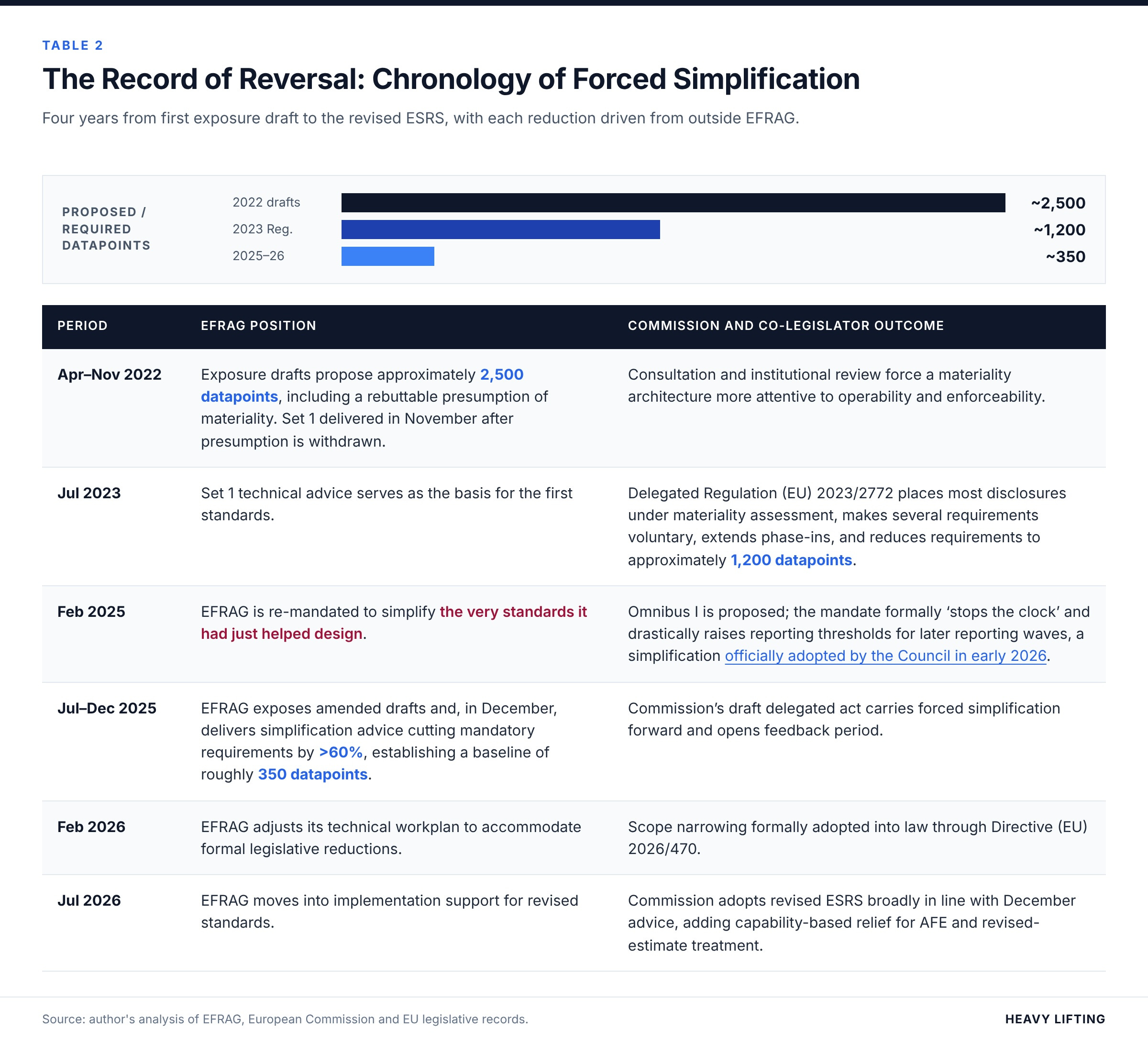
Revision is not itself evidence of failure. Serious standards evolve. But this degree of instability has a severe cost, especially when companies have already built systems, hired advisers, configured software, redesigned controls, and imposed data requests down their supply chains. Repeated reconstruction acts as a levy on preparers. It destroys the predictability that standard-setters are supposed to provide, eroding confidence that today’s expensive compliance build will still be required tomorrow. The fact that EFRAG ultimately delivered major simplification, albeit after four years of work and pressure, when explicitly told to do so is welcome. It is also the measure of how much burden had accumulated before the political system forced the recalibration.
What the Pen Produced: E1-11 and Article 40a
Two current design problems illustrate why governance cannot be separated from technical quality. Evaluating this governance, however, requires looking at two distinct levels: the internal governance of EFRAG itself, and the external oversight exercised by DG FISMA, which provides 90 percent of EFRAG’s funding. Neither design problem should be caricatured as proof that EFRAG alone caused the result, as EFRAG is constrained by Level 1 legislation—the foundational statutory directives passed by the European Parliament and Council—and the Commission retains the authority to alter EFRAG’s advice. The question is whether a properly governed technical process identifies operability problems early, records dissent, tests alternatives in real companies, and makes the consequences unmistakable to the institution that will turn advice into law.
Anticipated Financial Effects
The first example is anticipated financial effects (AFE) in ESRS E1-9. The 2023 standards already combined time-based phase-ins with an entity-specific test. ESRS E1-9 could be omitted entirely in the first year, and for the first three years an undertaking could provide only qualitative information if quantitative disclosure was impracticable. The revised 2026 architecture should therefore not be described as a move from a calendar test to a capability test. It replaced one demanding entity-specific test with a different, permanent one while retaining a separate phase-in. Revised ESRS 2 paragraph 29 says an undertaking need not provide quantitative anticipated-financial effects information if it lacks the skills, capabilities, or resources to do so. That relief does not expire in 2030. What ends then, for the relevant wave-one undertakings (large public-interest entities already subject to the NFRD), is the broader transitional permission to omit specified quantitative information. After 2030, the pressure therefore comes from application of the standing capability test—not from the disappearance of the test itself.
Borrowing that language from IFRS S2 is not inherently objectionable; interoperability argues for it. The harder question is how the same clause operates in a population concentrated, after Omnibus I, on very large undertakings. In IFRS S2 the proportionality mechanism must work across issuers of very different sizes and levels of reporting maturity. In revised ESRS it is available permanently to large companies as well, but its practical force depends on whether a company can substantiate that it still lacks the relevant skills, capabilities, or resources. That is a judgment auditors and supervisors may test, but it is not a calendar rule and should not be presented as one. Nor is the fact that estimates may later change an indictment of the standard. Revised ESRS expressly treats estimate revisions arising as additional information becomes known as distinct from prior-period errors, consistent with the general estimates-versus-errors logic already found in ESRS 1 and IAS 8. The serious operability question is narrower: whether the required E1-11 quantification can be produced with sufficient decision-usefulness, control and assurance across the large-company population, and whether the permanent relief is applied consistently enough to avoid arbitrary differences between similarly situated preparers.
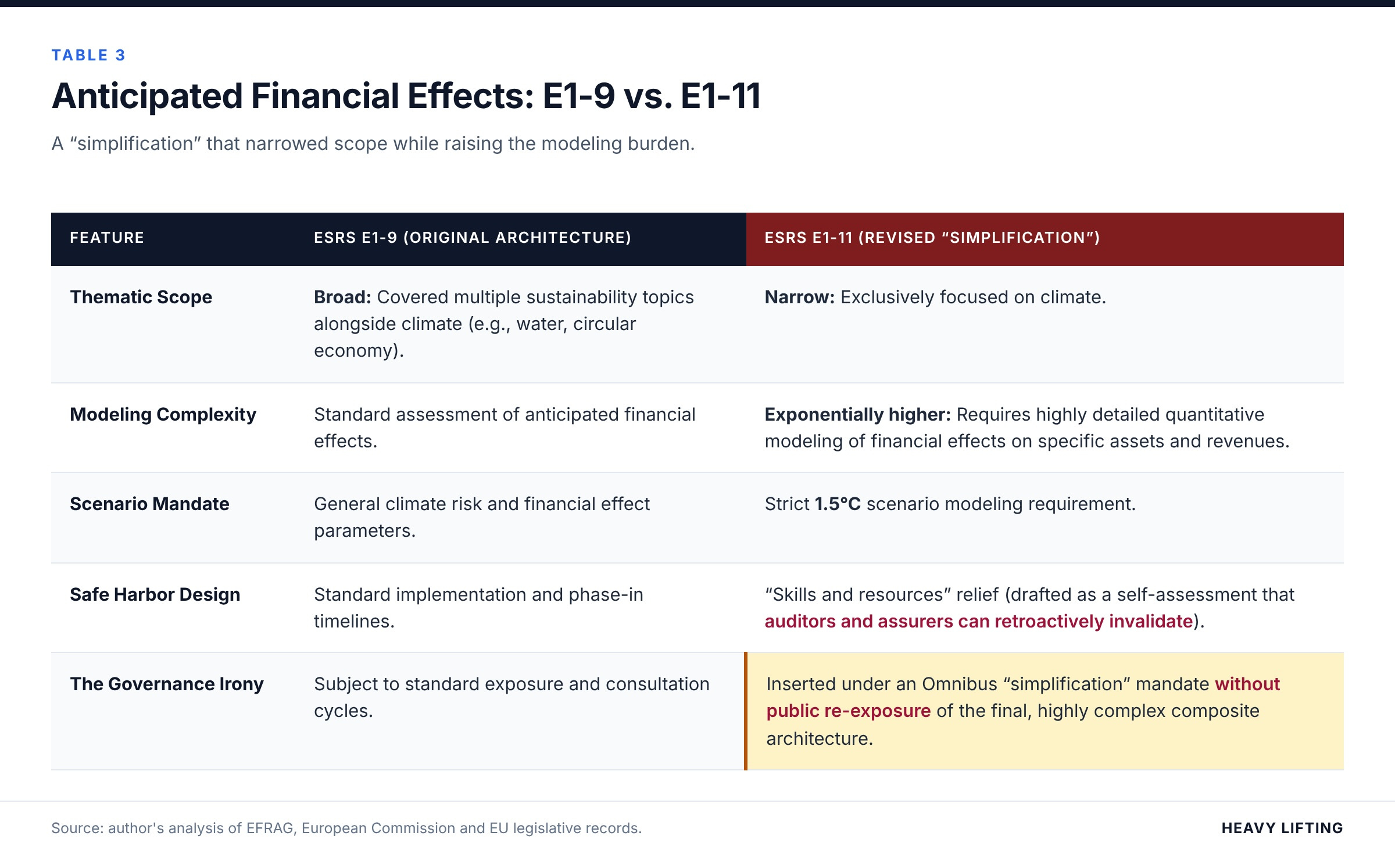
The technocratic framing obscures why AFE represents such a profound governance failure. The irony is staggering. Under an Omnibus mandate explicitly designed to deliver simplification, EFRAG quietly introduced a massive increase in modeling complexity. In the original standards, AFE (then located in E1-9) was a broader requirement covering multiple sustainability topics, including water and the circular economy. In the revised standards, AFE was shifted to E1-11 and narrowed specifically to climate but made exponentially more demanding. It now requires highly detailed quantitative modeling of financial effects on an undertaking’s assets and revenues under a strict 1.5°C scenario.
This brings us to the core due process question. EFRAG essentially snuck this complex, materially different 1.5°C financial modeling architecture into the final text without re-exposing it for public comment. The relevant standard here is not an American “logical outgrowth” doctrine transplanted into EU law; it is EFRAG’s own due-process framework read together with the statutory safeguards of Article 49(3b). Those safeguards obligate the European Commission’s DG FISMA to actively police standard-setting hygiene, not merely rubber-stamp the output. If a standard-setter uses a simplification mandate to quietly hardwire a vastly more complex requirement into the rules, the record must show who authorized it and what testing supported it. Formal adoption by the Commission does not cure the fact that EFRAG bypassed transparency; rather, it exposes a critical breakdown in DG FISMA’s oversight, raising the uncomfortable question of whether the Commission even understood the technical payload it was adopting. Respondents were denied a meaningful opportunity to challenge this new architecture before it was cemented into law. Table 3 below compares how AFE was handled in the two sets of standards.
Article 40a
Article 40a raises a different operability problem. As revised by Omnibus I, the extraterritorial mandate applies to non-EU parent groups that generate more than €450 million in EU turnover and have at least one EU subsidiary or branch generating more than €200 million. For these qualifying groups, the law requires a sustainability report at the ultimate-parent level under dedicated standards. But Article 40a does not simply apply “impact materiality” as a named test. Its statutory content is drawn from the impact-related side of the CSRD architecture: the third-country report is confined to impacts rather than the full package of impacts, risks, and opportunities. That means reliefs designed around anticipated financial effects have no object in the Article 40a report.
The important asymmetry is therefore operational. A European subsidiary within full ESRS applies double materiality. Its third-country parent under Article 40a is being asked to report on impacts whose perimeter is defined by business relationships and causal attribution rather than financial reporting control. That perimeter is not literally unbounded: severity and likelihood govern impact materiality, value chain information is conditioned by reasonable and supportable information, and the Omnibus reforms seek to limit trickle-down demands on smaller partners. But the remaining burden can still be substantial. Consider workers in the value chain. A multinational may need to identify material labor impacts, describe policies and engagement, explain remediation and actions, and support targets across upstream or downstream relationships that do not sit inside the accounting consolidation perimeter. That is a real information-system problem even where the legal design is defended as proportionate to access to the EU market.
The July 2026 ESRS-40a exposure draft proposes a mixed approach rather than settling one. Under the proposal, reporting is generally global, while a group may elect to limit non-climate disclosure to EU-related impacts; climate remains global. That distinction should be debated in the consultation, which remains open through October 31, not described as enacted law. It also changes the interoperability analysis. IFRS S2 already requires Scope 1, 2 and 3 greenhouse-gas emissions across the value chain, so climate inventories and related systems are substantially reusable. For non-climate impacts, however, the more relevant comparator is the Global Reporting Initiative (GRI), not the ISSB, because the ISSB has not issued topic standards covering the social and other non-climate impact disclosures at issue.
Many large U.S. multinationals already report with reference to, or in accordance with GRI, and EFRAG and GRI have rightly emphasized the high level of interoperability between their impact-reporting architectures. That means a serious critique cannot pretend those companies start from zero. But interoperability is not identity. The joint GRI-ESRS mapping itself records differences in scope, granularity, data type, and definitions, while Article 40a would impose a legally defined reporting perimeter and a mandatory European standard rather than a company’s existing voluntary selection of GRI disclosures. The practical issue is therefore conversion, boundary, and completeness—not wholesale duplication. A mature GRI reporter may reuse substantial processes and data, but it may still have to determine which global or EU-related impacts fall within the Article 40a perimeter, close disclosure gaps, document materiality under the European rules, and support a report capable of satisfying the legal and assurance framework. The equivalence route remains relevant, as does the possibility of parent-level full-ESRS reporting that can simplify subsidiary reporting, but neither should be treated as proof that fragmentation disappears.
Interaction Effects
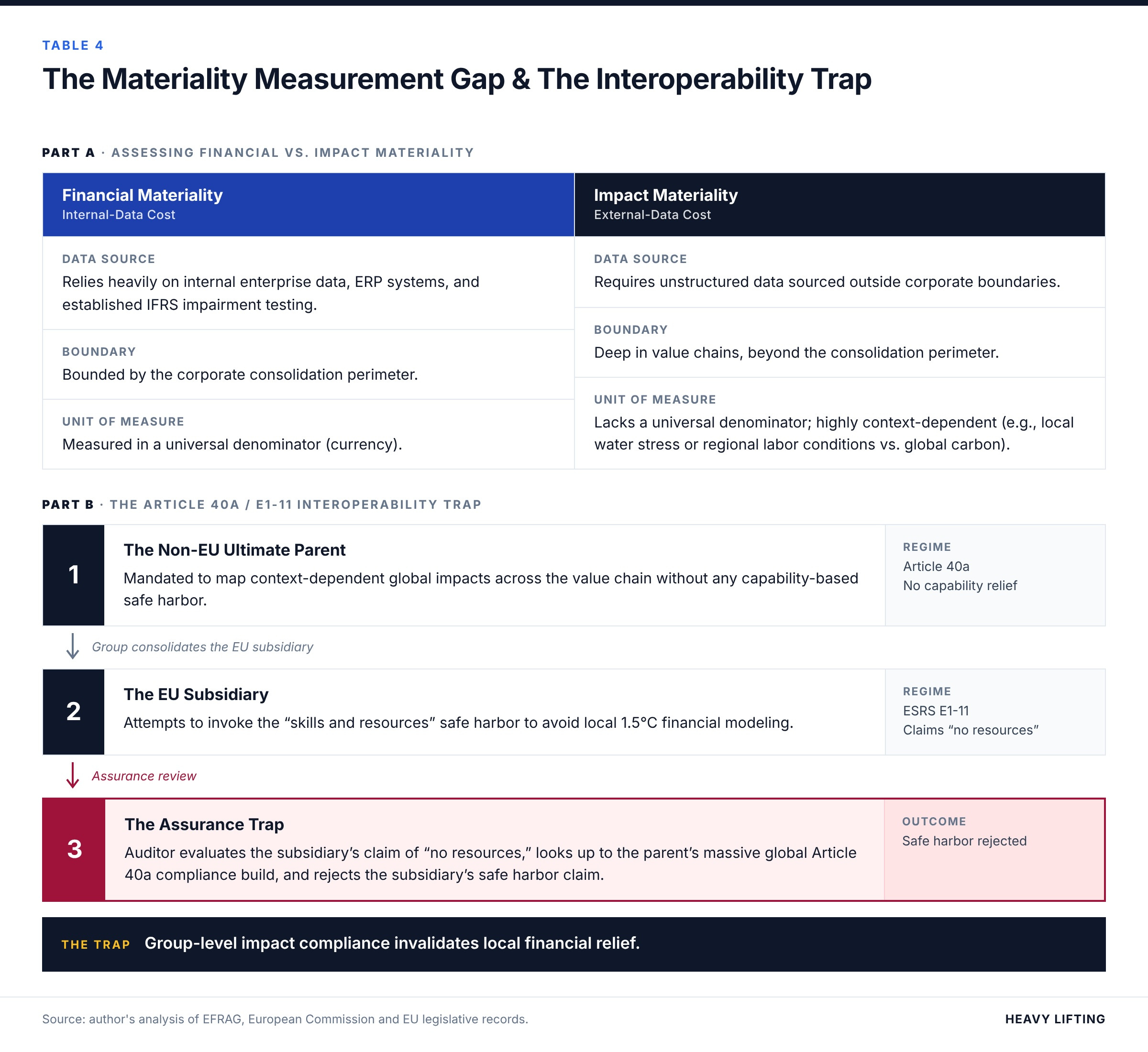
The interaction between Article 40a and the E1-11 safe harbor exposes a profound structural contradiction in the EFRAG architecture. Article 40a forces non-EU multinationals to report exclusively on the impact side of the double-materiality ledger at a global level. The irony here is acute. EFRAG provides a capability-based safe harbor for EU companies modeling financial effects yet demands that third-country multinationals map their global impacts with absolutely no such relief. This is a severe asymmetry, because impact measures are an order of magnitude more difficult to execute. Unlike financial materiality, which relies heavily on internal enterprise data and standard accounting parameters, impact materiality requires sourcing data from far outside the corporate boundaries. It raises profound boundary questions—challenges that the Global Reporting Initiative (GRI) grapples with constantly—and demands deep localized contextualization. For example, the impact of consuming 10,000 liters of water in a severely water-stressed region is vastly different from consuming the same amount where water is plentiful. The standard setter’s architecture effectively demands total, unmitigated global competence on the most difficult part of the equation while feigning leniency on localized financial effects.
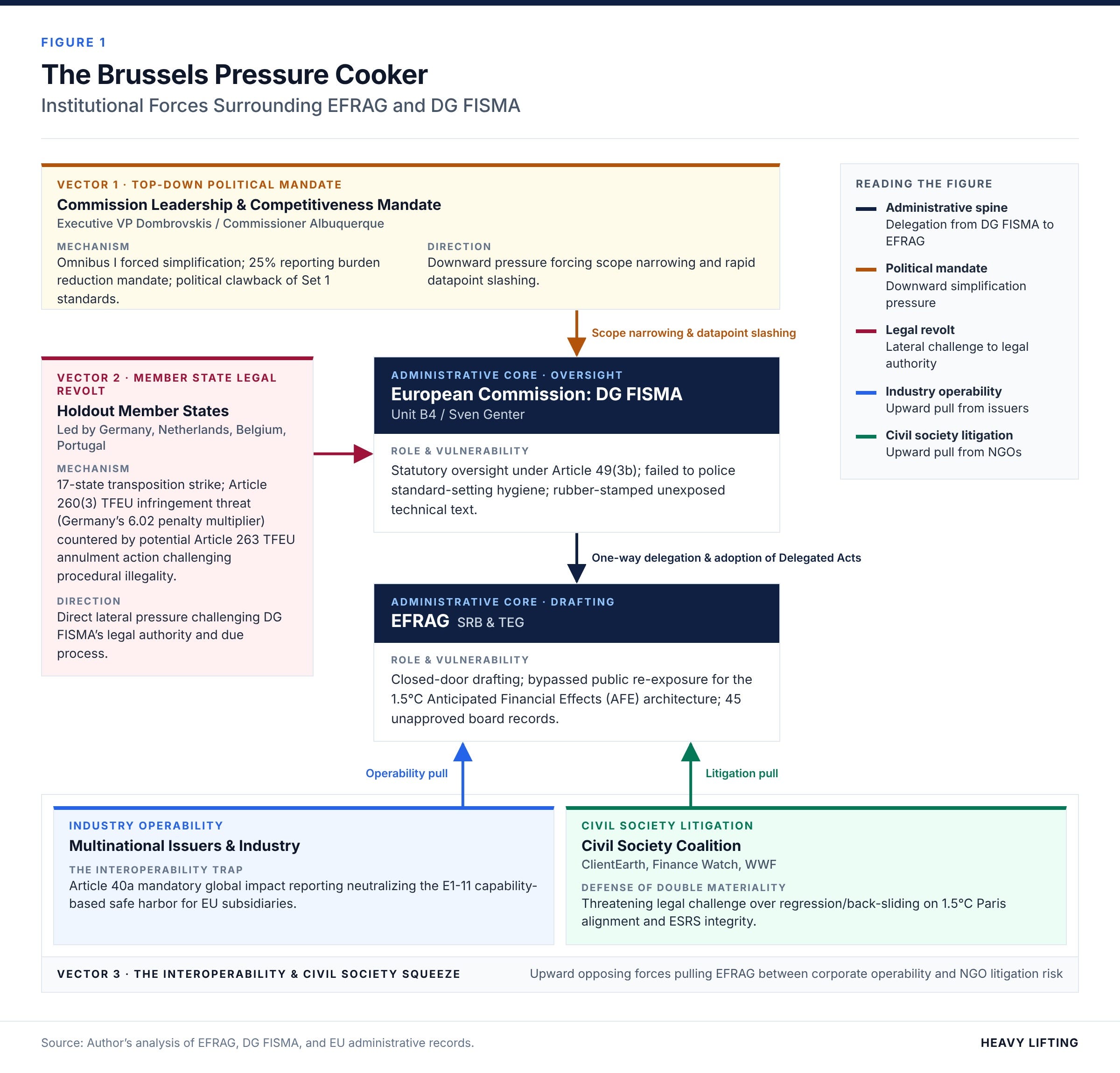
When you view this through the lens of a corporate group, the contradiction becomes an interoperability trap. If a U.S. parent company is marshaling the capital and data architecture to produce a comprehensive global impact report under Article 40a, its EU subsidiary can hardly turn to an auditor and credibly invoke the E1-11 safe harbor by claiming it lacks the resources to model local financial climate risks. While possessing global impact capabilities does not automatically guarantee localized financial modeling skills, an assurance provider will inevitably look up the corporate ladder. If the ultimate parent possesses the infrastructure to execute a complex global impact assessment, the assurers will be hard-pressed to accept that the subsidiary is devoid of resources. By forcing the parent to build a massive global reporting apparatus, the Article 40a mandate effectively neutralizes the E1-11 safe harbor for the subsidiary—a structural conflict detailed in Table 4.
The Governance Crisis
EFRAG’s sustainability pillar has a divided constitution. The Sustainability Reporting Board (SRB) carries institutional responsibility for EFRAG’s sustainability-reporting positions and the technical advice submitted to the Commission. The Sustainability Reporting Technical Expert Group (TEG) performs much of the technical work and advises the Board. The constitutional premise is therefore clear enough on paper; the Board decides and the TEG advises. The governance question is whether that division operates in practice when technical authority, deadlines, and institutional power collide.
That is why Lopatta’s departure matters, notwithstanding her own role in the system’s history. A person who helped steer the first standards, remained in the governance structure, and ultimately became the formally accountable SRB Chair resigned after five months amid reported disagreement about the allocation of authority between Board and TEG. In striking contrast, the Chair of the Sustainability Reporting TEG, Chiara Del Prete—whose background includes years as an auditor at KPMG and PwC before becoming a partner at Mazars—recently had her term extended through January 2028. This extension pushes her continuous service as an EFRAG TEG chair to nearly nine years, bypassing the organization’s standard six-year term limit. That juxtaposition does not prove a structural indictment. It does create a serious present-tense question that should be answered through minutes, decision records, and documented authority rather than through either side’s characterization.
The test of governance is not whether an organization has statutes, committees, and due process manuals. It is what happens when expert judgment conflicts with political urgency; when a board disagrees with the technical apparatus that serves it; when a deadline makes genuine reconsideration inconvenient; when dissent is regarded as obstruction; and when the institution must choose between admitting that a concept is not operationally ready and meeting a Commission timetable. If the Board can meaningfully reject, amend or remand TEG work, the minutes and decision record should show it. If it cannot, then the formal allocation of authority is misleading. If the relationship broke down during the simplification process, the breakdown matters because EFRAG was being asked to redesign standards whose legitimacy depends on precisely this governance chain.
The Administrative Board succession should be approached with the same discipline. Benoit Jaspar—a former KPMG manager, executive adviser at Assicurazioni Generali, and lecturer at the Université Libre de Bruxelles—is retiring as Administrative Board President at the end of the year. The issue is not which individual should replace him, nor should an essay like this imply that a particular candidate represents a predetermined outcome. But the candidates themselves are making the structural crisis explicit. Georg Lanfermann, President of the German standard setter DRSC, recently announced his candidacy to replace Jaspar with a public platform explicitly targeting the “growing external cristiscm about EFRAG’s governance.” His campaign presentation formally calls for establishing “clear reporting lines.” reworking the appointment process for Technical Board Chairs,” extending due process oversight to capture “governance deficiencies,” and fostering an open discussion culture “founded on mutual respect.”
When a leading candidate for the presidency builds his platform on the need to fix broken reporting lines and restore basic institutional respect, a transparent succession process is not a side issue. It is a test of whether EFRAG understands that legitimacy depends on demonstrable procedure, not confidence that insiders acted appropriately.
None of this requires assuming bad faith. Institutions can develop blurred lines of authority without conspiracies; technical groups can become dominant because they possess information, continuity, and staff support; boards can ratify work they formally control because deadlines make reopening it costly. Those are familiar organizational dynamics. They are also exactly why independent governance review exists. The question is not whether EFRAG’s organizational chart is defensible. It is whether authority, dissent, and accountability operate in practice as the chart says they do.
If Brussels Does Not Act
Brussels should consider what this record looks like to adversaries rather than colleagues. When corporate reporting rules move from voluntary guidance to hard law carrying severe liability, the theater of dispute inevitably shifts from standard-setting working groups to the courts. If a coalition of multinational corporations and transatlantic trade associations decides that the costs, ambiguities, and extraterritorial overreach of the revised ESRS are no longer acceptable, it will not engage through polite public feedback periods. It will deploy top-flight European public-law counsel and regulatory litigators.
The primary target in their crosshairs will not be broad political grievances, but the statutory trap embedded in Article 49(3b) of the Accounting Directive.
The Legal Artillery: Weaponizing Article 49(3b)
Article 49(3b) is not an aspirational preamble. It establishes mandatory statutory preconditions that the European Commission must satisfy before adopting delegated acts. The technical advice it relies upon must be developed under “proper due process, public oversight and transparency,” with balanced stakeholder representation, robust cost-benefit analysis, and demonstrably independent technical work. While the Commission inserted boilerplate recitals into Delegated Regulation (EU) 2026/1563 asserting that EFRAG complied with these criteria, a regulatory recital is merely an assertion—it is not an adjudicated fact immune from judicial scrutiny.
A serious legal assault would not waste time on fragile direct annulment claims before the General Court under Article 263 TFEU (Treaty on the Functioning of the European Union), where standing hurdles for private litigants are notoriously steep. Instead, the devastating route runs through the national courts via an Article 267 preliminary reference to the Court of Justice of the European Union (CJEU):
The Procedural Vehicle: A multinational or affected trade body challenges a national enforcement notice, transposition mandate, or audit requirement in a member state court (such as Germany, France, or the Netherlands), alleging that the underlying delegated act is void because the Commission acted ultra vires by relying on advice produced in direct violation of Article 49(3b).
The Evidentiary Pipeline: European administrative litigation does not have broad, American-style discovery or depositions, but challengers have equally lethal mechanisms to expose institutional dysfunction. Coordinated, massive access-to-documents requests under Regulation (EC) 1049/2001 targeting DG FISMA and Commission correspondence, paired with formal complaints to the European Ombudsman for maladministration, would force internal records into the light. Unapproved board minutes, documented procedural overrides of the Sustainability Reporting Board by the TEG, and internal dissents regarding un-consulted additions (like the 1.5°C anticipated financial effects mandate) would become direct evidentiary exhibits before the Court.
Timeline and Market Paralysis: An Article 267 preliminary reference is not a quick skirmish; it is an 18-to-24-month judicial siege that can easily stretch into three or four years before a final ruling from Luxembourg. (Article 267 establishes the “preliminary reference” procedure, allowing national courts in member states to pause domestic proceedings and ask the Court of Justice of the European Union to definitively interpret EU law or rule on the validity of EU regulatory acts before deciding a domestic case.) While obtaining formal interim relief to suspend an EU regulation under Article 278 TFEU requires meeting exceptionally high legal bars, the practical consequence is immediate paralysis. Boards, general counsels, and audit committees confronted with active, high-stakes litigation challenging the very validity of the ESRS will hesitate to commit tens of millions of euros into building systems to comply with standards that may be struck down.
The Internal Revolt: The 17-State Transposition Shield
The litigation threat does not exist in a vacuum; it lands in an EU where domestic political support for the CSRD has fractured. More than half the bloc—17 out of the EU’s 27 member states—failed to transpose the original directive by the July 2024 deadline and face formal European Commission infringement proceedings. The holdout list is striking. It includes Portugal, providing the severe political irony that the home country of Maria Luís Albuquerque has itself stalled on implementation. It also includes major economic players like Germany, the Netherlands, and Belgium (home of EFRAG). Having missed the initial two-month window to respond to formal notices, these nations trigger the Commission’s authority to issue “reasoned opinions,” the final warning before referral to the European Court of Justice. If referred, Article 260(3) TFEU empowers the Court to levy severe daily financial penalties and lump sums. For an economic heavyweight like Germany, the Commission’s penalty calculation multiplier—the ‘N’ factor, a metric based on a country’s gross domestic product and number of European Parliament seats—is the highest in the bloc at 6.02, ensuring any daily fines demanded by Brussels would be uniquely punishing.
But the Commission’s enforcement weapon can cut both ways. If Brussels attempts to financially coerce transposition, holdout nations possess a structural countermeasure: suing the Commission first. Under Article 263 TFEU, Member States are classified as “privileged applicants,” granting them automatic legal standing to seek the annulment of EU acts without having to prove individual harm. Rather than passively absorbing daily infringement fines, a country like Germany could launch an action for annulment against the Commission’s delegated act, leveraging the exact due-process failures EFRAG committed. The legal grounds for an Article 263 challenge map perfectly onto EFRAG’s bypassed transparency: procedural irregularity, lack of competence, and the infringement of statutory safeguards like those outlined in Article 49(3b). If Brussels attempts to force transposition through financial penalties, an aggressive Member State might simply force the European Court of Justice to adjudicate how a materially different 1.5°C architecture was smuggled into the final law.
The 40a Interoperability Collision
This internal member state defiance collides directly with the external pressure mounting across the Atlantic. Under the EU–U.S. trade framework, Washington has placed the extraterritorial reach of the CSRD squarely on the negotiating table. If Brussels bows to this bilateral pressure and offers third-country concessions—such as carving out non-EU groups from Article 40a or downgrading their global impact reporting to a voluntary status—European industry will erupt.
Domestic European companies, already bearing the full weight of double materiality, will not tolerate a regime where U.S. competitors operating within the single market are granted exemptions while local firms remain chained to burdensome disclosure mandates. Cries of “reverse discrimination” and and unlevel playing fields will render the current framework politically unviable inside Europe.
Caught between the threat of protracted judicial review under Article 49(3b), open rebellion from 17 member states refusing to implement the regime, and the commercial impossibility of offering one-sided reliefs to foreign multinationals, the Commission’s defensive perimeter will collapse. When an administrative architecture becomes this brittle, half-measures and minor technical amendments will no longer suffice. Brussels will be forced to reckon with the reality that the only path out of this institutional gridlock is a fundamental retreat: establishing a workable, interoperable global baseline anchored firmly in financial materiality, while fundamentally reconsidering whether the expansive, highly contested architecture of impact materiality can ever function as a mandatory statutory regime.
Figure 1 summarizes the forces at work.
What the Commission Should Do
The answer is not an EFRAG self-assessment, a lessons-learned exercise whose terms of reference are negotiated by the institution being examined, a stakeholder roundtable, or a review confined to whether written procedures were formally observed. Something much stronger than this is needed. The appropriate response is a genuinely independent governance review commissioned at a level capable of examining both EFRAG and the Commission’s oversight of it.
Europe has a direct precedent. In March 2013, Michel Barnier, then-European Commissioner for Internal Market and Services, appointed Philippe Maystadt—former Belgian Deputy Prime Minister, Minister of Finance, and President of the European Investment Bank—as a Special Adviser to examine EFRAG’s governance and recommend structural reforms to reinforce the EU’s role in international financial reporting. Maystadt’s report led directly to substantial institutional reform. The structural distinction matters. Maystadt was appointed by the Commission as an external special adviser; Jean-Paul Gauzès received the 2020 governance mandate while serving as EFRAG’s own President. An external review in 2026 would therefore not be an attack on EFRAG. It would be an established European method of protecting the legitimacy of an organization whose role has materially changed.
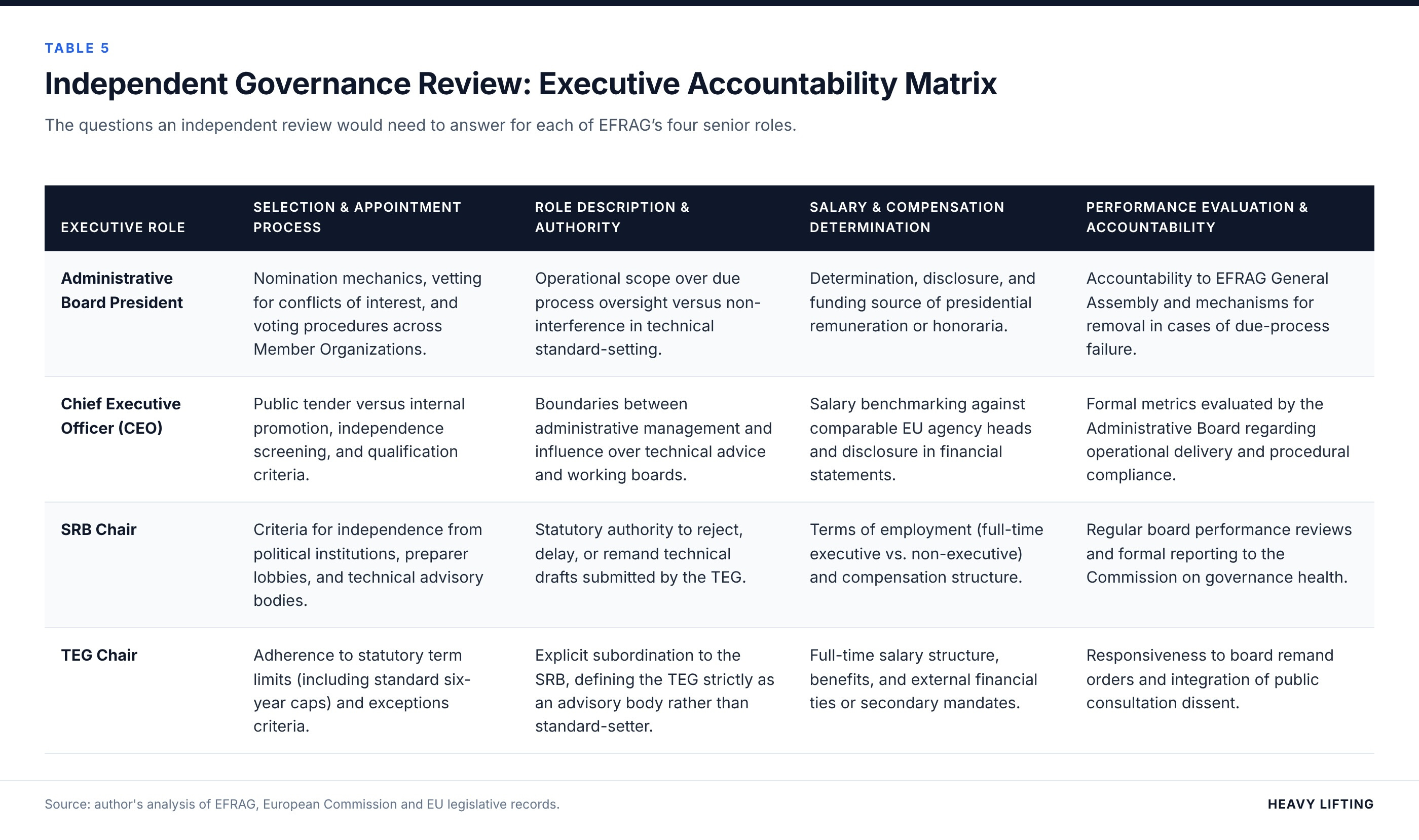
The review should examine the allocation of authority among the Sustainability Reporting Board, the Sustainability Reporting Technical Expert Group, the Secretariat, and the Administrative Board; the operation of the Due Process Committee; how material dissent is recorded and escalated; whether boards can in practice amend, reject, or remand technical work; the handling of major changes between exposure drafts, technical advice, and the final Commission text; the design and use of field testing and cost-benefit analysis; and the Commission’s own internal process for testing whether Article 49(3b)’s statutory conditions have been satisfied.
Crucially, this review must audit not just organizational charts, but how executive power and personnel are managed at the apex of the institution. The current ambiguity regarding leadership selection, compensation, and oversight requires a formal review framework (Table 5).
The independent review should also reconstruct several consequential standard-setting decisions from beginning to end—not to retry every technical judgment, but to establish who decided what, under which authority, and after what evidence and consultation. The complete report should be formally submitted to the European Parliament’s Committee on Economic and Monetary Affairs (ECON) and the Council, with the final findings published directly on DG FISMA’s official portal and in the European Union’s public document register, with legitimate commercial or personal confidentiality protected narrowly rather than used to obscure institutional facts.
DG FISMA’s oversight belongs inside the review because a standard setter does not operate in an institutional vacuum when its advice becomes the basis for delegated legislation. The Commission must be able to show that it has not outsourced politically consequential normative choices and then treated technical advice as presumptively legitimate because EFRAG complied with procedures EFRAG itself administers.
EFRAG also receives substantial Union financial support. That makes the European Court of Auditors—the European Union’s independent external auditor tasked with safeguarding sound financial management and scrutinizing the use of EU funds—a relevant institutional backstop on questions of EU financing and Commission oversight of grant recipients, even though the Court is not a technical appeals body for ESRS. The European Ombudsman—the independent body established to investigate maladministration, procedural unfairness, and lack of transparency across EU institutions and agencies—could likewise examine whether DG FISMA’s administrative oversight met required standards of diligence when complaints are brought before it. None of these routes substitutes for an independent review; their relevance is a reason for the Commission to act before external scrutiny becomes the mechanism of reform.
The historical responsibility is unusually direct. Valdis Dombrovskis helped initiate the governance architecture in 2020 when Europe wanted a sustainability standard setter. He now holds the Commission portfolio charged with implementation, simplification, reporting burden reduction, elimination of regulatory contradiction, and better law-making. He does not need to repudiate the CSRD, reject double materiality, or take sides in every internal EFRAG disagreement. He needs to ask a more basic question. Does an organization exercising this degree of influence over European corporate regulation have decision-making structures commensurate with that responsibility?
That is not an argument for weaker sustainability reporting. It is an argument for reporting strong enough to survive contact with preparers, auditors, investors, courts, trade officials, and the political economy in which the standards must operate. The IFRS Foundation—and its dual-board structure comprising the International Accounting Standards Board (IASB) and the International Sustainability Standards Board (ISSB)—offers an immediate comparative baseline. EFRAG does not need to copy the IFRS Foundation’s governance manuals verbatim, but it must reckon with its institutional credibility. The ISSB has successfully established a global baseline for financial materiality largely because its due process, board oversight, and executive boundaries are structurally legible to the markets it regulates. Europe’s ambition to lead on impact materiality cannot rely on a governance architecture that is less mature, less transparent, and less accountable than the global baseline it seeks to surpass.
EFRAG helped build ESRS. An independent review would protect both the institution and the standards from the consequences of unresolved doubt about authority, process, and operability. Dombrovskis now occupies precisely the office capable of asking whether the structure he helped set in motion still deserves Europe’s confidence. He should use it.