


Part 2 of “Making Sustainability Financially Relevant: A Man/Machine Collaboration” by Professor Shivaram Rajgopal and me is titled “The Operating Manual: Making It Work Inside Your Organization.” These are all short chapters focused on different roles. The one for CSOs is titled “For the CSO Convincing the CFO” and the sections are: The Resistance You Will Face, The Argument That Works, The Proof Points from ExxonMobil, and What to Do on Monday. The point of our book is clear but, in this chapter, nor anywhere else in the book, we don’t give our view of how we got to where sustainability is today. Understanding this is important. Our book is a very analytical one and for it to be useful it needs to be put in the context of what life is like for many, if not most, CSOs today.
Let’s be honest. It’s been a brutal stretch to be a CSO. Sustainability programs, particularly around DEI and climate change, have been walked back or given a new name or eliminated. Staffs and budgets have been cut. Sustainability reporting has been reduced or even ceases to exist. The title of the CSO has been changed or the position has been eliminated entirely and combined into another function. Dramatic stories hitting the press have created an atmosphere of concern and even dread.
Weeping and gnashing of teeth is an understandable reaction. We think it’s the wrong one. Rather, we think today’s circumstances have created the perfect opportunity for sustainability and the CSO to take their proper place in the world. We think our book can help but we aren’t so arrogant to believe it’s a silver bullet. What is also needed is some reflection about how things got to where they are today so people, and not just the CSO, can most effectively utilize the methodology we’ve created to put sustainability at the heart of sustainable value creation. Where it should have been all along.

The Great Confounding
Sustainability professionals need to face the music and recognize the vulnerability they created for themselves by confounding sustainable value creation with sustainability at the system level.Three years ago, before the election, one of us (Eccles) wrote with Alison Taylor for the Harvard Business Review “The Evolving Role of Chief Sustainability Officers.” They noted that many CSOs were largely operating as stealth PR executives, focused more on telling appealing stories to a wide variety of stakeholders, and particularly anxious about pleasing NGOs. Companies included “Everything Is Material” maps in their sustainability reports which had up to 50 items. Obviously ridiculous and the top right-hand corner could have 10 or more. Making things worse, there was virtually no information about the financial relevance of these issues.
A year later and just before the election, also for the Harvard Business Review, Eccles wrote “Moving Beyond ESG.” By this time the term had become so politicized it was no longer useful. Rather than fighting on this turf, he made some simple recommendations for companies: be clear about your purpose, be candid in your sustainability reporting, and be constructive in your shareholder and stakeholder engagements. He also emphasized that companies should be explicit about what negative externalities they can address from a shareholder value creation perspective, and which ones require public policy solutions in terms of laws and regulations.
It is this last point where too many companies opened the door to attacks, ironically originally from the left, before the right piled on from a different direction. Critics from the left were focused on sustainability at the system level and ignored or even derided sustainable value creation. System level sustainability is obviously important but in the heyday of sustainability the mantra was “The public sector is failing so the private sector has to do more.” And this created the path to perdition with companies and asset managers being pushed to do something they can’t do and too many succumbing to the siren song that they could. One example has been this enormous pressure on carbon reporting by companies and investors. Yes, reporting is important but if you really want to reduce carbon emissions, have a carbon tax. Which we support. And is bound to happen.
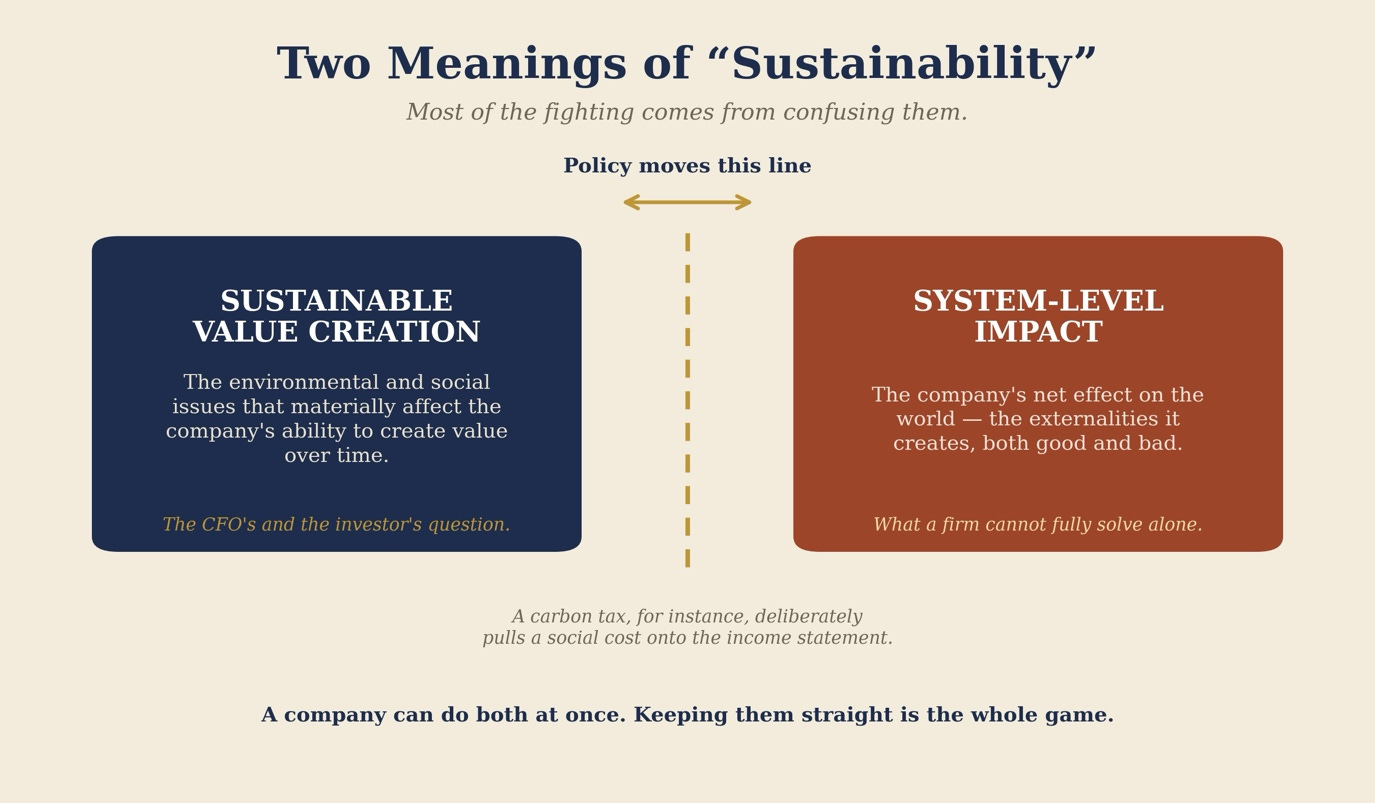
But it’s this confounding of the two meanings of sustainability, replete with sustainability reports filled with the icons of the Sustainable Development Goals, that provided the foundation for critics on the right to say that companies were forsaking shareholder value creation to make the world a better place. In a progressive, left-wing sort of way, of course. But rather than have an honest and important debate about the appropriate roles of the public and private sector for the two meanings of sustainability, Republican politicians saw a political opening handed to them on a platter and grabbed it and kicked down the door. (Admittedly mixing metaphors.)

The Republican Assault on ESG
A 2024 report from Pleiades Strategy shows that between 2021 and 2024 Republican law makers in 38 states introduced 318 pieces of anti-ESG legislation which resulted in 37 pieces of legislation in 17 red states. Both 318 and 37 are important numbers. The fact that only about 10% of these bills passed illustrates the lack of any economic rationale behind them and many of these bills were opposed by red state business groups. But the sheer volume of this proposed legislation generated enormous attention and succeeded in framing a narrative completely contrary to ESG’s original intent—which was about material issues relevant to sustainable value creation. Trump provided some rhetorical wind to the red states’ anti-ESG sails but, as is his custom, no economic rationale.
But it wasn’t just laws. Lawsuits were also a part of this concerted and coordinated anti-ESG campaign. Thirteen Republican attorneys general sued BlackRock, State Street, and Vanguard, alleging an antitrust “climate cartel.”
Then came the election. On his first day back in office, President Trump moved to withdraw the United States from the Paris Agreement, and his administration skipped the COP30 negotiations in Brazil. He signed EO 14151 on January 20, 2025, to dismantle Federal DEI programs and the next day issued EO 14173, “Ending Illegal Discrimination and Restoring Merit-Based Opportunity,” which directed agencies to discourage and investigate private-sector DEI.
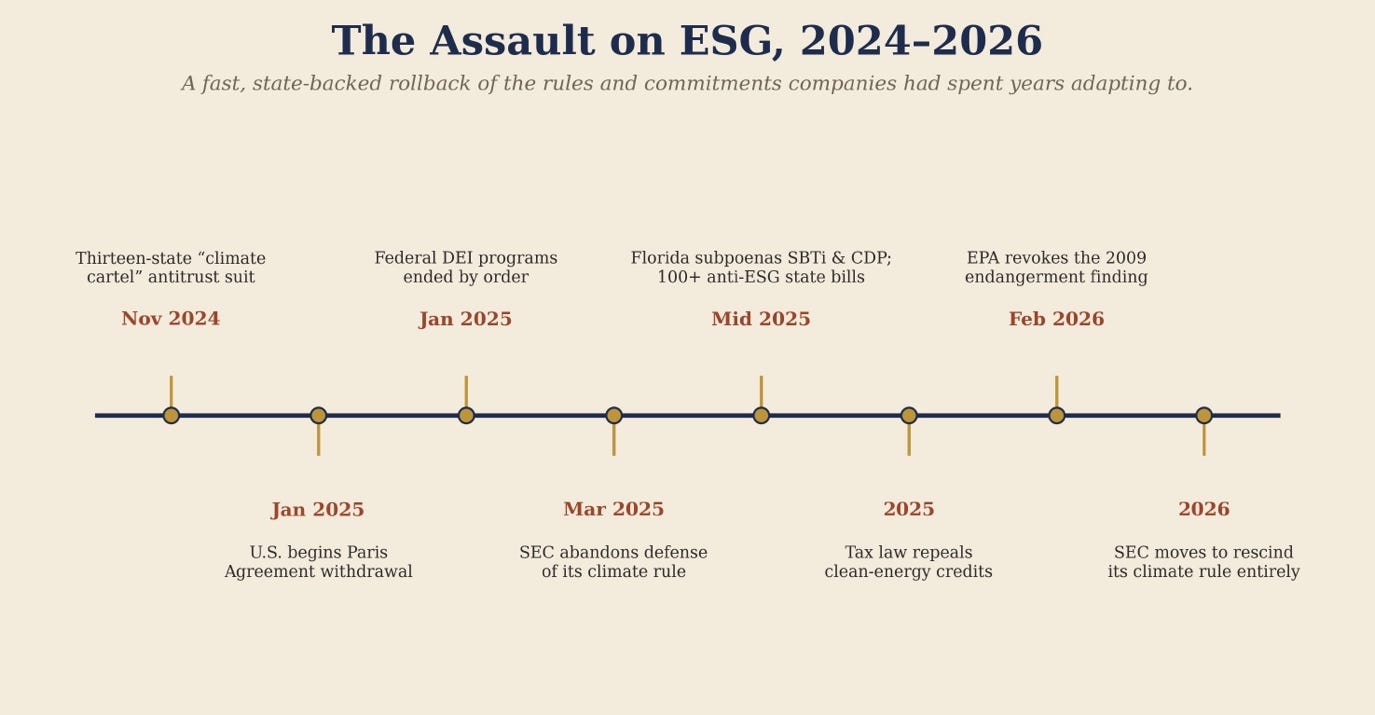
The SEC, having adopted a climate-disclosure rule in March 2024, voted in March 2025 to abandon its defense of that rule in court and has since moved to rescind it entirely. In February 2026 the EPA finalized the revocation of the 2009 endangerment finding—the legal foundation for federal greenhouse-gas regulation—a step its administrator had earlier described as driving “a dagger straight into the heart of the climate change religion.” The administration claimed the rollback would save $1.3 trillion, a figure resting heavily on new-car sticker prices and conspicuously quiet about the fuel savings drivers forgo. And the 2025 tax law repealed or phased out the clean-energy credits that had underwritten the transition.
Red states continued to pile on. Indiana hit BlackRock with a fifty-four-count cease-and-desist order. Florida’s attorney general subpoenaed the Science Based Targets initiative and CDP.

Going Quiet but Not Going Away
Much sound and fury from the right about a definition they’ve given to ESG for political purposes. Faced with all this aggressive blather from elected public officials, most companies went quiet. You can say this was rational. Our view is that if their work in sustainability had been more grounded in financial performance, they could have stood stronger. But we are where we are.
The result is not a disaster for sustainability. It is a real blow but not a fatal one. An EcoVadis survey of large U.S. firms found nearly half kept sustainability investment unchanged and roughly a third were investing more while promoting it less. A Deloitte survey of some 2,100 executives found 83 percent had increased sustainability investment year over year. And an analysis in Harvard Business Review of 75 global companies found only about 13 percent had publicly retreated, while roughly 85 percent held steady or accelerated—often under cover of darkness. What collapsed was the talking. GlobeScan found only 36 percent of consumers saw any brand sustainability messaging in 2025, down from 49 percent two years earlier.
Restoring communications is relatively easy if there is substance to be communicated about. Institutional degradation of the sustainability function has made this a challenge. ERM reports that a late-2025 analysis found the CSO role downgraded at 220 U.S. companies since the start of the year. Yet according to The Weinreb Group’s 2025 CSO report, 90 percent of CSOs say they haven’t changed their underlying approach vis à vis the political landscape, even as a quarter quietly dial back what they say. The work is mostly still getting done, but by fewer people and with less status and fewer resources.
Some of the quiet makes sense. While we are dubious about the motives of the Republican pushback, it turns out to have been a gift. Companies let enthusiasm for sustainability get ahead of economic logic. There was a lot of happy handwaving that “We are creating long-term value for our shareholders by taking care of the needs of all of our other stakeholders!” The existence of tradeoffs was ignored. Bold targets were set with no clear view for how to accomplish them. So going quiet to reflect and become more rigorous makes sense.
Strange as this may sound, ExxonMobil provides a model worth looking at in terms of rigor, analytical clarity, and not overpromising. Sustainability is a tab on the company’s main page. On May 5, 2026, it published a 79-page Sustainability Report filled with data and links to many other documents (e.g., taxes, managing socioeconomic impacts, workforce development, and working with suppliers) which include quantitative and qualitative information. On the same day it published a 20-page Advancing Carbon Solutions Report. Before being too cynical since it’s ExxonMobil, look at these reports. We aren’t saying they’re perfect. But we do want to flag that ExxonMobil has stuck to its guns while the political theater merrily carries on.

Bucking Up
When you can demonstrate the link between sustainability performance and financial performance staying quiet isn’t necessary; it’s actually irresponsible. By law public companies have to report on their financial performance and for those filing a 10-K or 10-F also on risk factors (Item 1A) and a Management Discussion and Analysis (MD&A). When material sustainability issues matter to financial performance and are discussed in Item 1A and the MD&A, management needs to be as clear and candid about this as possible. Our methodology enables it to do so. Yes, there are estimates and uncertainties. Financial accounting is filled with both. And progress in developing standards for sustainability reporting from the International Sustainability Standards Board (ISSB) and EFRAG’s Sustainability Reporting Board (SRB) will improve the quality of this information. Take all of this together and we have what one of us (Rajgopal) has called Integrated Reporting 2.0.
Thanks to AI when used by humans with domain expertise and judgement, we can make integrated reporting real. In a previous post summarizing our book we described the essence of how this is done. Understand the company’s business model. Map disclosed risk factors in the 10-K/20-F to a sustainability framework such as SASB’s (others can be used). Determine which ones are missing from the company’s reporting and which ones are not included in the framework. Use human judgment to settle on the list of material issues. Use AI to map these issues to line items in the income statement, balance sheet, and cash flow statement. Use AI again to estimate the financial effects with a distribution and confidence level. This analytical work becomes the basis of internal resource allocation decisions regarding sustainability initiatives and the company’s external integrated reporting.
Let us be clear. In disclosure parlance, we are completely focused on financial materiality—those sustainability issues that matter to shareholder value creation. While our methodology can assess the negative externalities a company is producing, it does not provide a real assessment of the consequences at the system level, or impact materiality. We are now exploring this by expanding our approach to measure stakeholder value added. This is much harder since the needed information is of less quality even when it is available and often it is not.
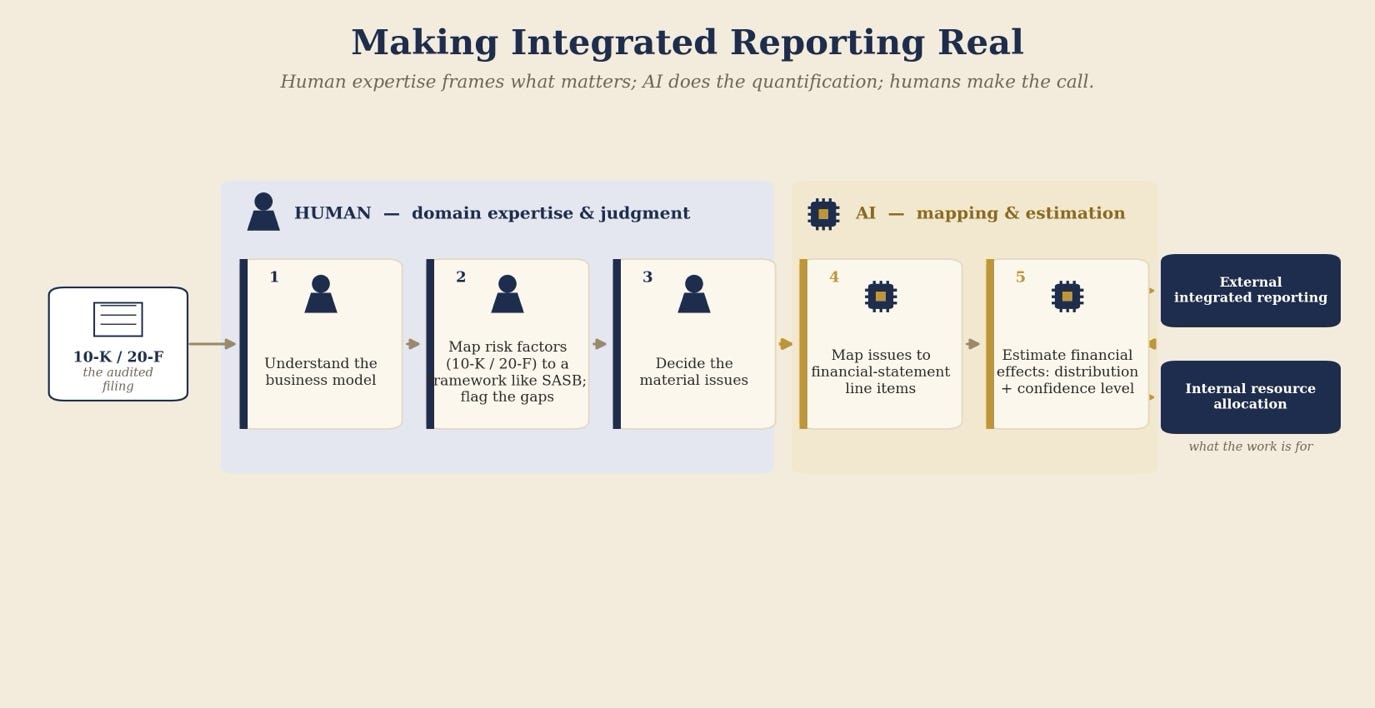
The analytics are pretty straightforward. As always, humans are both the success and gating factors. To implement what we are recommending, CSOs need more knowledge and more resources. The knowledge they need includes a deep understanding of the industry they are working in, the company’s strategy, and its business model for creating value. The best ones do. Most don’t. They are subject matter experts in a sustainability domain. This is important but it’s not enough to show how sustainability contributes to sustainable value creation. CSOs also need a baseline of financial literacy and not see this as a domain completely handled by the finance function. The test here is whether the CSO could explain to an investor the company’s sustainable value creation strategy without anyone from IR being in the meeting.
CSOs also need more resources and it’s easy where to find them. The finance function. The political theater hasn’t touched this function at all. The finance function has both the resources and the expertise to produce high quality sustainability information for external reporting and can do so in the 10-K/20-F with supplementary information being given in other reports. Capital allocation ultimately resides in the finance function, and this is where the rubber meets the road for sustainable value creation. We are seeing companies where the CSO is reporting to the CFO. We aren’t saying this is the only appropriate reporting relationship. What we are saying is that the necessary tighter integration between sustainability and finance—which also means finance folks need sustainability literacy—is how to solve the resource problem.
Companies now have a fabulous opportunity to change the narrative about sustainability that is analytically grounded and impervious to politics. Don’t waste it. The time has come for them to go on offense and clearly and confidently report and explain their sustainable value creation strategy by integrating information on financial and sustainability performance. CSOs have a fundamental role to play here. They just need to buck up. Get the knowledge. Get the resources. Get on with it.
Interesting, we need to discuss!