

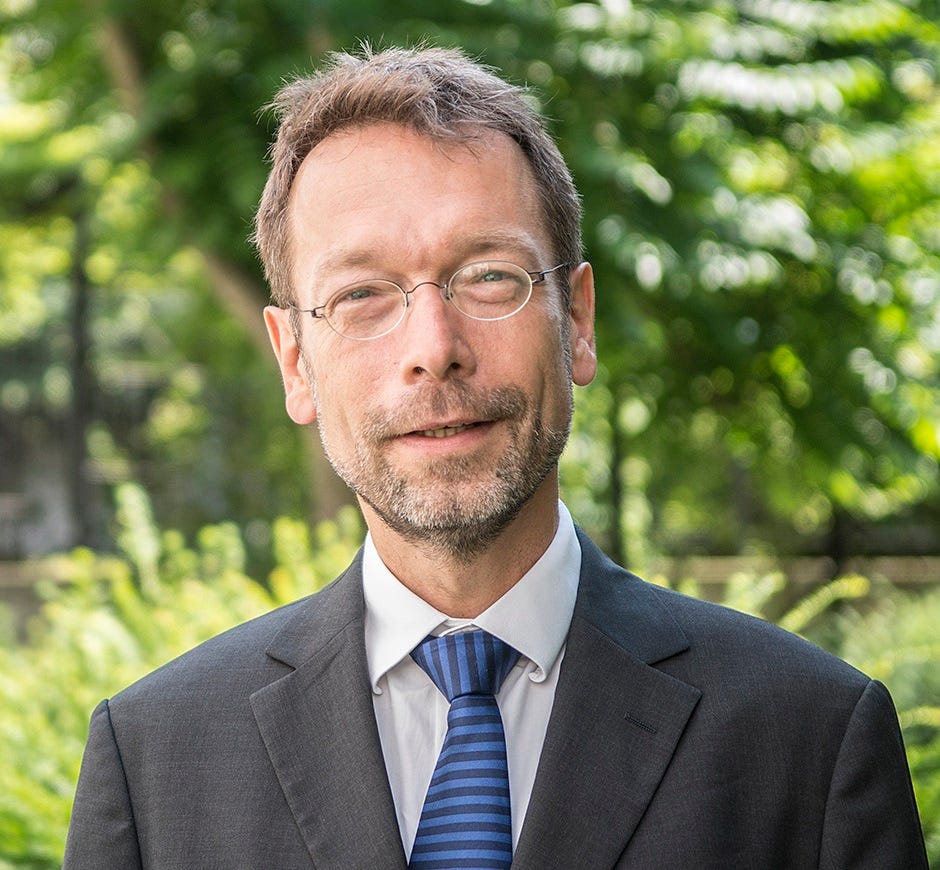
This is a guest contribution by Dr. Ulf von Kalckreuth
A note to the reader: It is time to return to our strengths! This blog post discusses religion and climate change on two levels that need to be clearly distinguished. First, I argue that religion has the potential to overcome even the most extreme externalities, because it can internalize the effects of what adherents do to others and facilitate coordination across dispersed actors even without contractual, legal, or financial incentives. To make this argument, one does not need to take any position on supernatural realities. Second, I discuss how this potential may operate within Christianity. This is not meant to be representative of other belief systems. From the perspective of the first part, it is an example, a proof of concept. The argument therefore needs to be complemented by views from other belief systems.
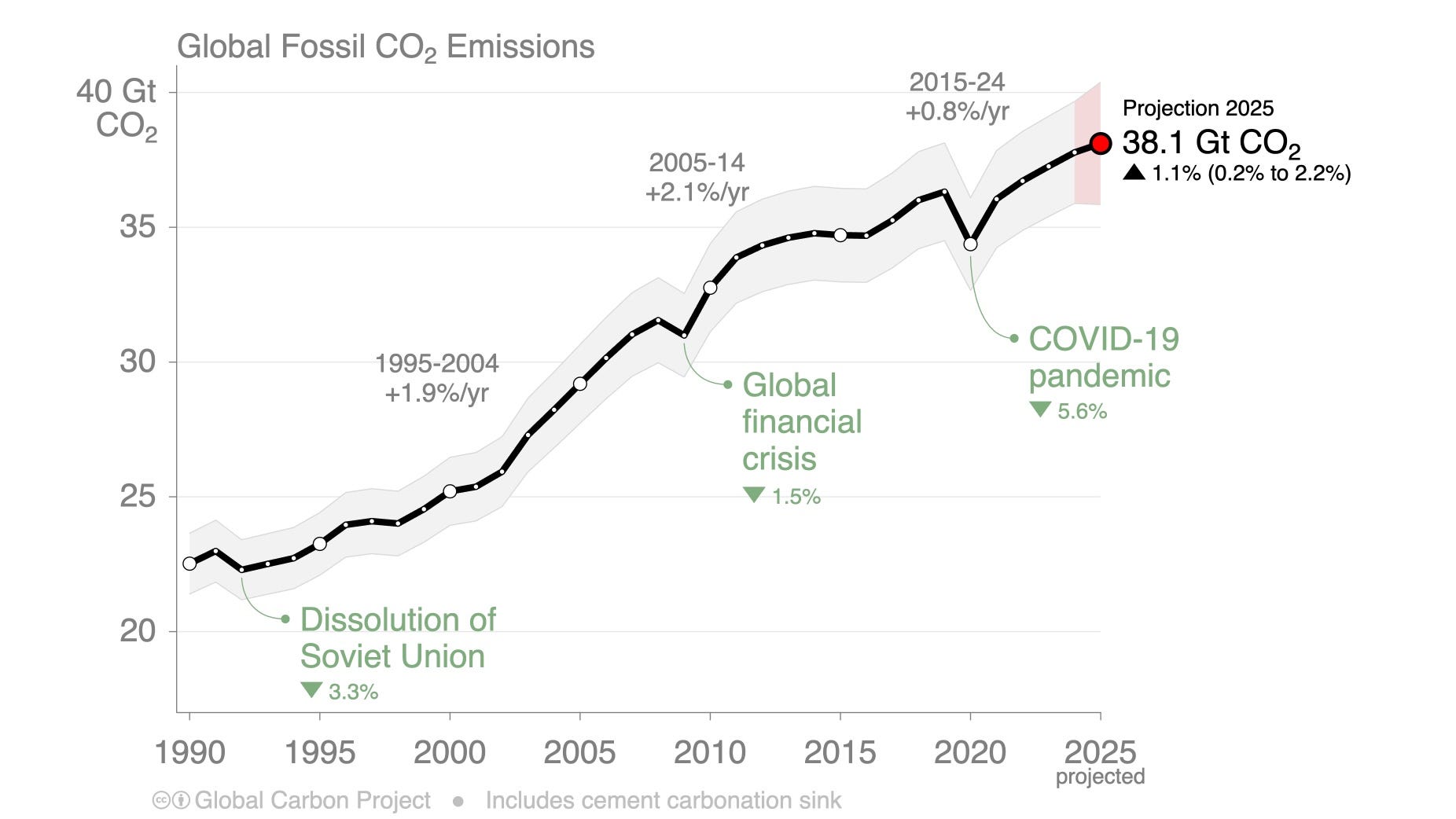
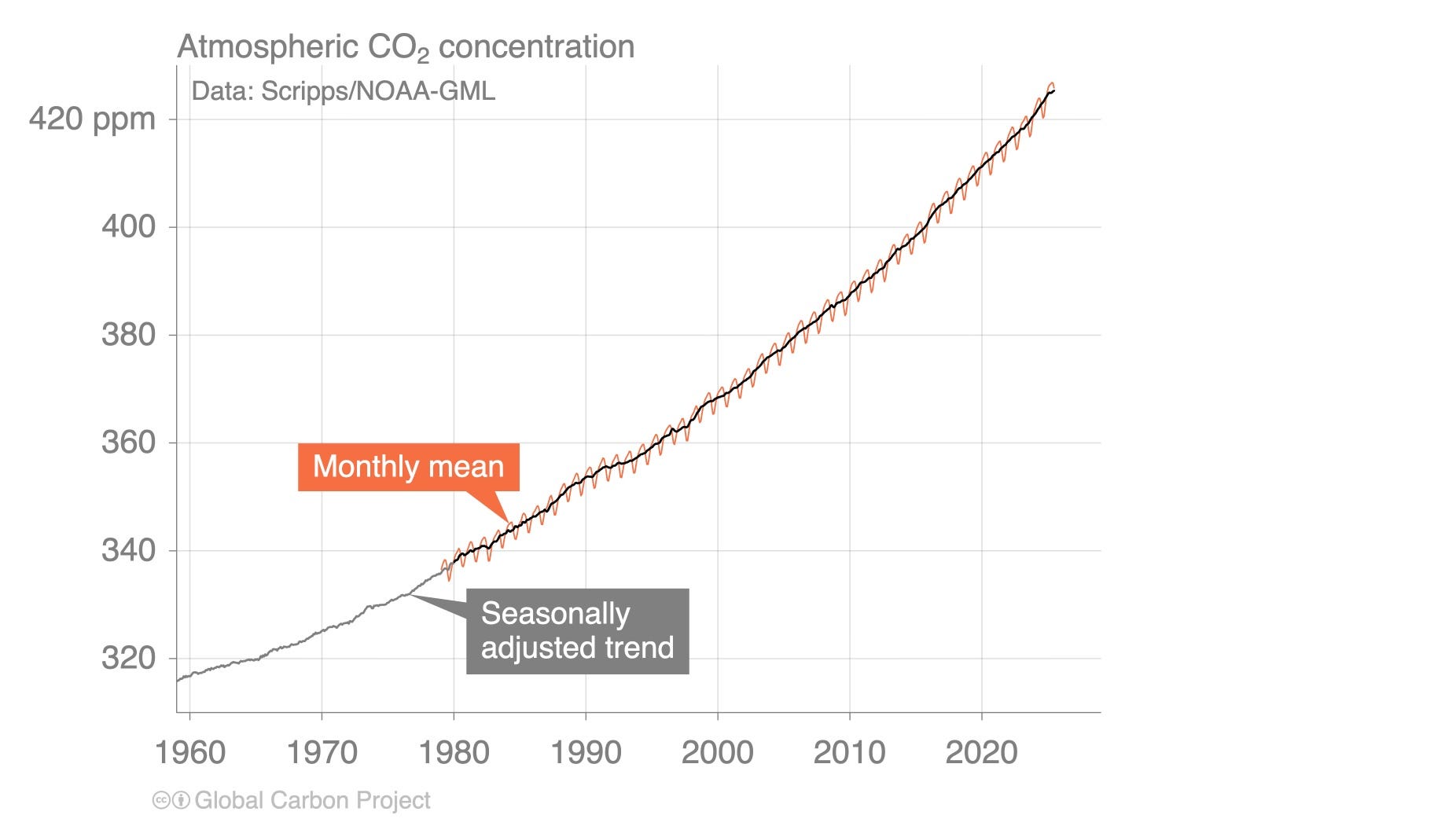
To start, I would like to look briefly at two graphs[1] that many of you will know: the evolution of the global fossil fuel emissions, in gigatons (Gt) of CO2 and the atmospheric CO2 concentration, in parts per million (ppm). The emissions graph shows the annual flow into the atmosphere; the concentration graph shows the accumulated results. Atmospheric CO2 concentration has been increasing steadily and smoothly, with a slight acceleration that reflects the rising emissions, and seemingly unperturbed by all discussions about climate change and mitigation!
Looking at the concentration graph, forecasting the next decade or two appears easy. In its simplicity and clarity, it looks almost beautiful. Yet it is hard to think of anything more frightening.
Climate change is not only a technical challenge. It is perhaps the most difficult coordination problem humanity has ever faced.
The problem is not that we do not know enough. We know a great deal. We know that carbon dioxide and other greenhouse gases warm the planet. We know that the effects are global and long-lasting. We know that a rapid transition away from fossil fuels would probably create very large net benefits for humanity, even if the transition is costly. We know that the costs of inaction will grow. And yet global emissions remain stubbornly high.
Why?
Emission reduction is costly, on many levels and for almost everybody involved.[2] But many important things that get done are costly.
The deeper answer is: because carbon emissions — and their reduction — are an almost perfect externality.
An externality exists when my action affects others, but I do not fully pay for the damage I cause or receive the benefit I create. If I burn fossil fuel, the benefit is mine: heat, mobility, production, profit, comfort. But the harm is spread across the whole world and across future generations. Almost none of it comes back to me personally. If I avoid emissions, I bear the cost myself, while the benefit is spread across billions of people, countless living creatures, and many generations.
This makes climate change different from many other environmental problems. If a factory pollutes a local river, a government can regulate it. If noise harms a neighborhood, a city can set rules. If traffic creates congestion, public authorities can tax, restrict, or invest. In these cases, the externality may be sizeable, but it is still roughly within the reach of a state or municipality.
Carbon is different. It crosses every border. It stays in the atmosphere for centuries. Its effects are planetary. No national government has the same reach as the problem itself. Even the largest countries internalize only a fraction of the benefits of their own climate action. Smaller countries internalize almost none. This means that governments face the same temptation as individuals.[3] Why pay the full cost of reducing emissions if most of the benefit goes to others?
This is the familiar tragedy of the commons[4] — but on a planetary scale.
The Limits of Contracts and Institutions
Economists know several ways of dealing with externalities.
One is regulation: prohibit harmful behavior or require better technology. Another is taxation: make the polluter pay. Long ago, Arthur Cecil Pigou (1920) told us exactly how much: If the tax is equal to the marginal social damage, the externalities are internalized and the resulting allocation is efficient. A third is bargaining. This solution is associated with Ronald H. Coase (1960). If the affected parties can negotiate and enforce agreements, they may find a mutually beneficial solution on their own. These tools are powerful. But they all require institutions with enough authority to define rules, monitor behavior, and enforce compliance at the relevant scale.[5]
For climate change, this is precisely the problem. There is no world government. International treaties exist, but they are difficult to enforce. Countries can promise, delay, reinterpret, withdraw, or free-ride. Even if political leaders are sincere, they face voters, firms, interest groups, and crises at home. When energy prices rise, when jobs are threatened, when growth weakens, climate commitments become politically fragile.
This does not mean climate policy is useless. National and regional policies matter greatly. Carbon pricing, regulation, green investment, innovation, and climate finance are essential. Over the last decades, the carbon intensity of output has diminished considerably. Falling renewable-energy costs and technological innovation are essential and encouraging. But technology does not decide who pays, who moves first, and how commitments survive political resistance. The basic incentive problem remains unresolved. Each actor would prefer others to move first, pay more, and carry the burden.
This is why climate change can feel like a trap. We can see the danger. We can calculate the benefits of action. We can design policies. But we lack a fully effective mechanism to coordinate costly action at the scale and speed required. The problem is also one of justice: those who contributed least to climate change often suffer most from it, and future generations cannot bargain with us at all.
So the question becomes: What can make human beings and societies act for a benefit they cannot fully capture themselves?
Religion as a Coordination Technology
Here religion enters the picture.
I am not talking about religion as a particular creed, or as a substitute for science. I mean religion in a social and historical sense: as one of humanity’s most powerful ways of creating shared meaning, shared norms, shared values, and shared obligations among people who are not personally connected.
Human beings are unusual animals. We can cooperate in very large groups with strangers. We do this through shared stories, symbols, institutions, rituals, and moral commitments. In his book Sapiens: A Brief History of Humankind, Yuval Noah Harari (2014/2015) has argued that this capacity to believe in shared realities — including religious realities — may be one of the evolutionary advantages of homo sapiens. Religion has helped human beings coordinate beyond kinship, beyond the small tribe, and beyond immediate reciprocity.[6]
This is the kind of capacity climate change requires.
All over the world, we see people who adhere to their beliefs and traditions despite severe persecution — Jews, Muslims, Christians, and others. Many of them are intelligent, well-educated people. They know the costs, and they consciously decide to bear them.
Religion can do something that contracts and markets mostly cannot. It can make people act according to obligations without immediate reward. It can create duties where there is no policeman. It can make invisible consequences morally visible. It can connect private behavior with a larger order of meaning.
In economic language, religion can help internalize externalities. It can make the well-being of others — distant others, future others, and even non-human others — part of the moral horizon of the acting person.
This works in several ways. First, religion gives authority to norms. Some actions are not merely inefficient or unfortunate; religion classifies them as wrong, as forbidden. Second, religion creates communities in which norms are taught, repeated, embodied, and sometimes sanctioned. Third, religion reaches the inner life: guilt, gratitude, reverence, hope, repentance, love. Fourth, religion can stretch the moral imagination beyond the visible present. It can make the future, the stranger, and the whole of creation matter now.
None of this requires one world religion. That would be neither realistic nor desirable. The point is different. If several religious traditions can develop, from their own foundations, an ethic of preserving the conditions of life, then a shared global effect may emerge without a single shared theology.
I will later show that Christianity can do this. But Judaism, Islam, Buddhism, Hinduism, and other traditions may do it in their own and independent ways. The necessary agreement is not doctrinal. It is practical and moral. The destruction of the biosphere is not compatible with faithful living.
Religion Can Fail
Of course, religion does not automatically deliver good results. There is no shortage of counterexamples. Religion can support destructive equilibria as well as constructive ones. It can define outsiders as enemies. It can sanctify domination, passivity, fatalism, or denial. Religious communities can be captured by politics, money, nationalism, or resentment. They can become part of the problem.[7]
This is an important warning. The claim is not that religion always solves coordination problems well. The claim is that religion is one of the few human capacities strong enough to solve problems of this type at all.
This does not mean that secular moral traditions are irrelevant. Human rights, civic duty, scientific responsibility, and philosophical ethics can all support climate action. My point is that religion is one of the deepest and most widely available sources of such moral coordination.
A purely individualistic ethic is too weak. A purely national framework is too small. A purely contractual approach lacks an enforcer. A purely technocratic approach may know what should be done but cannot make societies accept the cost.
Religion, at its best, changes what people want, what they see, and who they understand themselves to be.
That is why it matters.
Emission Control and Church Financing
Have you ever wondered how churches survive financially? It is worth asking. If you think about it, restricting emissions is like paying taxes. Taxes are for the common good, but only a small part of what you pay will be for your own benefit. Very few people donate to their governments. To overcome this externality problem, governments need to enforce taxes.
Churches do not seem to have that need, at least not in principle. Most churches live from voluntary contributions of their members. One prominent exception is Germany, where the two mainstream churches are financed by a church tax collected by the state from registered church members.
People believe that the works of the church are important, and they know that contributions cannot be imposed and the responsibility is with them – and they pay! There may be lots of micro-level nudging and social pressure going on, and there may not be enough money in the end, but the outcome itself is striking and telling.
The analogy may not look perfect. Churches are communities, and contributors often receive belonging, recognition, and meaning in return. But that is precisely the point: religion can transform a contribution to a common good into part of a shared identity.
Religion as a “Game Changer”
In history, religion has proved to be a powerful driver. Joseph Henrich (2020) has argued that Western Christianity helped reshape family structures, social psychology, and institutions in ways that contributed to the distinctiveness of Western societies.
Game theory studies how social outcomes can emerge from strategic interactions among “players” who act rationally and whose objectives may or may not be aligned. Looking at religion through the lens of game theory, we can see several fundamental ways in which it can shape social outcomes.
The first and most direct is this: If people believe in a divine king who abhors certain acts, observes them, and stands ready to punish, these beliefs will modify their internal payoff matrix – that is, the perceived costs and benefits of their choices – in a straightforward way. The effect is reinforced if, as part of religion, the same people feel the obligation to punish deviant behavior by others. Adultery or theft may pose a temptation. The temptation vanishes if the expected punishment – from God or in his name from others – is harsh enough. The word of the Lord can make the tragedy of the commons disappear.
“Watched people are nice people”, says Ara Norenzayan (2013) in Big Gods.
Most of us do not live in a theocracy, and most of us would not wish to. But religion can be much more subtle. Samuel Bowles’s (2016) book The Moral Economy presents convincing evidence that people do not only care about their own payoff, but also how payoffs are distributed within their social group. In other words, people care not only about what they receive, but also about whether they are acting fairly and whether others are doing the same. Bowles speaks of social preferences. People understand that there can be a trade-off between individual outcomes and social outcomes. Human beings are social animals, and we like to be on the “good side” – to cooperate, when everybody else is cooperating. What we do not like is to cooperate when others are defecting. In that situation, it feels better to be a defector, too.
Imagine that the general pattern is this: people are willing to help save the planet, but only if others do the same. They do not like to pay the cost of cooperation, with nobody there to cooperate with. In that situation, what we will do depends very much on what we expect others will do. In a two persons game with social preferences, there can be two equilibria: both players are defecting and both are co-operating. Whether or not players will defect depends on the strength of their social preferences and on their beliefs regarding the action of others.
I argue that religion can help coordinate on the “good” outcome. First, religion encourages us to look at the social dimension of outcomes. Second, religion gives a clue about what to expect from others. It helps to build trust.
“Trust people who trust in God”, says Ara Norenzayan (2013), rather pointedly.
If I know that the other person is an adherent of a religion that values cooperation highly and puts emphasis on the preservation of nature, the two of us can coordinate on the better equilibrium, without enforcement and even without communication. I know that if I choose to defect, the probability is high that the other would have been willing to cooperate and I will be the one who spoils the game. In game theoretic terms: cooperation will be the focal point where we can meet.[8]
This mechanism allows people to build cathedrals and hospitals all over the country and mission stations all over the world. It is powerful, and it may help to deal with the carbon challenge. If I know that the other person believes in God and that God mandates preservation, I will have trust in the other one’s action. It is enough to sense the other’s obligation. Even if we do not believe in the same God!
Robert Putnam and David E. Campbell’s (2010) book American Grace shows how much of America’s social capital depends on religiosity, and that social interaction, rather than specific theological beliefs, drives the effect of religion.
Finally, to the degree that religion makes us see the needs of others, it may transcend and overcome the logic of individual rationality entirely. What happens to those others will become relevant for us, and the effects of our actions on them will be part of our payoff. In the extreme case, if we consider all effects of our actions and take them into account, externalities will cease to exist! They are internalized, like under optimal taxation.
As in the case of the divine king, the tragedy of the commons disappears. This time because of solidarity, not because of fear.
Love as the End of Externality
I am a Christian, so I can best show the idea from within Christianity. What follows may serve as an example of why love of life and creation can be a natural part of religion-based ethics.[9] I do not intend to evangelize. If a fellow Christian draws inspiration from what I am writing, that is more than welcome, and much of it will generalize anyway. The next paragraphs loosely follow a sermon I was invited to give at the Church of the Nazarene in Frankfurt, Germany in February 2026.
At the center of Christian ethics stands a double commandment. Jesus was born a Jew, and he lived his life as a Jew. When he was asked about the greatest commandment in Jewish law, he answered that there are two:
· “You shall love the Lord your God with all your heart, and with all your soul, and with all your mind.”
· “And you shall love your neighbor as yourself.”
He presents this as the heart of the law.
From the perspective of economics, the second commandment is astounding. “Love your neighbor as yourself” is a direct instruction to overcome externalities. If I love my neighbor as myself, I will not ignore the harm my action causes to another person simply because the harm does not fall on me. I take his loss into account as if it were my own. I do not need a contract to force me to consider him. I already do.
Of course, Jesus does not mean only the neighbor I like, or the neighbor who belongs to my group. In the parable of the Good Samaritan, the neighbor is the outsider, the stranger, even the traditional enemy. Christian love expands the circle.
Climate change forces us to expand it still further. My neighbor may live in Bangladesh, Kenya, Brazil, or the Pacific islands. My neighbor may not yet be born. My neighbor may be a child in the year 2150. My neighbor may also be part of God’s non-human creation: animals, forests, oceans, and the living world that does not speak in our political assemblies but suffers the consequences of our choices.
Christianity does not say, “Love only those whose suffering you can see.” It says, “Love as God loves.”
Creation is Not Disposable
The Bible begins with creation. The world is not described as raw material without meaning. It is called “good.” Human beings are placed within creation, not outside it. They receive responsibility.
After the flood, God makes a covenant, not only with Noah and his descendants, but with “every living creature.” The sign of this covenant is the rainbow. It is a promise of preservation. God binds himself to the continuity of life on earth.
This is a powerful image for climate ethics. The rainbow is a sign of self-limitation. God has power, but God promises not to use it destructively. With that rainbow, the preservation of life becomes part of the divine order.
If Christians believe that the earth is God’s creation, then the atmosphere is not a free dumping ground. The biosphere is not merely an input into production. It is part of a world loved by God.
The Holy Spirit and a Larger “We”
The climate problem is so difficult because we remain trapped in a narrow “I.” What do I gain? What do I pay? What happens to my comfort, my income, my country, my industry?
Christian faith offers another perspective. The Holy Spirit connects. The Spirit creates communion — with God, with other people, and with creation. In this perspective, the self is not erased, but it is opened. I become part of a larger “we.”
This matters politically and economically. People act differently when they believe they are not alone. If I think everyone else will continue as before, my sacrifice feels pointless. If I believe others are also committed, my own action becomes part of something real. Religious communities can create this expectation. They can be laboratories of trust.
This is why churches and other religious communities are important. Faith lived alone in the forest may be beautiful, but it does not coordinate society. Communities teach, repeat, celebrate, correct, and encourage. They make moral commitments visible.
Jesus tells his followers: “You are the salt of the earth” and “the light of the world.” Salt is small, but it changes the whole dish. Light is local, but it can be seen. A Christian community that lives a preservation ethic will not save the planet by itself. But it can show that another form of life is possible.
What Would a Christian Preservation Ethic Require?
A Christian preservation ethic would not begin with guilt. It would begin with love, gratitude, and responsibility.
It would say:
· The world is creation, not possession.
· Future generations are our neighbors.
· The poor and vulnerable, who often suffer most from climate change, have a special claim on us.
· Freedom does not mean the right to destroy the conditions of life.
· Self-limitation can be an expression of love.
· Hope is not optimism; it is faithful action even when success is uncertain.
This ethic would affect individuals, but it would not stop with private lifestyle choices. It would speak to firms, investors, governments, churches, universities, and international institutions. It would support serious climate policy, not replace it. It would make carbon pricing, regulation, innovation, and climate finance easier, politically and morally.
The aim is not to moralize every detail of daily life. The aim is to change the background understanding. High emissions are not normal, neutral, or merely unfortunate. They are a form of harm. Avoiding them is not only prudent policy. It is a form of loving one’s neighbor and preserving God’s creation.
No Common Religion Required
If this can be developed within Christianity, similar work may be possible in other traditions. The language will differ. Metaphysics will differ. The rituals and authorities will differ. But the practical direction may converge. It is heartening to look at the Islamic Declaration Al Mizan – A Covenant for the Earth based on the Qur’an and hold it against Laudato Si´ by Pope Francis.
We do not need one global religion to address climate change and the destruction of the environment. We need the many existing religious and moral traditions to activate their deepest resources for preserving life.
Carbon emissions and climate change are an almost perfect externality. They escape the reach of ordinary incentives. They expose the limits of markets, states, and contracts. But human beings have another capacity: the capacity to live by shared meaning, to accept obligations beyond calculation, and to become part of a larger whole.
That capacity has often been carried by religion, for better and also for worse.
It may now be needed again.
The question is not whether religion can replace economics, science, or politics. It cannot. The question is whether economics, science, and politics can succeed without a moral and spiritual transformation deep enough to overcome the externality trap.
For Christians, the answer begins with a commandment: Love God and love your neighbor as yourself. If we took this seriously, the climate problem would not disappear. But its deepest obstacle — the separation between my benefit and your harm — would begin to lose its power.
What Do we Need from Religions?
We must deal with climate change based on what we have: the nation states, our cultures and the religions, as they have developed over history. Faith has a very strong potential. What is needed to unfold it?
First and most of all, we need credible commitments to the value of creation in the name of faith. Commitments in ways that are fitting and suited to each of them. These commitments must be preached, promoted and reinforced vertically, from religious authorities to local communities, and horizontally, among community members themselves. It must become clear to everyone, insiders and outsiders alike, that religious identity carries these commitments.
Credibility will require specific activity. Faith-based organizations will have to decarbonize buildings in religious use, align their investments with preservation, support just climate policies, educate children and adults, and join interfaith initiatives where common ground exists.
As to the last point, some very important steps have been taken already. One is the work of the Alliance of Religions and Conservation (ARC) founded by the late Prince Philip, Duke of Edinburgh. The mission of ARC has been completed, and part of the foundation’s work is continued by FaithInvest. Between 2017 and 2025, the Faith for Earth Coalition,[10] supported by the United Nations Development Program, engaged in the exchange between faith-based organizations. Meanwhile, the work has been transitioned to localized and regional interfaith networks. An important outcome is the Al Mizan Declaration mentioned above. The WWF’s Faith and Nature Hub collects and shares faith-based projects and mission statements. Ultimately, the Yale Forum on Religion and Ecology,[11] is a rich platform that strives to find, describe, and promote common ground between religions.
It is time to return to our strengths. To escape from the trap of individual rationality, we need the shared knowledge that we are part of something greater than ourselves as individuals. This shared knowledge may have a name: awe. It is up to us to build it — in ourselves and in our communities.
Climate change is a challenge. But in the end, instead of destroying our culture, climate change may make us heal it.
The Author
I am Principal Advisor in the DG ‘Data and Statistics’ of the Deutsche Bundesbank in Germany, working on statistical concepts, methodological innovation, international coordination and research.
My commitment to carbon accounting and carbon statistics started in 2020, with a research paper published in 2025. It describes product level carbon accounting as cumulative information processing driven by information exchange between producers. I show that the system performance can be well described using the analytics of Input-Output economics, and that a system of product level carbon content indicators will converge to the true values under rather general assumptions, even if the initial values are off the mark. Further work looks at aggregate indicators of carbon content and the carbon content of portfolios, from the perspective of statistics. I helped organize the 2024 Hamburg conference on carbon content measurement.
Earlier, I directed the Corporate Balance Sheet Statistics and I coordinated the implementation of an integrated micro-data based information and analysis system (IMIDIAS), designed to serve as a hub for micro data in the Bundesbank – both externally and internally. In the Research Department of the Bundesbank, I set up the German PHF, a large scale panel survey on household finance.
In 1998, I entered the Deutsche Bundesbank, having completed my PhD studies at the University of Mannheim. Ten years later, I received a habilitation degree in Economics from the same university. Apart from carbon accounting and statistics, my research involves theoretical and empirical work on household and firm behavior, specifically issues related to corporate finance, household finance, investment, development, innovation, the distribution of income and wealth, as well as studies of the monetary transmission process. Here is a website focusing on my scientific work.
I live in Frankfurt, Germany, with my wife and two daughters. Apart from these three, I love music — singing and playing the guitar, the piano, and the Arabic oud. I am engaged in the music team of my church congregation. I love languages, they are the mind’s window to the world. In decreasing order of proficiency, I know German, English, French, Portuguese, Spanish and Hebrew, both old and new. And I love the Bible. Have a look at this fascinating project: Every week I draw a verse of the Bible at random, and I do my best to make sense of it.
An Endnote
This post represents my personal opinions and does not necessarily reflect the views of the Deutsche Bundesbank or its staff. Interpersonal exchange was decisive for all aspects of this text. I am grateful to many people I had the chance to talk with, including my own local church community and the participants in a course on Economics and Climate Change at the Deutsche Bundesbank. Special thanks go to Tony Cox, Robert Eccles, Sandra Eickmeier, Angela Lahee, Francesco Mongelli, Karl Richter, Mark Weth, and no less than three protestant pastors: Simon Grunwald, Wolfgang Schwarzfischer, and my wife! An initial closed form was generated by giving ChatGPT a brief outline and a large pile of communications to other people, much of it in German language. ChatGPT also helped with language editing. Ultimately, I want to thank the Lord for the initial idea and the perseverance to follow it.
[1] CO2 concentration: Globally averaged surface atmospheric CO2 concentration, data from: NOAA-GML after 1980; Scripps Institution of Oceanography before 1980. Sources for both graphs: Friedlingstein et al 2025; Global Carbon Project 2025, used with permission of the Global Carbon Project under the Creative Commons Attribution 4.0 International license.
[2] A heavily cited report, IPCC (2022), Mitigation for Climate Change, Summary for Policymakers, Section C12.2, concludes that limiting global warming to 1.5°C by 2100 could decrease global GDP by 2.6% - 4.2% by 2050, compared to a scenario where climate policy is limited to the policies already implemented. These figures do not include the effect of mitigation on GDP. The loss is sizeable; it is commensurate to global expenditures for defense. It is the result of a long accumulation process, though. Average annual GDP growth would be lower by 0.09 to 0.14 percentage points over the time horizon. In both scenarios, estimated real global GDP will be more than twice of what it is in 2020. The damage of climate change to GDP are widely considered to be larger. Bilal and Känzig (2024) estimate that, with a worldwide temperature of 2°C higher than 2024, GDP could be around 30% lower by 2100 compared to what it would have been under current temperatures. This results from losses to annual growth of the order of 0.35 percentage points in the course of the time horizon.
[3] For an encompassing treatment of the difficulties associated with international environmental agreements see Scott Barret (2005) and (2007). The key problem is that no one is there to enforce contracts or punish non-compliance.
[4] The name was coined by Garrett Hardin (1968), who generalized an idea that is much older.
[5] Institutions may well emerge endogenously. Elianor Ostrom’s Governing the Commons (1990) investigates how, in the face of externalities individuals can form institutions that are neither state nor market. Her work won her the Nobel Prize. But self-governance will always need monitoring and enforcement.
[6] In his book Darwin’s Cathedral: Evolution, Religion, and the Nature of Society, David S. Wilson (2002) considers religion as a group level adaptation. In a similar vein, with A Cooperative Species. Human Reciprocity and its Evolution, Samuel Bowles and Herbert Gintis (2011) consider reciprocity and altruism among human beings as the outcome of genetic and cultural coevolution on the group level.
[7] It has been forcefully argued that Christian religion is indeed one of the root causes of the ecological crisis. See the classical critique by White (1967). I cannot enter this discussion here. But it is fair to say that, given the importance of religion for the evolution of Western culture, it would be surprising if religion would be entirely dissociated from this development.
[8] This important concept is due to Thomas C. Schelling (1980).
[9] A leading statement, also for many non-Catholic Christians like me, is the ecological encyclical Laudato Si´ by Pope Francis (2015) An earlier highlight is Jürgen Moltmann’s God in Creation (1985, 1993).
[10] See the legacy website and the outside description by Faith and Nature Hub.
[11] For an overview, see Tucker and Grim (eds.) Ecology and Religion (2014).
Vielen Dank, Herr Doktor Ulf!
I am a Christian, as Bob knows.
Agree re faith (a word I prefer to religion). I was involved with ARC, then FaithInvest briefly, but they seem to have fallen off the edge of the earth?!
I am an actuary, and very involved in climate change.
Yes re the second commandment. Spot on it's a No Externatlity commandment. I have thuoght that for years. Though we might discuss humans' grandchildren/local first focus.
I would say I am part of a large global secular community (some members have a faith, indeed a friend said some years ago how a high proportion of people she knew working on cliamte change had a faith).
We give plenty of our time pro bono to this "secular faith".
We should talk? Some beliefs at this end:
*Societal risk and financial risk are seperate paradigms. Emissions are not a financal risk (directly)
*Accountancy is bamboozling finance (see IAS37/38)
*Narratvie climnate scenarios (several year ago we said how useless the NGFS ones are. The Bank of England laughed...
*Trauma can be a useful lens
And on the way to mutuality, shared values, I expect you would be intersted in the (secular!) forward price curves for insurance. That conversaton is developing rapidly. Imagine all the data that insurance companes (and DB!) hold was not focused on "will the next year's premiums cover the expected claims?" But rather, they shed light on the path several years ahead. Insurance companies can become heros, not villians for withdrawing. What might the DB do with that?
Please email me mikeclark@arioadvisory.com if interested.
Bob, thanks for the "intro".
Herzliche Gruesse,
Mike