

16 September 2026
I have been a big supporter of reporting standards for sustainability performance for nearly 40 years. I was the Founding Chairman of the Sustainability Accounting Standards Board (SASB). With Richard Barker, then a colleague of mine at the Saïd Business School at the University of Oxford and now on the board of the International Sustainability Standards Board (ISSB), in 2018 I wrote a Green Paper titled “Should FASB and the IASB Be Responsible for Set Standards for Nonfinancial Information?” Three years later at COP26 the IFRS Foundation announced the launch of the ISSB. Richard and I were so excited! We were also excited when Sue Lloyd, who had a distinguished career at the International Accounting Standards Board (IASB), was named the Vice-Chair. This made perfect sense. Sue has deep expertise in financial accounting and understands the importance of having quality standards for sustainability reporting to supplement financial statements and help explain financial performance. She and I have been in touch over the years and more so recently as the debate about ESG and sustainability rages on, particularly in the U.S. Some of this is due to people simply not understanding the purpose of the ISSB. I figured now was a good time to help make clear to everyone the purpose of the ISSB and how it does its work. I asked Sue if she would be willing to do an interview with me and she kindly agreed.
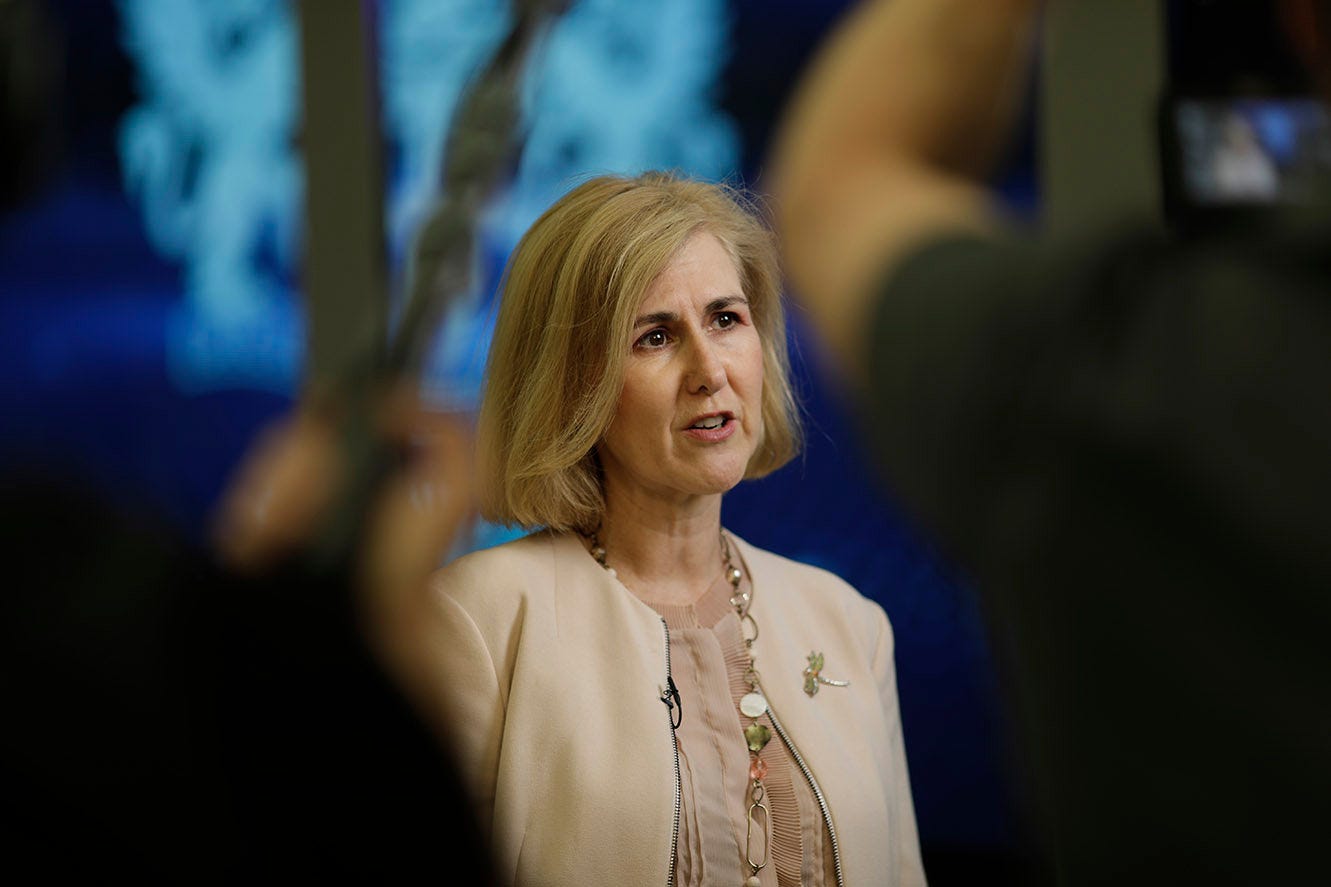
Eccles: Sue, thanks for taking the time for this conversation. For more than 20 years you have been setting standards to help companies report information about their financials, but you never worked as an accountant. Is this not surprising?
Lloyd: It is certainly surprising for professors of accounting! When I was a teenager in New Zealand, I wanted to be an accountant, but after my degree in accounting and finance I started my career in investment banking rather than accounting.
Eccles: It sounds like you were taking Monopoly way too seriously when you were a child! Did you have any childhood habits that hinted you might end up in international accounting?
Lloyd: I am not sure that as a child anyone would have thought I would end up working in international standard setting and being based outside New Zealand for my entire career. I grew up in a small country town in New Zealand. My upbringing was very much a rural one. My holiday jobs were pruning and picking kiwi fruit. I didn’t even have a passport until I needed one for the job interview in Australia that led to me moving to Sydney in my early 20s. People probably wouldn’t be surprised to hear that I have always been pretty academic and studious. You would have been more likely to find me playing the piano or studying than on a sports field. Perhaps the only sign of the international life to come was that my thesis for my Masters in Accounting and Finance at Auckland University was about harmonisation of accounting internationally.
Eccles: How did that job interview in Australia go?
Lloyd: It seems well. It led me to pack up and leave New Zealand – at that time with the clear intention that it was for two years. That plan didn’t quite pan out – I won’t say how many years later having worked overseas since, but that ended up being the direction of my career. In investment banking, I worked in structured debt teams initially and later in structured equity derivatives and dealt extensively with accounting standards. I often found myself frustrated by the difficulty of using them to reflect the economic reality of transactions. My interest in standard-setting grew out of a desire to improve the way transactions were represented in financial reporting so that investors and other stakeholders could better understand what was really going on.
Eccles: Which accounting standards were you dealing with at that time?
Lloyd: I worked in Hong Kong, Sydney and London, but started out first working in Australia. My first role in standard setting was as a member of the Australian Accounting Standards Board (AASB), so mainly Australian accounting standards, whose conceptual foundations are very aligned with what are now IFRS Accounting Standards. I was actually on the AASB when Australia made the decision to move to IFRS Accounting Standards. And showing my age here, I remember getting faxed copies of international accounting standards from a central library source in Australia as they started to become increasingly relevant in the late 1990s.
Eccles: From Auckland to London, via Hong Kong and Sydney. What attracted you to the IASB and to leave what must have been a profitable job in investment banking?
Lloyd: The possibility to make a difference. I hoped that I could use my market experience to help ensure IFRS Accounting Standards were high quality. I’m also genuinely interested in standard setting. It is something I am passionate about. I strongly believe that high-quality standards matter. They are fundamental to the effective operation of capital markets.
Eccles: When did your journey with the IASB begin and what was it like working there at that time?
Lloyd: I have been fortunate to be at the IASB at some important moments in its history. I was there as a staff member in the early 2000s in the early days of the IASB when David Tweedie was Chair, when the IASB was getting its standards ready for adoption in the European Union. I went back to banking for a few years and then came back again to the staff in 2009 after the global financial crisis, which was an exciting time in standard setting.
Eccles: Why was it so exciting?
Lloyd: I was fortunate to work on some very significant projects that transformed accounting internationally. I worked closely with IASB Chair Hans Hoogervorst from 2011 to 2021, as a senior technical director and then ultimately as Vice-Chair. We completed IFRS 15 on revenue recognition, IFRS 9 on financial instruments, IFRS 16 on lease accounting and IFRS 17 on insurance contracts. Each addressed areas where confidence in reported information had been weakened and where investors needed better information.
Eccles: The so-called Big4 IFRS Accounting Standards. Which one do you consider particularly transformative?
Lloyd: I am sometimes called the Mother of IFRS 9 so it is appropriate I choose that! It brought accounting closer to the way credit risk is actually managed. It was fundamentally about ensuring that financial statements provided a more relevant picture of risk and reflected economic reality more effectively and on a timely basis. The IASB had already started a complete overhaul of financial instruments reporting at the time of the financial crisis of 2008, but the crisis reiterated the need for transparency. The expected credit loss model in IFRS 9 was a critical response to this and close to my banking heart of course.
Eccles: While juggling your IASB Vice-Chair responsibilities, you were instrumental in bringing the ISSB to life, including driving the development of the ISSB’s two inaugural Standards. Given your unique perspective, how do you view the relationship between financial statements and sustainability-related disclosures?
Lloyd: The IASB has always been focused on providing information to enable investors to make investment decisions. Over time, the range of information investors need to understand the prospects of companies they are investing in has broadened. Sustainability-related disclosures fill that gap.
Eccles: How?
Lloyd: Sustainability-related disclosures provide additional information that investors need to understand a company’s current and potential financial performance. So, sustainability-related financial disclosures complement the information in the financial statements, providing more context about how business performance has been affected by things like climate-related risks and also the anticipated effects of those risks and opportunities. When applying ISSB Standards, disclosures are presented in a way that enables investors to understand how the information provided about climate and other risks and opportunities relates to information in the financial statements. So, looking at the information together, investors should see a cohesive story that enhances their understanding of a company’s performance and prospects.
Eccles: Can you give me an example?
Lloyd: It may be the case that a company has plans to make changes to its business, for example to improve energy efficiency, that will involve future investment. That may not be recognised in the financial statements yet given accounting requirements. The sustainability-related disclosures should enable those complementary perspectives to be understood.
Eccles: There’s been a growing narrative that ESG reporting is facing a backlash—with some even declaring it ‘dead.’ From where you sit, what is the reality on the ground and what would you say to the sceptics?
Lloyd: What we are seeing is the evolution of ESG reporting in sustainability reporting. The market is moving away from vague, disconnected, fragmented ‘ESG’ commentary towards decision-useful financial disclosures. First reports prepared in accordance with ISSB Standards are not too long and focus on reporting information that really matters for investment decision-making.
Eccles: Where is this reporting coming from?
Lloyd: More than 45 jurisdictions—representing over half of global GDP—are already taking steps to adopt or use the ISSB Standards in their regulatory frameworks. Reporting is starting in accordance with regulation in some jurisdictions, but even ahead of regulations kicking in, companies around the world are choosing to adopt these Standards on a purely voluntary basis.
Eccles: Why?
Lloyd: Because investors are demanding clear, comparable data on sustainability-related risks and opportunities, and business leaders recognise the value of high-quality disclosure to communicate efficiently and effectively with providers of capital. Applied well, ISSB Standards allow companies to provide information about matters that truly drive value creation and to explain to investors their resilience to the risks that they face. So, to the sceptics, I would say to look at the market fundamentals. Capital markets continue to need information about what matters. Disclosures help capital to move where it can be most productive.
Eccles: Critics often question whether standard setters are driving a specific sustainability agenda or exist to promote specific environmental or climate transition policies.
Lloyd: Let me be very, very clear that the ISSB is policy neutral. We do not require companies to set targets or to develop a plan to reduce GHG emissions. We do not tell companies how to run their businesses. We do not advocate for specific climate goals, such as achieving net zero by 2050. We do not evaluate whether a company’s strategy is good or bad.
Eccles: So, what are ISSB Standards about?
Lloyd: ISSB Standards are all about risks and opportunities. They require companies to disclose information about the climate and other sustainability-related risks and opportunities they have identified that could truly affect their financial prospects. And to provide information about what, if anything, they are doing about them and what that means for the company’s strategy and business model.
Eccles: Do you have an example in mind?
Lloyd: Does your company need to access a significant volume of water to run its agricultural product business? Are there issues with access to water due to this being in water-stressed areas? How are you dealing with this risk of water scarcity? That’s what the ISSB Standards are about. It’s business information, not about old style ESG. People also think climate reporting is just about carbon emissions and it’s not. It’s about how the business may need to change over the short, medium and long term in response to climate risks and opportunities, including physical climate risks. The aim is to enable investors to have reliable information about companies’ exposures, plans and prospects to decide how to allocate capital to companies.
Eccles: The ISSB is not affiliated with any jurisdiction, but you did not start from scratch, right?
Lloyd: We have not re-invented the wheel. We intentionally built on existing, capital markets-oriented frameworks and standards to ensure that we were using concepts and practices that were well known to market participants. The creation of the ISSB involved the consolidation of the Climate Disclosure Standards Board (CDSB) and the Value Reporting Foundation, which governed materials from the International Integrated Reporting Council (IIRC) and from the Sustainability Accounting Standards Board (SASB). In developing the ISSB Standards, we also built on the work of the IASB. For example, the definition of material information in ISSB Standards is the same as in IFRS Accounting Standards.
Eccles: The roots of the SASB lie in the U.S., which I know well having been its Founding Chairman. So, the SASB material was born in the U.S. and it is now being internationalised?
Lloyd: Our standards are really about what is material information for the particular entity. We think the industry-based materials developed by the SASB support this by enabling companies to provide industry-specific disclosures across the range of sustainability matters that are relevant to their business activities. And industry-specific disclosures enable better comparisons between companies, which is aligned with how investors conduct research and make investment decisions. And when you look at the statistics of who use the SASB Standards you see that 70% of companies using the SASB Standards are outside the U.S.
Eccles: So, you have incorporated these materials in the ISSB Standards as they are already used internationally?
Lloyd: We reference the SASB Standards as guidance to assist companies to provide information that is relevant for investment decision-making. Reflecting the international focus of the ISSB we had a dedicated project to ‘internationalise the SASB Standards’, for example by ensuring some specific U.S. references are more relevant to an international setting so that the SASB materials could be used internationally.
Eccles: You naturally share a close link with the IASB as you operate under the same IFRS Foundation umbrella, but when talking about financial reporting do you see anything in common with the U.S. Financial Accounting Standards Board (FASB)?
Lloyd: If you compare the definition of material information under IFRS Accounting Standards or ISSB Standards with the definition of material information under US GAAP you will see it is conceptually identical, focusing on whether an item’s omission or misstatement could influence economic decisions made by investors.
ISSB/IASB: “Information is material if omitting, misstating or obscuring it could reasonably be expected to influence investor decisions.”
FASB: “Information is material if there is a substantial likelihood that a reasonable investor would view the omission or misstatement as having significantly altered the total mix of information made available”
Eccles: We all take it for granted that we had those financial accounting standards, but we did not have anything in the U.S. until the SEC was formed. We had country gap for a long time.
Lloyd: In consolidating the global sustainability disclosure landscape, we are following the harmonisation path that the IASB took two decades ago. In the early 2000s, companies faced a patchwork of national accounting standards (such as UK GAAP, French GAAP, US GAAP), making international corporate performance incredibly difficult for global investors to compare. With IFRS Accounting Standards now used in more than 140 jurisdictions, the world’s capital markets are fundamentally dependent upon a single set of standards so investors can compare information developed using the same set of standards – in other words, people can do ‘apples to apples’ comparisons.
Eccles: So, are you leveraging the IASB’s experience?
Lloyd: What we are doing for the ISSB is the same thing but for a different set of investor-focused information that is complementary to the financial statements, using the same definition of material information. Companies want to just have to report according to one set of standards. Investors want to get information according to one set of standards so they don’t have to make the adjustments themselves to get to comparable information. That’s why we’re working for a global baseline of sustainability disclosures.
Eccles: How did you decide to start this journey to develop a global baseline?
Lloyd: We asked a question. Well, the trustees of the IFRS Foundation asked a question, via a consultation they launched in 2020: “Is there a need for a global set of internationally recognised sustainability reporting standards? If yes, should the IFRS Foundation play a role in setting these standards and expand its standard-setting activities into this area? If not, what approach should be adopted?”
Eccles: And I guess the response was that the IFRS Foundation had to play a role?
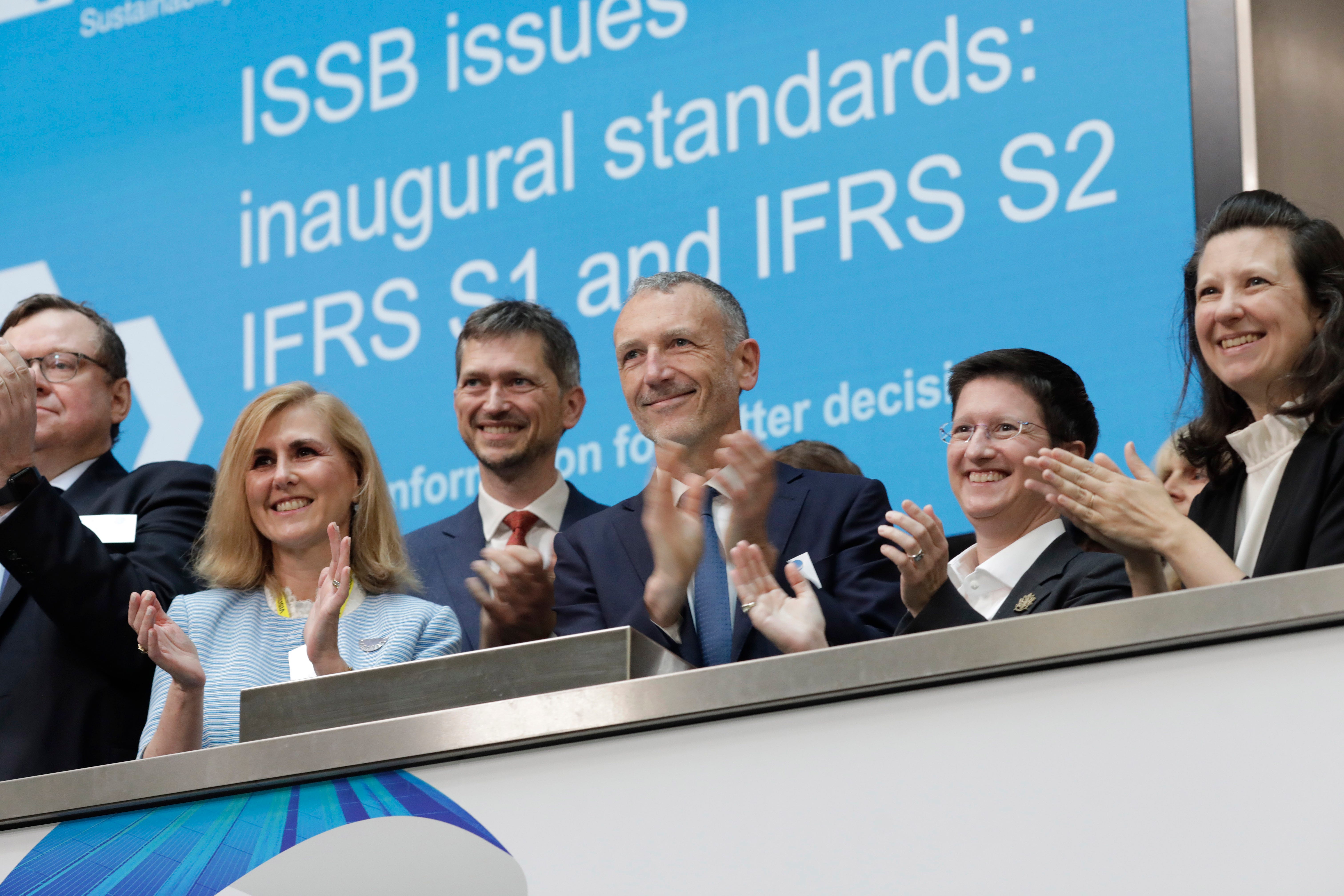
Lloyd: The feedback from the consultation made it clear that there was an urgent, global demand for comparable sustainability-related information for investment decision-making. Stakeholders, including the G20, G7, IOSCO and Financial Stability Board, called on the IFRS Foundation to take a leading role in setting international sustainability disclosure standards. The summary of feedback was published in April 2021, when I was still the IASB Vice-Chair. One year later we had the Exposure Drafts of IFRS S1 and IFRS S2 out for consultation and I was the ISSB Vice-Chair. The call to consolidate and reduce fragmentation in sustainability-related financial disclosure standards was indeed urgent. Our standards are based on what capital markets participants tell us is important and feasible through our public consultation processes.
Eccles: Did you hear anything from investors, given you are doing all the work for them?
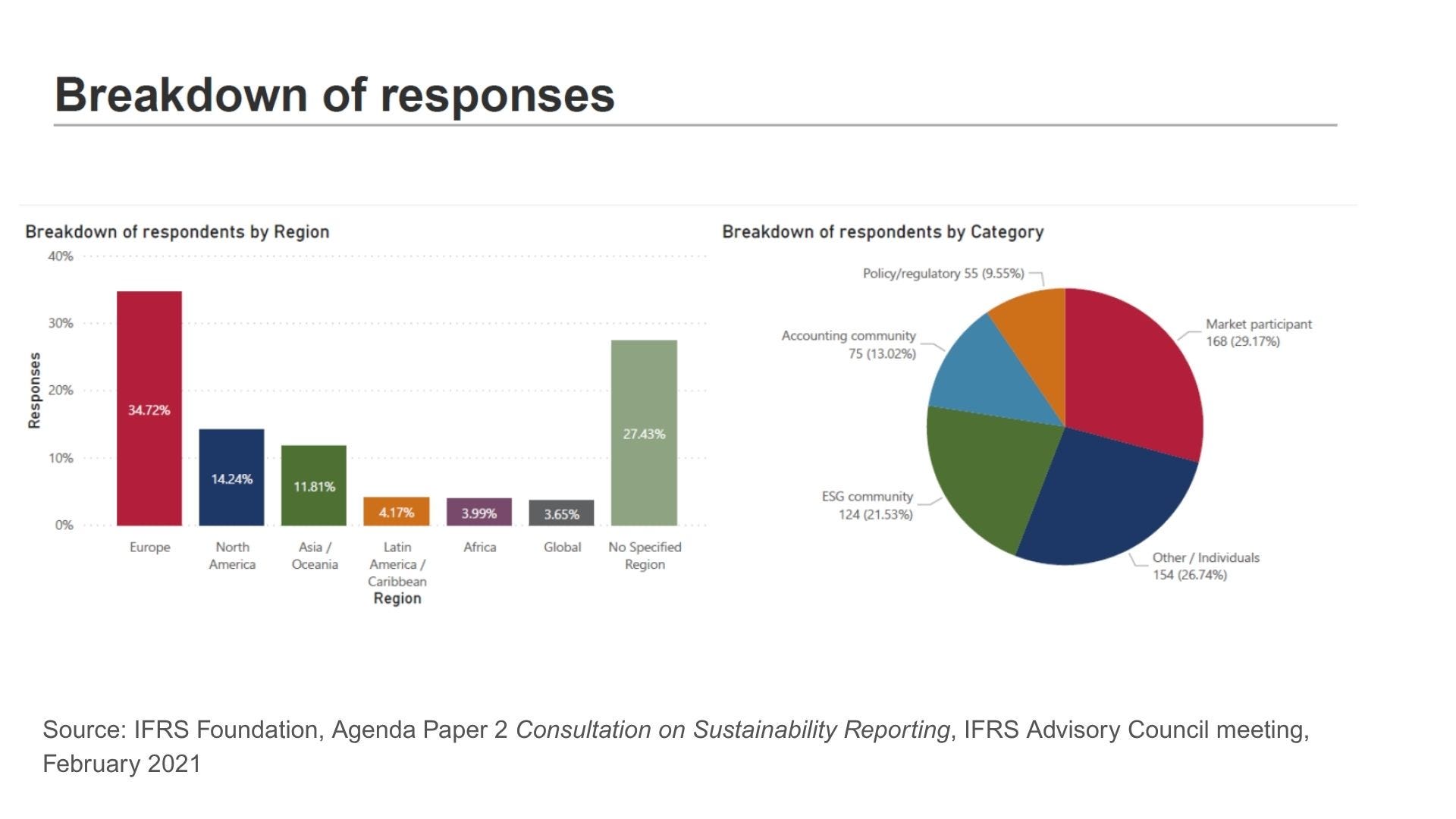
Lloyd: Investor perspectives are essential to our process. During the trustees’ consultation we engaged heavily with them. We had more than 50 investment houses and investor associations commenting on the consultation. Almost 30% of comment letters received were from market participants.
Eccles: How is this investor support translated in practice?
Lloyd: In several forms. For example, some asset owners are encouraging their portfolio companies to disclose in accordance with ISSB Standards. Many investors engage in jurisdictional consultations about the adoption of ISSB Standards, including by sending comment letters noting the benefits of aligning local requirements with ISSB Standards. Some global investors refer to the ISSB in their investment guidelines and voting policies.
Eccles: Right, I have seen BlackRock policies calling for standardised disclosures.
BlackRock “Standardized disclosure of sustainability-related data supports investors in making informed decisions. The International Sustainability Standards Board (ISSB) standards, IFRS S1 and IFRS S2, represent one such approach to standardization that we find useful in our analysis”.
Source: BlackRock Investment Stewardship Global Principles for Benchmark Policies Effective as of January 2026. https://www.blackrock.com/corporate/literature/publication/blackrock-investment-stewardship-benchmark-global-principles.pdf
Eccles: However, you are not consolidating all the sustainability disclosure landscape. The most popular term since the creation of the ISSB is probably ‘interoperability’. I heard you saying several times that it is because the European Commission started to develop European Sustainability Reporting Standards (ESRS) before the ISSB was created. When the ISSB work started, the U.S. SEC also had its own work to develop a climate rule. And then there’s the Global Reporting Initiative (GRI), which takes a multi-stakeholder approach. Why are you investing so much time working on interoperability between ISSB Standards and other initiatives?
Lloyd: To ensure that investors receive comparable information and to limit the burden and costs for companies. As sustainability-related disclosure requirements come into effect around the world, reducing duplication and making requirements work together more effectively can significantly reduce the reporting burden for companies while providing high-quality information for investors. ISSB Standards provide the foundations for globally applicable disclosure requirements for investors, thereby establishing a consistent global baseline. Jurisdictions are then able to require disclosure of further information, by adding their own additional ‘building blocks’ to these global foundations, tailored to the incremental information needs that a jurisdiction considers necessary. Companies can also build on top of these disclosures to communicate to additional stakeholders, for example using the GRI Standards.
Eccles: Why did you use a building block approach when designing ISSB Standards?
Lloyd: Taking this building block approach provides an efficient reporting system for the benefit of companies, retaining alignment with ISSB Standards. That is the case for ESRS, for example. When the ISSB was established, we knew that our investor focused standards needed to work within this context – where parties other than investors may also be interested in sustainability-related information. That is why we are clear in our general standard (IFRS S1) that a company can still comply with ISSB Standards, as long as any incremental information that is beyond that for investors, is presented in a way that enables the globally comparable, investor-focused information to be clearly identified.
Eccles: You talk about alignment with ESRS despite a different approach to what companies have to report? In other words, despite a different approach to materiality?
Lloyd: That is right. This is a prime example of the building block approach. There are many disclosures common to our sets of standards as there are disclosures relevant to investors (our focus) and for the broader focus of ESRS (which covers both investor needs and other stakeholder information needs). ISSB Standards and ESRS use different overall materiality concepts, but they are substantially aligned when it comes to financial materiality and information relevant to investors.
Eccles: To what extent can companies reuse disclosures across these two different sets of standards?
Lloyd: We have focused on ensuring that for that common set of information that is financially material there is as much alignment as possible, meaning that companies reporting under one set of standards should generally be able to identify the disclosures required by the other, particularly for climate-related reporting. While ISSB Standards focus on the provision of information relevant to investors, or in other words, information that could influence decisions to invest in a company, ESRS also consider the provision of information regarding a company’s impacts on people and the environment that do not create risks or opportunities for a company. So, this means there is additional information required by ESRS that we do not require.
Eccles: So, do ISSB Standards ignore impacts?
Lloyd: No, they don’t. ISSB Standards acknowledge that a company’s risks and opportunities arise from its impacts and dependencies on resources and relationships throughout its value chain. Information about impacts and dependencies could be material to investors in understanding the sustainability-related risks and opportunities that could reasonably be expected to affect a company’s prospects.
Eccles: How does this work in practice? Is there a specific example you’re thinking of?
Lloyd: In the example of the company using water to operate its business, the company’s activities could impact a local marine species. If the company’s activities have the potential to contribute to the degradation or depletion of that water source and therefore endanger the marine species, these potential impacts could create a risk to the company’s operations because of its dependency on its legal and social licence to operate. So, the company might determine that these impacts give rise to a sustainability-related risk that could reasonably be expected to affect the amount and timing of the company’s incoming and outgoing cash flows, its ability to obtain funding and/or the cost of capital and, therefore, the company’s prospects. Of course, when companies are using other standards to meet information needs beyond the common information needs of investors, they might report on the impact on the marine species regardless of whether it creates a risk for the business or not.
Eccles: How does this compare to the requirements in ESRS?
Lloyd: What makes ISSB Standards different from ESRS is that reporting under the ISSB Standards is focused solely on providing material information about impacts if they give rise to sustainability-related risks and opportunities that could reasonably be expected to affect a company’s prospects (that is, its cash flows, cost of capital and access to finance) and when that information could reasonably be expected to influence investment decisions, whereas ESRS do not limit the disclosure of information about impacts in this way. They cover information on impacts more broadly including as an effort to support Europe’s policy objectives.
Eccles: In short, how does the philosophy of ISSB Standards differ from that of ESRS?
Lloyd: ISSB Standards were developed to provide sustainability-related financial disclosures that provide critical information for capital markets, whereas ESRS were also developed to achieve policy objectives which extend beyond providing information to capital markets. They can coexist efficiently.
Eccles: So, information about impacts might be relevant for investors. Of course there are lots of different types of investors. Some, including those with a mandate beyond financial return alone, might be interested in information not provided by companies applying ISSB Standards.
Lloyd: It is important to consider what financial reporting can do and what it cannot do. The ISSB’s focus, like the IASB’s focus, is to develop standards that - when applied by companies - provide investors with financially material decision-useful information so that they can make informed investment and capital allocation decisions. A company should provide information directly relevant to its business; that is, information that relates to the company’s prospects for economic success, without inherent bias towards any particular investment or capital allocation approach.
Eccles: When looking at groups outside the European Union doing business within the European Union, the next chapter in the ESRS sequence is ESRS-40a. Are the same considerations about interoperability between ISSB Standards and ESRS also valid between ISSB Standards and ESRS-40a?
Lloyd: As there are non-EU groups within the scope of ESRS-40a that already use ISSB Standards, or ISSB-aligned jurisdictional standards, we are engaging with EFRAG to identify efficient ways for these non-EU groups to use an “ISSB+” approach; that is, to enable them to start from their reports prepared applying ISSB Standards to add the information needed to comply with ESRS-40a.
Eccles: Is there any overlap?
Lloyd: Yes. Although the two sets of standards have different perspectives, with ISSB Standards focusing on sustainability-related risks and opportunities that could affect a company’s prospects and ESRS-40a focusing on impacts on people and the environment, there is overlap. EFRAG’s proposals for ESRS-40a identify investors as a user group for the information, alongside other stakeholders. And, as I talked about earlier, information about impacts can be relevant to explain sustainability-related risks and opportunities. As a result, there is an overlap in disclosures, particularly for climate-related matters.
Eccles: To conclude, can you tell me what good will look like in five years?
Lloyd: I hope that in five years, we won’t even need to have a debate about whether information about sustainability matters to capital markets. Having the ISSB’s global baseline used across major capital markets worldwide, delivering consistent, comparable data that investors rely on just as routinely as traditional financial statements is what good looks like to me.
Eccles: And how do you expect companies and investors will be using the disclosures?
Lloyd: We’ll see sustainability-related disclosure reported side-by-side with financial statements that is robust such that investors can rely on it. It can also be imagined that that enhanced quality of information will support strategic board discussions on company prospects that are already occurring. Ultimately, good is when transparent disclosure isn’t seen as a burden of compliance, but as the clearest path to understanding resilience, accountability, and long-term value creation.
Eccles: Which strategic ramifications do you see?
Lloyd: Investors in New York, Hong Kong, Tokyo, London or São Paulo can look at a company’s sustainability disclosure and evaluate it with the same trust and rigour as traditional financial metrics. It means we’ve built the global baseline we set out to build, and that it’s actively helping companies and investors navigate an uncertain world with confidence.
Eccles: This means, you hope sustainability reporting is no longer treated as a separate, extra exercise. It is simply business as usual. You mentioned robust disclosure, which provides investors with the confidence in the information disclosed that they ultimately use to make their investment decisions. What role does the ISSB play with assurance?
Lloyd: Our mandate does not include requiring a particular level of assurance or developing auditing/assurance standards. The question of whether information has to be assured and the level of assurance is determined by regulatory or jurisdictional authorities. This is also the case by the way for financial statements. The IASB does not decide on assurance there either. Our role is to set standards that enable the information to be assurable.
Eccles: What do you mean by ‘assurable’?
Lloyd: For example, a company is only required to disclose information about sustainability-related risks and opportunities identified by the company using reasonable and supportable information that is available at the reporting date without undue cost or effort. This was included in finalising the ISSB Standards to clearly specify the basis for identifying which sustainability-related risks and opportunities need to be reported on.
Eccles: We’ve covered a lot of ground in this conversation. Thanks again for your time, Sue. It was great catching up.
Lloyd: Thanks to you, particularly for the provocative questions. I enjoyed the conversation.
What a great interview. And who better to interview Sue than Bob?!
I have two questoins for Sue. Please excuse any misunderstandibgs from ths actuary. Feel free to correct them!
1. That energy compnay you refer to. "...a company has plans to make changes to its business, for example to improve energy efficiency, that will involve future investment. That may not be recognised in the financial statements yet given accounting requirements. The sustainability-related disclosures should enable those complementary perspectives to be understood."
As an investor I am uncomfortable with "not yet recognised". My capital has been committed to DEA (Desirable Economic Activity). I am pleased. But as money is spent, I assume it will be expensed through the P&L. Tax benefits! (But unhelpful for citizens). I would rather it was a contingent liability of sufficient relevance to make it to an IAS37 Provison. (It might support a Net Zero commitment by the company). And when the company, doing with my/its money what I approve of, creates economic and thus financial value, surely it's an Intangible? There is a view the IFRS is still scared of the Ghost of Enron Past. CRAs would like a number. We'd all like a number! How does ISSB help IASB to do better? That IAS37 decision was over two years ago now.
#2 in next post!