


Don Quixote in his library: “A world of disorderly notions, picked out of his books, crowded into his imagination.” Gustave Doré, illustration for Don Quixote, 1863. Public domain, via Wikimedia Commons.
“Now it’s time for the EU to deliver.” That was Andrew Puzder, the U.S. Ambassador to the European Union, posting on X on August 14, 2026, the day his mission published comments warning that “the United States will take any actions necessary to address unreasonable burdens on U.S. commerce” created by the EU’s sustainability reporting and due diligence rules. The European Union had promised, in its 2025 trade framework with the United States, to make efforts to ensure that its Corporate Sustainability Reporting Directive, the CSRD, does not “pose undue restrictions on transatlantic trade” (Joint Statement, paragraph 12). Washington wants to see results.
In my last piece, I tried to work out what ESRS-40a, the EU’s planned sustainability reporting standard for large non-EU companies, actually is. Two findings matter here. First, the obligation behind it. Article 40a of the EU’s Accounting Directive, is much weaker than its reputation. It binds a company’s EU subsidiary, not the non-EU parent, and if the parent declines to supply information, the subsidiary publishes what it has and a statement saying so. Second, Article 49(3b), the provision that makes the Commission’s reliance on EFRAG’s advice conditional on proper due process, has never applied to ESRS-40a.
This piece follows the argument where it leads. Washington’s objections fit Article 40a most closely, but that is the provision that compels least. What actually binds American groups in Europe is something else: the reporting their large EU subsidiaries must do in their own right, under the main European Sustainability Reporting Standards. Those standards are covered by Article 49(3b). That puts a procedural vulnerability exactly where the real burden lies, and it changes what the Commission can usefully give, and should be careful about giving, in the trade talks.

Don Quixote and Sancho Panza set out: the statue in the Place d’Espagne, Brussels, after Lorenzo Coullaut Valera’s figures for the Cervantes monument in Madrid. Photograph by Romainbehar, 2025. Public domain (CC0), via Wikimedia Commons.
The Trade Backdrop
The current phase of transatlantic trade relations began with a framework agreed by President Trump and Commission President Ursula von der Leyen on July 27, 2025, at the President’s golf resort at Turnberry, Scotland, which Europeans call the Turnberry deal. It was set out in a Joint Statement on August 21, 2025. The United States would cap tariffs on most EU goods at 15 percent; the European Union would eliminate tariffs on U.S. industrial goods, buy U.S. energy, and encourage investment in the United States.
The framework has been unstable since. On February 20, 2026, the Supreme Court held that the emergency powers statute on which the tariffs rested does not authorize them, and the administration rebuilt its tariffs on other statutory bases, with steel and aluminum tariffs as high as 50 percent. The Council gave final approval to the EU’s side of the deal on June 25, 2026, but with the right to suspend it if U.S. tariffs exceed the ceiling or the steel question is not resolved by the end of 2026, and with its main tariff preferences expiring at the end of 2029 unless renewed. The negotiation is continuous, and each side will keep asking whether the other has delivered.
The principal players are the U.S. Trade Representative (USTR), Jamieson Greer, who leads the negotiation, and Ambassador Puzder, the administration’s most public voice on EU sustainability rules. On the European side, trade belongs to Maroš Šefčovič, Commissioner for Trade and Economic Security, but the CSRD belongs to Maria Luís Albuquerque, Commissioner for Financial Services and the Savings and Investments Union, and her department, DG FISMA. A commitment made in a trade statement has to be delivered by a different Commissioner and a different department, working with EFRAG, the private Brussels association that drafts the standards.
As I explained in the last piece, think of the European Parliament and the Council as the two houses of Congress, and the Commission as a federal agency that alone can propose legislation. The CSRD is the statute (”Level 1”); the standards are rules the Commission adopts under it (”Level 2”), much as the SEC does. The Commission can change the rules on its own. Changing the statute takes both houses.
What Washington Wants
U.S. objections to the EU’s sustainability directives predate this administration. In 2023 a Democratic Treasury Secretary, Janet Yellen, told Congress that the United States was concerned about the reach of the EU’s Corporate Sustainability Due Diligence Directive (CSDDD), and congressional letters that year raised both directives. The CSRD entered the trade text in paragraph 12 of the Joint Statement: “The European Union commits to undertake efforts to ensure that the Corporate Sustainability Due Diligence Directive (CSDDD) and the Corporate Sustainability Reporting Directive (CSRD) do not pose undue restrictions on transatlantic trade.” The language is soft, an undertaking of efforts rather than results, and the softness is political. The same statement commits the EU plainly to eliminating its industrial tariffs. But the Commission has insisted throughout on the EU’s “regulatory autonomy,” its right to set its own rules; Šefčovič said in May 2025 that “we clearly would preserve our regulatory autonomy.” With its own simplification package already under way, it could promise efforts it was making anyway. Still, the paragraph made the CSRD a legitimate subject of trade negotiation.
Congress pressed the point. On September 30, 2025, the chairs of the Senate Banking and House Financial Services committees, Tim Scott and French Hill, wrote to Ambassador Greer describing the CSRD as a non-tariff barrier, calling double materiality “misguided,” and asking USTR to support an indefinite pause. The EU, meanwhile, completed its “Omnibus I” simplification law. Directive (EU) 2026/470, adopted on February 24, 2026, and in force since March 18, 2026, is expected to remove roughly 90 percent of companies from the CSRD’s scope and, by EFRAG’s estimate, to cut the number of non-EU groups covered from around 10,000 to about 1,200. In July 2026 the Commission adopted the revised ESRS, with about 60 percent fewer mandatory datapoints.
Washington’s answer came on August 14, 2026, in comments published by the U.S. Mission to the EU in response to the Commission’s consultation on guidance for the CSDDD. Most of the five-page submission concerns that directive, but it argues that the two “have significant interoperability, complementarity, and overlap, particularly in reporting” and should be addressed together. The Omnibus reforms, it says, “failed to fully address U.S. concerns.” Reporting under both directives includes “impact-based materiality reporting and a ‘double materiality’ standard, which differs from the single financial materiality standard under US law,” so that “the extraterritorial reach of the CSRD and CSDDD would significantly expand the reporting burden for non-EU companies with minimal links to the EU market.” The submission invokes the “objective territorial principle of international law” and “principles of international comity,” and asks the EU to “significantly limit CSDDD and CSRD reporting and due diligence requirements on U.S. businesses, and limit enforcement actions against U.S. businesses.” I have found no public response from the Commission.
The due diligence directive’s prominence is understandable. As originally adopted, it combined supply chain obligations with an EU-wide civil liability regime and a maximum penalty that member states had to set at no less than 5 percent of worldwide turnover. Omnibus I scaled it back sharply. It now applies to EU companies with more than 5,000 employees and €1.5 billion of worldwide turnover, and to non-EU companies with more than €1.5 billion of turnover in the EU. The maximum penalty is capped at 3 percent of worldwide turnover, civil liability is left to the member states, and the obligation to adopt a climate transition plan is gone. Member states have until July 26, 2028, to transpose it, and it applies from July 26, 2029. In other words, it has not disappeared; it has been shrunk and postponed into the same end-of-decade window as the CSRD’s own milestones.
The submission names no article of the CSRD. But its target is clear: “the obligations CSDDD and CSRD impose on U.S. businesses domiciled outside of the EU.” In the CSRD, the provision that imposes obligations with respect to companies domiciled outside the EU is Article 40a. One of its requests is especially revealing. For the due diligence directive, it asks that “the EU subsidiary or firm located in the EU, and not the parent company located in a third country, should hold responsibility for due diligence and related enforcement.” Washington, in other words, is proposing to move obligations onto EU subsidiaries. As the next section shows, that is exactly where the CSRD’s heaviest obligation already sits.

Sancho Panza protests that the giants are only windmills; Don Quixote charges anyway. William Stewart Watson, Don Quixote Tilting at a Windmill. National Galleries of Scotland, Edinburgh. Public domain, via Wikimedia Commons.
The Obligations with Teeth
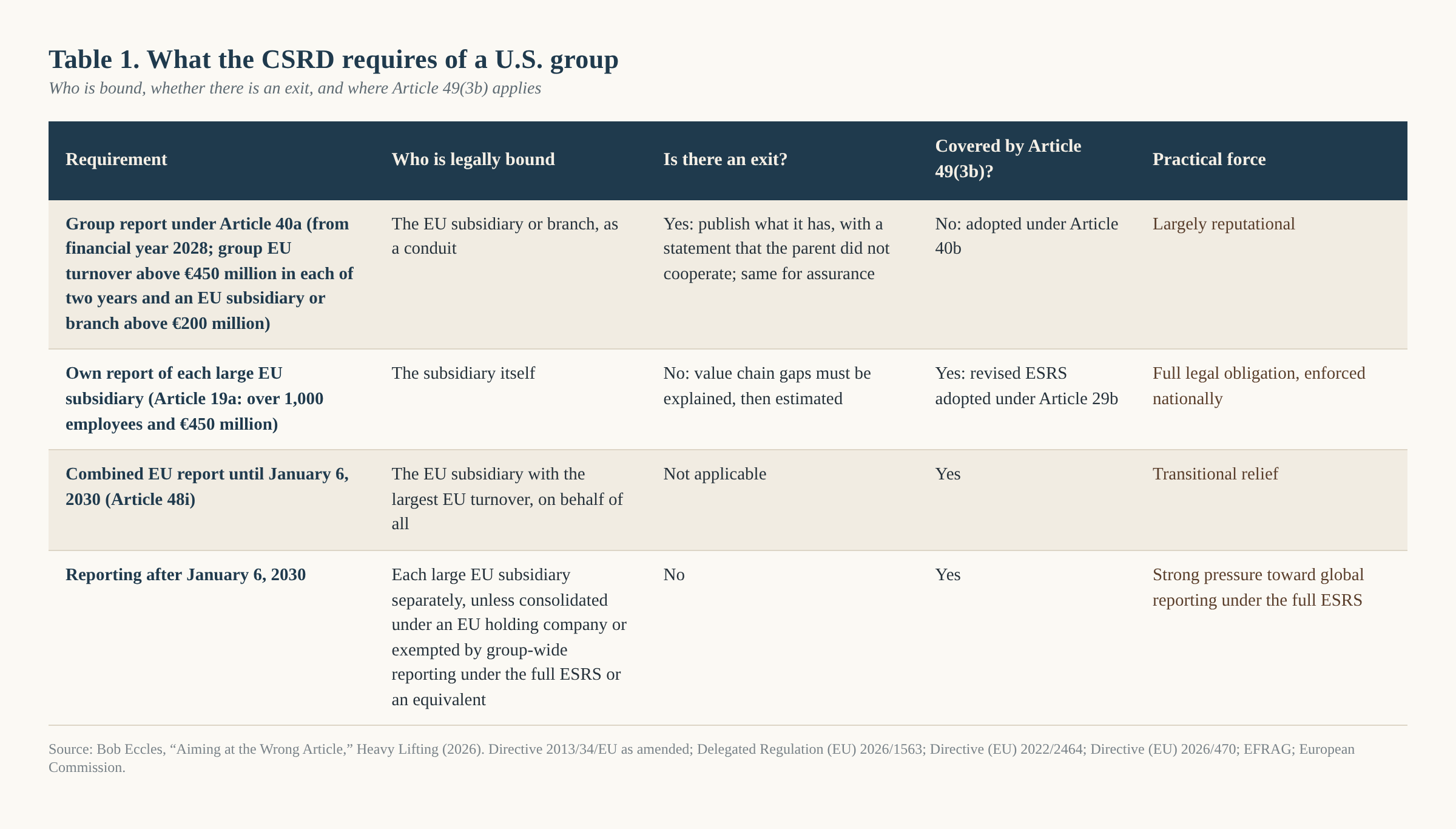
Article 40a is the provision that looks most extraterritorial. It applies where a non-EU group’s EU turnover has exceeded €450 million in each of the last two years and it has an EU subsidiary or branch with more than €200 million of turnover, and it requires that subsidiary or branch to publish a sustainability report covering the whole worldwide group. But the EU cannot bind the parent, and the Directive does not try. If the parent does not provide the information, the subsidiary publishes “all information in its possession, obtained or acquired,” and “a statement indicating that the third-country undertaking did not make the necessary information available.” The same exit applies to the required assurance opinion. The co-legislators described the arrangement plainly in the Omnibus I recitals. The subsidiary “is only required to publish and make available the sustainability report provided by the third-country undertaking, whereas undertakings subject to Articles 19a and 29a are required to report on their own behalf.” A parent that declines faces a public statement, not a penalty.
The obligation with teeth is the one in that last clause. Under Article 19a, any company in the EU with more than 1,000 employees and €450 million of turnover must report on its own behalf under the full ESRS, double materiality included. That covers the large EU subsidiaries of American groups, and there is no non-cooperation exit. Their reports must cover their “own operations and... value chain, including its products and services, its business relationships and its supply chain.” For a European sales or distribution subsidiary whose supply chain runs through its parent’s global operations, that is a reach well beyond Europe. Omnibus I protects smaller companies in the value chain, those with 1,000 or fewer employees, from information requests beyond a voluntary standard, but that protection does not extend to a large parent. After a three-year transition, gaps must be filled “by using information directly obtained from undertakings in its value chain or estimates for that information.” The subsidiary cannot simply say the parent would not help.
The burden grows after 2030. Until January 6, 2030, a transitional provision, Article 48i, lets a non-EU group’s large EU subsidiaries report together in one EU-level report, prepared by the subsidiary with the largest EU turnover. After that, each reports separately, unless they sit under a single EU holding company or the parent reports for the whole group under the full ESRS or a standard the Commission deems equivalent, which exempts them under Article 19a(9). A report under ESRS-40a does not qualify.
EU subsidiaries already publish their own financial statements, so separate reporting is not new in itself. But financial statements work at the level of the legal entity because transactions are booked entity by entity, while supply chains, procurement, product design and climate strategy are managed at group level. Segment reporting under IFRS 8 and its U.S. equivalent follows how management runs the business, not the corporate chart, for exactly this reason. The post-2030 rule does the reverse. Faced with several such reports, many groups will find it simpler to report globally under the full ESRS.
That is the real extraterritorial lever in the CSRD, and it is not Article 40a. It works through obligations on European companies, applied on the same terms as to their European competitors, which makes it much harder to attack as discrimination against foreign firms. And it pushes American groups toward global reporting under European standards not by command but by making the alternative expensive.
Where Article 49(3b) Does Bite
Article 49(3b) provides that, when adopting delegated acts under Article 29b, the Commission “shall take into consideration technical advice from EFRAG, provided that... such advice has been developed with proper due process, public oversight and transparency, with the expertise and balanced participation of relevant stakeholders, and with sufficient public funding to ensure its independence.” Article 29b is the power under which the main ESRS are adopted. So while the condition does not reach ESRS-40a, it governs precisely the standards that bind American groups’ EU subsidiaries. Those standards, Delegated Regulation (EU) 2026/1563, enter into force on November 10, 2026, and apply from financial year 2027.
The Commission’s finding that the condition was met occupies a single sentence in Recital 3 of the regulation: EFRAG’s advice “meets the criteria set out in Article 49(3b), first, second and third subparagraphs.” I have found no condition-by-condition assessment by the Commission explaining how it reached that conclusion. Table 2 summarizes what the public record shows.
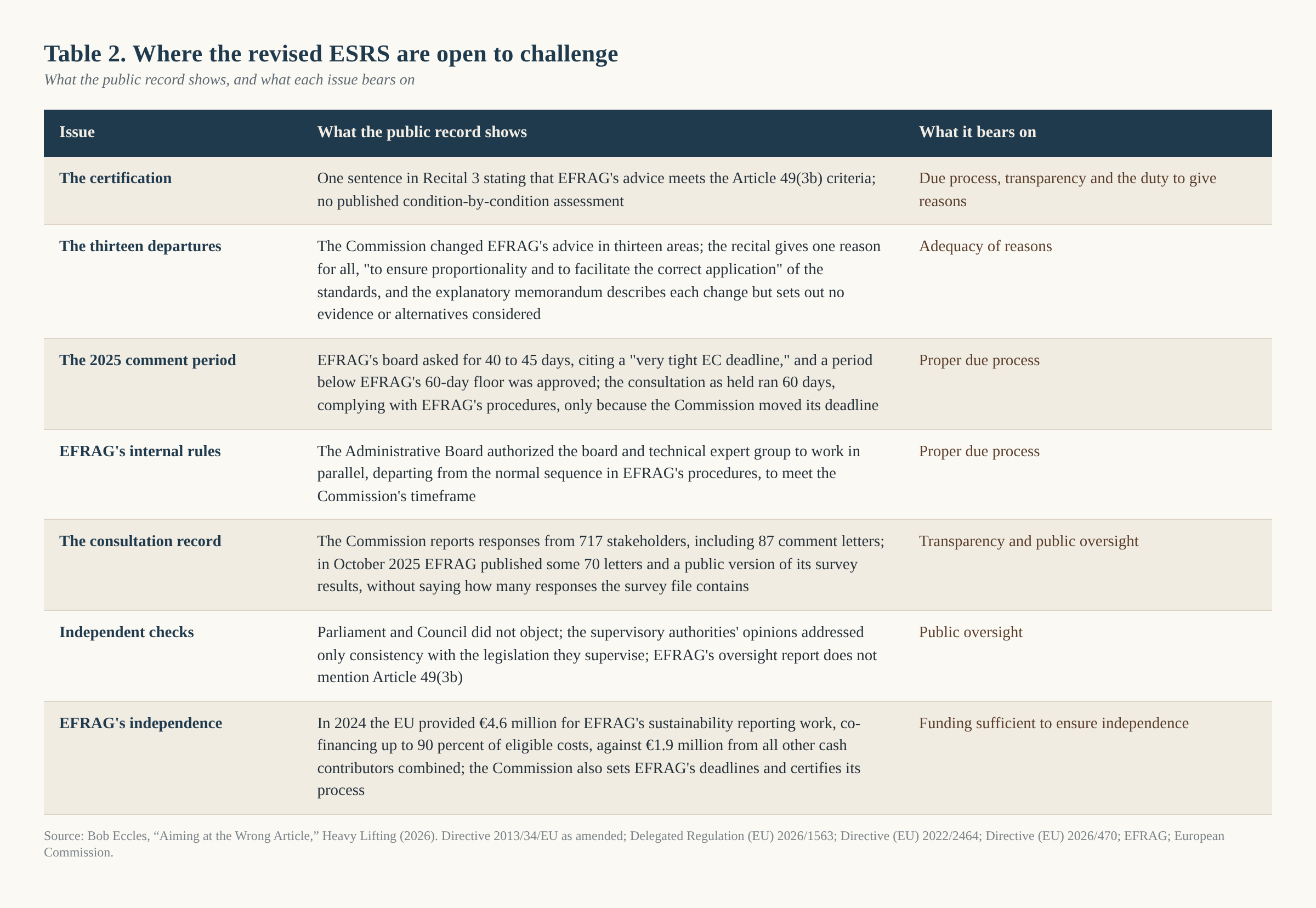
None of this establishes that the condition was not met. EFRAG’s consultation complied with its procedures in the end, and the Commission ran its own public consultation on the draft regulation. But no one inside the European system has tested the Commission’s finding. The Parliament and the Council let the scrutiny period expire without objection, ESMA’s opinion says nothing about EFRAG’s due process, and EFRAG’s own oversight report does not mention Article 49(3b). A challenger would still need to show not merely that the process was imperfect, but that a defect was legally material to the Commission’s decision to adopt the standards.
An untested condition in a contested regulation is an invitation, and the most powerful party to accept it is not a company but a government. Under Article 263 of the Treaty, member states, like the Parliament, the Council, and the Commission, are “privileged applicants.”:They may ask the EU courts to annul any EU act without showing that it affects them. A member state that had doubts about the CSRD, Germany or the Netherlands for example, both of which have yet to fully transpose the Directive, could bring such an action against the revised ESRS. There is precedent. Austria sued the Commission over the inclusion of nuclear power and gas in the EU taxonomy, and the General Court dismissed the action on September 10, 2025, finding that the Commission had not exceeded its powers. The courts give the Commission considerable room on the substance of such acts. A challenge built on the procedural conditions of Article 49(3b) would test something different.
Time matters. On the standard calculation, the period for a direct challenge to the revised ESRS runs to about December 15, 2026. After that, a company subject to the standards can still raise their validity before a national court, which can refer the question to the Court of Justice, although a company that clearly could have brought a direct challenge in time may be barred from doing so later. In a member state that has not transposed the Directive, that route is not yet open.
American readers should not picture the EU courts as a European Supreme Court with identifiable blocs. Judges of the Court of Justice (one per member state) and the General Court (two per member state) are appointed by common accord of the governments for renewable six-year terms, after vetting by an independent panel. They deliberate in secret and publish no dissents. Their tendencies are institutional rather than ideological: protective of the effectiveness of EU law, deferential on complex technical judgments, but strict on procedure and the limits of delegated power. Whether a particular challenge would succeed is an open question. But a U.S. official pressing the point would not need to argue about double materiality at all, only to ask whether the EU has complied with its own law in adopting standards that bind American companies’ European subsidiaries. That costs Washington nothing to ask and is awkward for Brussels to answer with the record as it stands.

Sancho Panza, promised an island, enthroned as governor of Barataria, a post that proves more ceremony than substance. John Gilbert, Don Sancho Panza, Governor of Barataria, 1875. Manchester Art Gallery. Public domain, via Wikimedia Commons.
What the Commission Can and Cannot Give
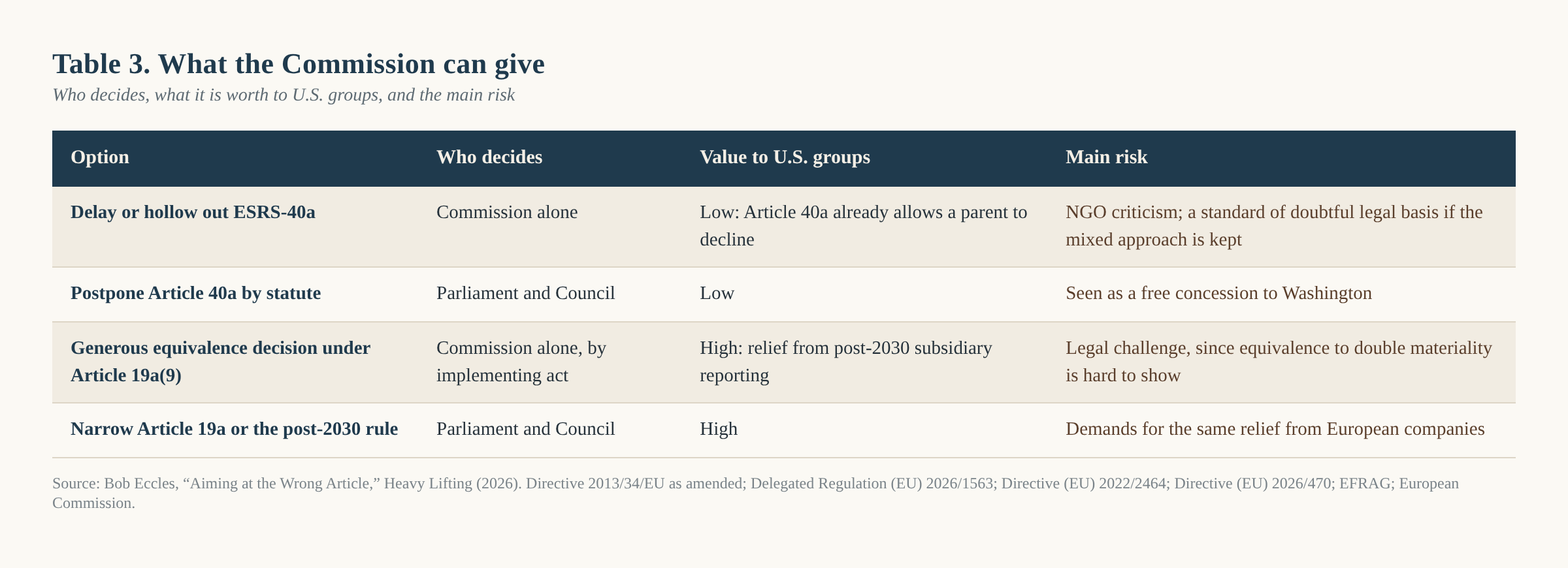
The Commission has four realistic options, summarized in Table 3.
The cheapest is to delay or hollow out ESRS-40a: take its time past the deadline it has already missed, adopt a thin standard with long phase-ins, or keep the “mixed approach,” which lets groups confine much of their reporting to EU-related impacts. None of this requires legislation, but since Article 40a already lets a parent decline, it is worth little to American groups. A statutory postponement of Article 40a, like the 2025 “stop-the-clock” directive, would need both houses, which the current Parliament would probably welcome, and would be worth as little.
The option that would matter most, and that the Commission controls alone, is equivalence. Article 19a(9) exempts EU subsidiaries whose non-EU parent reports group-wide under standards the Commission has deemed equivalent to the ESRS, through an implementing act under the EU’s transparency rules. A generous equivalence decision would relieve American groups of post-2030 subsidiary reporting without legislation. But the ESRS rest on double materiality, and neither U.S. practice nor the ISSB’s financially focused standards cover impacts. A finding stretched to fit a trade deal would itself invite challenge.
The last option is to change Article 19a itself. Because it is part of the statute, both houses would have to agree. The softening could go a long way: raising the thresholds again, exempting the EU subsidiaries of non-EU groups, extending the transitional relief beyond 2030, or letting an ESRS-40a or ISSB report qualify for the exemption. There is a ready vehicle. The CSRD requires the Commission to report on its implementation by April 30, 2029, and every three years after that, “accompanied, if appropriate, by legislative proposals,” including an assessment of Article 40a’s “enforcement mechanism and... thresholds,” although few if any Article 40a reports will have been published by then. Narrowing Article 19a is also exactly the concession European business would demand for itself, since the same rules apply to European companies of the same size. Here the level-playing-field argument becomes a ratchet. Relief granted to American groups’ subsidiaries becomes the case for relief for everyone.
The European Side
In November 2025 the Parliament adopted its position on the Omnibus with the votes of the center-right and the far right, a majority that wanted the Directive cut further than the Commission had proposed. As of September 2026, six member states, including Germany and the Netherlands, had still not fully transposed the original CSRD into national law, more than two years after the deadline (Gibson Dunn). And in June 2026 the European Ombudsman confirmed her finding that the Commission’s preparation of Omnibus I, including an internal consultation cut to under 24 hours over a weekend, amounted to maladministration. In this climate, the forces that might resist a concession to Washington are weaker than they were, and the forces that would demand the same concession for European companies are stronger.
What the Commission Should Do
The Commission’s position is weaker than it needs to be, largely because of what it has not said. Five steps would strengthen it.
First, be candid about Article 40a. The statute already contains the exit Washington is asking for: a parent that declines to cooperate exposes its subsidiary to a public statement, not a penalty. Saying so costs nothing and takes the heat out of the most visible part of the dispute.
Second, shore up the record behind the revised ESRS. Publish a condition-by-condition account of how the Commission concluded that EFRAG’s advice satisfied Article 49(3b), and ensure that the public record of EFRAG’s 2025 consultation is complete, including how many responses were received and how many are published. The standards that actually bind American groups’ European subsidiaries rest on that finding, and it should be able to bear scrutiny.
Third, make any substantive concession in the statute, openly, through the Parliament and the Council. That includes any postponement of Article 40a. Concessions made quietly through delegated acts are neither visible nor accountable, and they invite the challenges they were meant to avoid.
Fourth, do not stretch equivalence to buy peace. An equivalence decision that cannot be defended on its merits would trade a political problem for a legal one.
Fifth, for ESRS-40a, make the voluntary process as transparent as the statutory one ought to be: publish the consultation responses promptly and explain how they shaped the standard.
Don Quixote vanquished on the beach at Barcelona by the Knight of the White Moon, in truth a neighbor determined to bring him home. Etching by Adolphe Lalauze for John Ormsby’s translation of Don Quixote, 1895. Public domain, via Wikimedia Commons.
A Scenario: Why Better Process Will Not End the Pressure
Suppose the Commission did all of this. It would strengthen the standards’ legitimacy in Europe and make them harder to challenge in court. It would not make Washington care. Trade negotiators are interested in whether a standard applies to American companies, not in how it was made. As long as the EU applies the CSRD to American groups’ European subsidiaries, the pressure will continue.
Nor is it likely to fade with a change of administration. Objections to the reach of the EU’s sustainability directives began under a Democratic administration. A future one would press with less hostility and might seek something different, perhaps acceptance of ISSB-based reporting as equivalent rather than outright exemption, but it would not defend an obligation on American companies to report under European impact standards. Nor would it necessarily feel bound by the Turnberry framework, a political statement rather than a treaty, with no term of its own.
The end of 2029, when the EU’s tariff preferences under that framework expire unless renewed, is part of a striking convergence. Consider what falls due in little more than a year at the end of the decade.
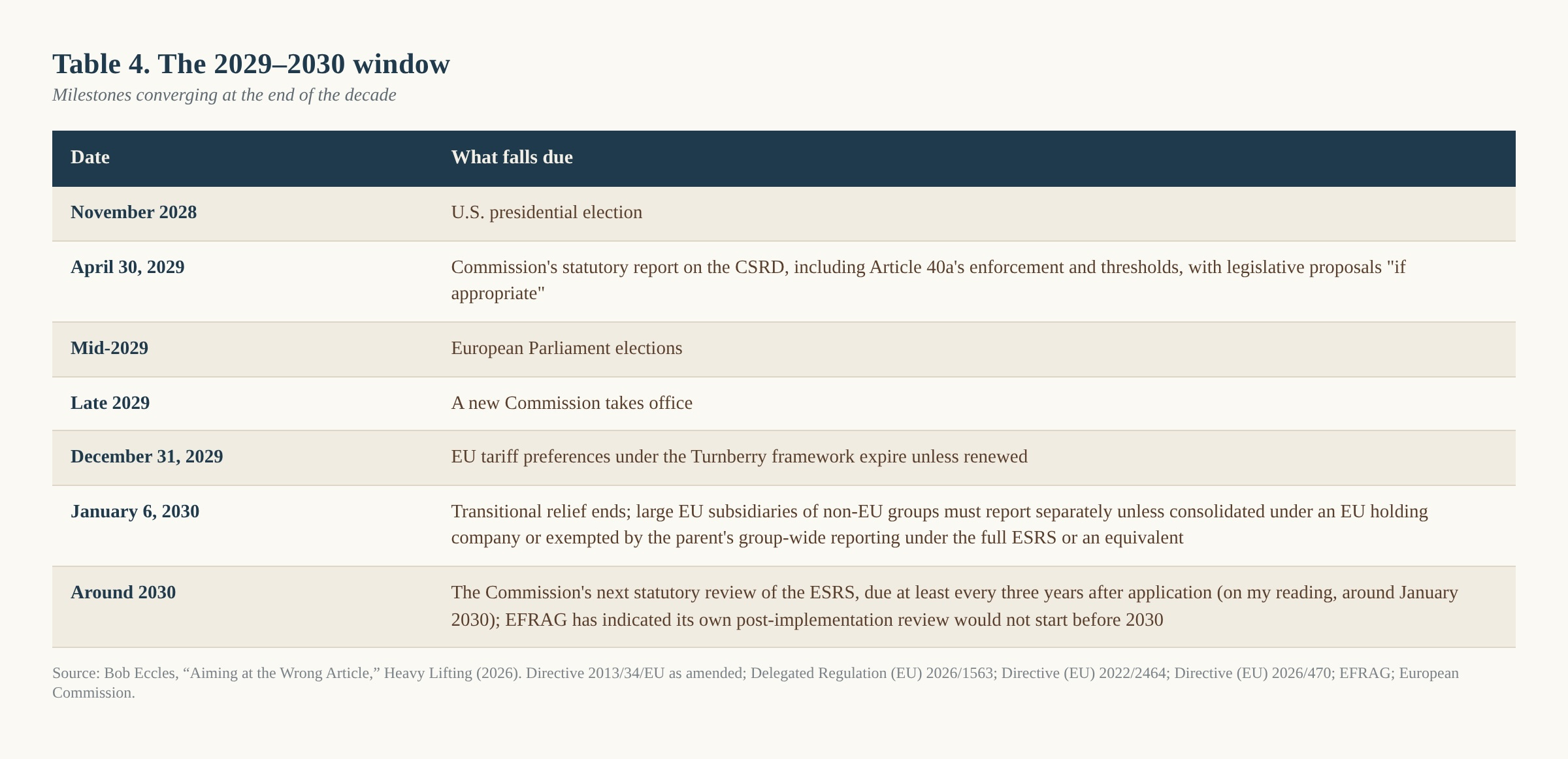
Two broad paths lead out of that window. The first is managed erosion, with no single decision anyone has to defend: transposition stays incomplete in some member states, enforcement stays light, ESRS-40a is delayed or left thin, and an equivalence decision or an extension of the transitional relief quietly spares American groups’ subsidiaries the post-2030 rule. The CSRD survives for large European companies, but its reach to American groups withers. The second is renegotiation in the statute, with the 2029 review, a new Parliament and a new Commission providing the occasion to rewrite Articles 19a and 40a openly. Either path is plausible. What is hard to imagine is the status quo surviving the window intact.

Don Quixote and Sancho Panza ride on, the knight still ahead, the squire still following. Honoré Daumier, Don Quixote and Sancho Panza, 1865–1867. RISD Museum, Providence. Public domain, via Wikimedia Commons.
Conclusion
Washington’s objections fit Article 40a, which compels little. The provisions with real force are the obligations on American groups’ large European subsidiaries under Article 19a, especially the rule that from 2030 requires each to report separately unless the parent reports globally under European standards. Those obligations apply to European and American-owned companies alike, which gives the EU its strongest ground. It is regulating companies operating in Europe, not discriminating against foreign ones.
The process record matters because it determines whether the EU can stand on that ground. A standard certified in a single sentence, after a consultation compressed by the Commission’s own deadline, gives the United States, and any member state or company that shares its doubts, a way to attack the standards without engaging their substance. A defensible record forces the argument back onto substance, where the EU is strongest. Better process will not end the pressure from Washington. A weak one makes the standards easier to challenge.
The decisions that matter will be taken at the end of the decade, by a different Parliament, a different Commission and possibly a different American administration. The EU can arrive at that moment having decided openly what it wants the CSRD to require of foreign-owned companies, and with a record that can defend it. Or it can arrive having let the question be settled by erosion, by litigation, or across a negotiating table where the CSRD is one item among many. The time to choose is now, while the choice is still Europe’s to make.
Appendix: Two Issues from the HIT Analysis
In preparing this series, I worked with a Hybrid Intelligence Team (HIT) of three AI models (Claude, Gemini, and ChatGPT) to examine potential Article 49(3b) issues in the revised ESRS. Two of the issues bear directly on this piece. Each distinguishes what is Documented in public sources, what is a Reconstructed concern, meaning an analytical inference rather than an established fact, and Stakeholder exposure, meaning the groups with a demonstrable interest in the issue.
A1. EFRAG’s 2025 consultation
Documented. EFRAG’s consultation on its exposure drafts ran from July 31 to September 29, 2025. Its 2025 due process oversight report records that the Sustainability Reporting Board requested a consultation of 40 to 45 days, citing a “very tight EC deadline”; that the Administrative Board “approved the request for a shorter public consultation period than 60 days”; and that after the Commission extended its deadline for the advice to November 30, 2025, the period was extended to 60 days, bringing EFRAG into compliance with its procedures. It also records that the parallel process between the Sustainability Reporting Board and its technical expert group differed from EFRAG’s internal rules and was maintained to meet the Commission’s timeframe. The report does not mention Article 49(3b). EFRAG’s September 2025 Update reported 678 submissions through the survey or comment letters; the Commission’s staff working document later reported responses from 717 stakeholders, including 87 written comment letters. In October 2025, before delivering its advice, EFRAG published some 70 comment letters and a public version of its survey results, without saying how many responses the survey file contains or how many respondents asked for confidentiality. The Commission’s report on EFRAG’s 2024 activities records that the EU co-financed up to 90 percent of the eligible costs of its sustainability reporting work.
Reconstructed. The approval of a period below the accelerated floor was overtaken by the extension, so the consultation as held complied with EFRAG’s procedures. But the record shows EFRAG’s oversight body prepared to approve a departure from its own procedures because of the Commission’s timetable, and maintaining another for the same reason. EFRAG deserves credit for publishing letters and survey results before delivering its advice, which is more than it has committed to for ESRS-40a. But without knowing how complete the published record is, an outside reader cannot fully test how EFRAG weighed the responses, or check the Commission’s Article 49(3b) finding against the consultation on which the advice rested.
Stakeholder exposure. All groups, and particularly respondents to the 2025 consultation, who cannot compare their views with those of others; and the EU subsidiaries of non-EU groups, which are bound by the standards the advice produced.
A2. Standing and time limits
Documented. Under Article 263 of the Treaty on the Functioning of the European Union, a company may challenge an EU act if it is of “direct and individual concern” to it, or, for “a regulatory act which is of direct concern to them and does not entail implementing measures,” direct concern alone. Under the Aarhus Regulation, qualifying NGOs may request internal review of certain acts by the adopting institution, with a subsequent route to the Court. The validity of an EU act can also reach the Court of Justice through national proceedings and a preliminary reference under Article 267.
Reconstructed. Companies subject to the revised ESRS are better placed than NGOs to show direct concern, although whether the standards “entail implementing measures,” given that the reporting obligation itself runs through national law transposing the Directive, is a question a court would have to decide. On the standard calculation, the period for a direct challenge to a regulation published on September 21, 2026, runs to about December 15, 2026. Any challenger would need to contest the recital’s statement of compliance with evidence, which brings the analysis back to the public record. A procedural defect does not automatically lead to annulment, and a contestable process is not automatically a defective one.
Stakeholder exposure. Affected undertakings, EU and non-EU, considering litigation; investors and auditors concerned with the durability of the standards; and governments seeking leverage in negotiations over them.