

This piece is co-authored with Prof. Dr. Kerstin Lopatta, an accounting professor at the University of Hamburg

Investors who price a company’s securities are, in the end, pricing its future cash flows. To the extent that climate change will alter those cash flows, through physical damage to assets, the cost of carbon, shifts in demand or the terms on which capital is available, investors have a legitimate claim to information about it. The question is not whether such information is wanted. It is what form it should take, where it should sit, and how much confidence a reader can place in it.
The most ambitious answer so far is the requirement to disclose the “anticipated financial effects” of sustainability-related risks and opportunities. The concept appears in the ISSB’s IFRS S1 and IFRS S2 and, since 2023, in the European Sustainability Reporting Standards; both build on the recommendations of the Task Force on Climate-related Financial Disclosures. The revised ESRS, adopted by the European Commission on 3 July 2026 and published in the Official Journal on 21 September 2026 as Commission Delegated Regulation (EU) 2026/1563, retain the requirement and align it more closely with the ISSB standards. Because the ESRS specify their climate content in more detail than IFRS S2 does, they are the more demanding test case, and the one we examine here. We take the requirement as written and ask a single question: what do anticipated financial effects actually tell a reader?
Key Takeaways
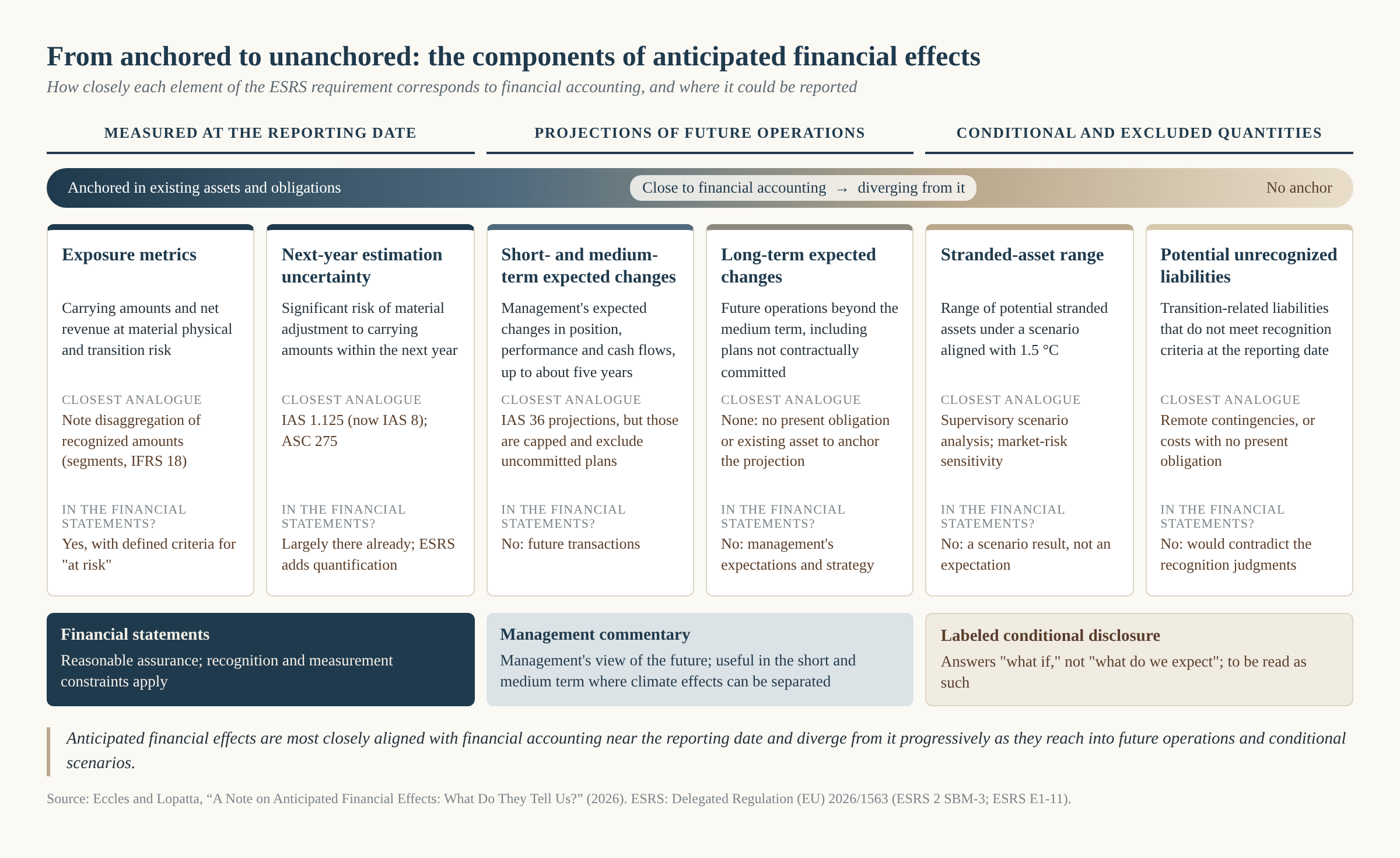
1. The requirement has three components that should be read separately: exposure metrics measured at the reporting date; management’s expected changes in financial position, performance and cash flows over the short, medium and long term; and two climate datapoints, a stranded-asset range and potential unrecognized liabilities, that quantify what the financial statements do not.
2. The exposure metrics are useful and close to the financial statements. The ISSB treats comparable figures as cross-industry metrics rather than as anticipated financial effects. With defined classification criteria and the operational capacity to apply them, they could be reported in the financial statements themselves.
3. Long-term projections of future operations are management commentary. Financial accounting measures cash flows over long horizons only where they arise from an obligation or right that exists at the reporting date. When it projects future operations, as in an IAS 36 impairment test, it caps the explicit projection period and excludes uncommitted plans. The ESRS requirement does neither.
4. The stranded-asset range is a scenario result, not an expectation. It is based on a 1.5 °C scenario and is closer in structure to supervisory scenario analysis than to an estimate of what management expects.
5. Limited assurance cannot validate a forecast. Assurance on forward-looking information addresses the reasonableness of assumptions and the integrity of preparation, not whether the projected outcomes will occur.
Materiality and Where the Information Could Go
IFRS Accounting Standards and U.S. GAAP both define materiality by reference to investors’ decisions. Under the IASB’s Conceptual Framework, information is material if omitting, misstating, or obscuring it could reasonably be expected to influence the decisions primary users make on the basis of the reports. The US formulation, derived from the Supreme Court’s decisions in TSC Industries v. Northway and Basic v. Levinson, asks whether there is a substantial likelihood that a reasonable investor would consider the information important. In substance the tests converge, and the ISSB and ESRS adopt the IASB’s wording for financial materiality. Climate can clear the hurdle; the IASB’s illustrative examples on reporting uncertainties (November 2025) show how it bears on impairment, useful lives, provisions, expected credit losses, and estimation uncertainty. Materiality establishes that the information can be important. It does not establish which representation of it is reliable enough to bear the weight investors will place on it.
That representation could appear in three places. The first is the financial statements, audited to reasonable assurance, where the Conceptual Framework admits forward-looking information only insofar as it relates to assets, liabilities, equity, income, or expenses of the reporting period, and leaves management’s expectations and strategies to other reports. The second is a sustainability report under IFRS S1 and S2 or ESRS; under the CSRD, the sustainability statement is a section of the management report, subject since the Omnibus I amendments to limited assurance only. The third is management commentary: the management report in Europe and MD&A in the United States. In the United States, Item 303 of Regulation S-K requires disclosure of known trends and uncertainties, and forward-looking statements there can benefit from the PSLRA safe harbor, which does not extend to statements in GAAP financial statements. In the European Union, sustainability reporting and management commentary appear in the same document, and liability for it is a matter of national law, with no Union-wide safe harbor.
The SEC’s 2024 climate rule, stayed pending litigation and no longer defended by the Commission, drew a similar line. Its financial statement note covered costs and losses from severe weather events and other natural conditions above thresholds of one percent of pre-tax income and of equity; carbon offsets and renewable energy certificates material to a company’s climate targets; and whether estimates and assumptions had been materially affected by severe weather or by transition plans or targets. Each concerned amounts and estimates of the reporting period. Transition plans, scenario analysis and targets went into the narrative part of the filing with a tailored safe harbor.
What ESRS Requires
ESRS 2 (disclosure requirement SBM-3) describes anticipated financial effects as how the undertaking “expects its financial position, financial performance, and cash flows to change over the short, medium and long term, given its strategy to manage material risks and opportunities.” In preparing the disclosure it considers its announced investment and disposal plans, “including plans to which the undertaking is not contractually committed.” The disclosures are “designed to produce information that complements information provided in the financial statements.” Horizons are defined in ESRS 1: the short term is the financial reporting period, the medium term runs to five years, and the long term lies beyond, although an undertaking may define the medium and long term differently where the standard definitions would not produce relevant information. Quantitative information may be a single amount or a range.
The quantitative requirement is subject to reliefs aligned with IFRS S1 and S2: where effects are not separately identifiable; where measurement uncertainty is so high that quantitative information would not be useful; and, for anticipated effects only, where the undertaking “does not have the skills, capabilities or resources to provide that quantitative information.” An undertaking using a relief must explain why, give qualitative information identifying the financial statement line items likely to be affected, and provide quantitative information on combined effects unless that too would not be useful. The ISSB’s educational material on anticipated financial effects (August 2025) explains these mechanisms for IFRS S1 and S2 and ties the disclosures to the company’s financial planning, with examples drawn from near-term budgets. ESRS 2 also requires qualitative and quantitative information where there is “a significant risk of a material adjustment within the next annual reporting period to the carrying amounts of assets and liabilities reported in the related financial statements.” A revised estimate “does not therefore necessarily imply that there has been a reporting error,” and the data and assumptions used must be consistent with the financial statements to the extent possible.
For climate, E1-11 requires the carrying amount of assets at material physical risk and at material transition risk, the parts addressed by adaptation and mitigation actions, and the net revenue at material physical and transition risk. It also requires “a range of estimated potential stranded assets from the reporting year until the mid-term and long-term time horizons based on a scenario aligned with limiting climate change to 1,5 °C,” and “the estimated potential liabilities related to climate transition that do not meet the accounting recognition criteria at the reporting date but that may have to be recognized in financial statements in future periods.” Carrying amounts are measured at the reporting date, consistent with the financial statements. The transitional provisions allow undertakings already reporting under the CSRD to omit anticipated financial effects before financial year 2028, and quantitative information before 2030, but the asset carrying amounts, the parts addressed by adaptation and mitigation, and the stranded-asset range are not phased in; they remain subject to the general reliefs. Several E1-11 datapoints, including physical-risk exposure and the breakdown of real estate collateral, are linked in ESRS 2 to the Climate Benchmark Regulations and to bank Pillar 3 disclosures. The stranded-asset range and the potential-liabilities datapoint are not; for them, usefulness to investors is the relevant test.
The ISSB’s own architecture supports separating the exposure metrics from the rest. IFRS S2 (paragraph 29) requires the amount and percentage of assets or business activities vulnerable to transition and physical risks as cross-industry metrics, not as anticipated financial effects. ESRS places figures of the same kind under the anticipated-effects heading.
The Analogues in Financial Accounting
Financial accounting deals with the future constantly, and its tools map closely onto the components of anticipated financial effects.
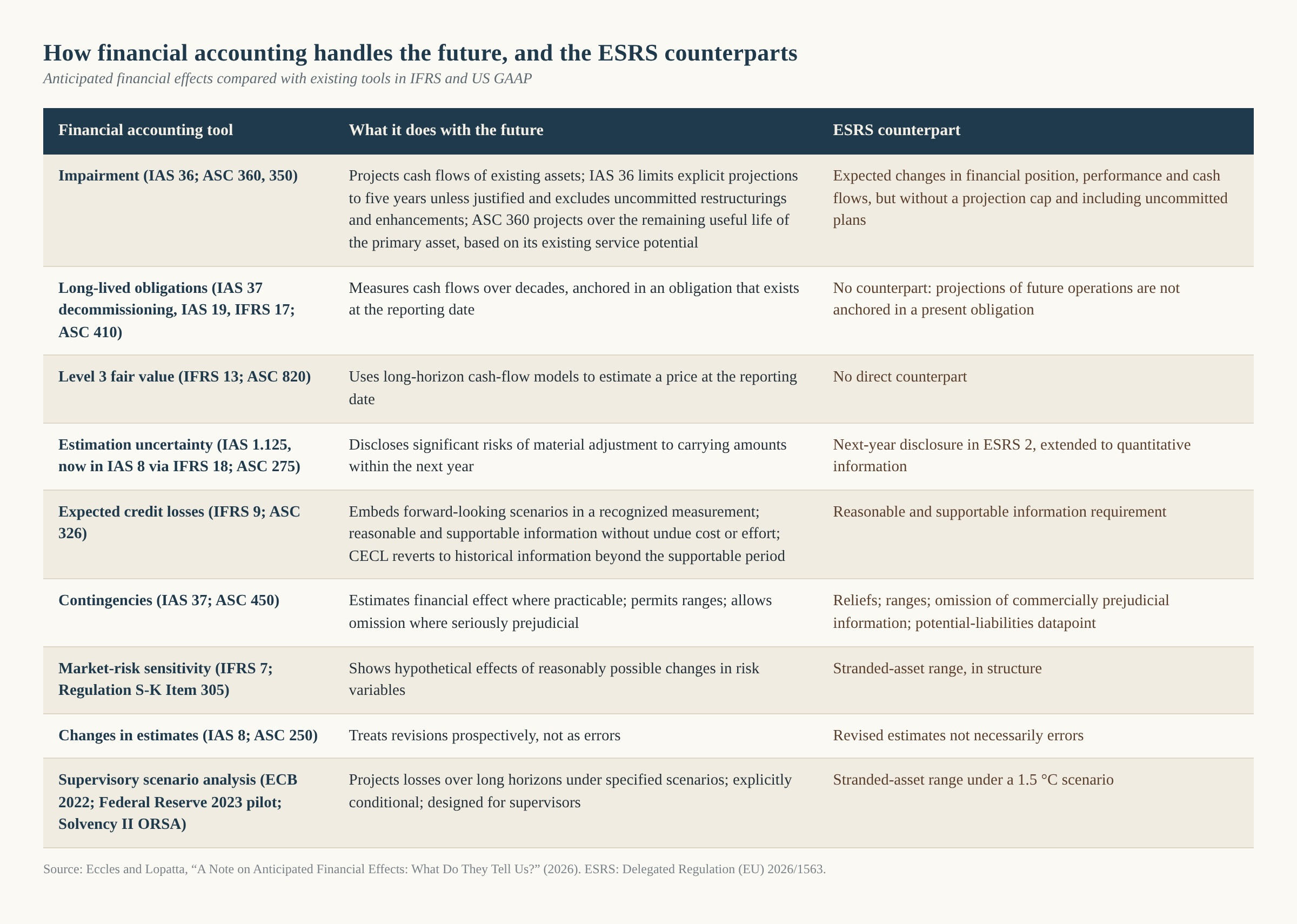
Much of the requirement is therefore built from financial accounting’s own materials. The next-year disclosure is in substance IAS 1 paragraph 125, the reliefs echo IAS 37 and IFRS 9, ranges mirror ASC 450, the treatment of revised estimates restates IAS 8, and the exposure metrics are carrying amounts and revenues. Anticipated financial effects are not an alien concept. They differ from their analogues in five respects, and in each the standard leaves questions open that practice, assurance providers, or future guidance will have to settle.
Five Differences and the Questions They Leave Open
The anchor and the horizon. Financial accounting measures cash flows over long horizons only where they arise from an obligation or right existing at the reporting date, as with decommissioning provisions, pensions, and insurance contracts. Where it projects future operations, it either caps the explicit projection period and excludes uncommitted restructurings and enhancements (IAS 36), or projects over the remaining useful life of an existing asset on the basis of its existing service potential (ASC 360). In both cases the projection is anchored in an asset the entity already holds. The ESRS requirement projects future operations over the long term and directs the undertaking to consider plans to which it is not contractually committed. Whether an undertaking can use the flexibility in ESRS 1 to align its long-term horizon with its planning horizon, and so limit the projection period in practice, is not settled by the text.
Attribution. Financial accounting attributes changes in recognized measurements to components. IFRS 9 separates fair value changes attributable to own credit risk, IAS 19 separates service cost, net interest and remeasurements, and IFRS 17 separates insurance service results from finance income and expenses. It does not attribute expected future revenue, operating costs or capital expenditure to an external driver. As the German Accounting Standards Committee observed in a January 2026 submission to the ISSB’s Transition Implementation Group, companies plan in an integrated way and investment and revenue usually have several causes. The relief for effects that are not separately identifiable is therefore likely to be where much of practice settles. Analysts make such attributions in their own models, and management’s version has value to them even without a measurement basis in the accounting framework.
Probability and measurement uncertainty. Financial accounting attaches recognition and disclosure to defined thresholds: probable, reasonably possible, and remote. “Expects” and “anticipated” have no equivalent definition, and the standard does not say how likely an effect must be before it is quantified. ESRS distinguishes, as the Conceptual Framework does, between outcome uncertainty and measurement uncertainty. ESRS 1 states that even high measurement uncertainty does not necessarily prevent an estimate from being useful, while ESRS 2 relieves quantification where it would not be useful. The provisions are consistent, but the standard does not say where the line falls.
Classification. The carrying amount of an asset is a financial statement number. Whether the asset is “at material physical risk” or “at material transition risk,” or related to a climate-related opportunity, is a judgment about the future for which financial accounting supplies no criterion, and ESRS does not define one. The required methodology disclosure makes each undertaking’s approach visible but not comparable.
The two climate datapoints. Financial accounting recognizes a stranded asset through impairment when there are indicators of impairment and the recoverable amount falls below the carrying amount; otherwise, it does not quantify it. The ESRS range is conditioned on a stated pathway rather than on management’s expectation, and the standard does not say how an undertaking whose central expectation differs from that scenario should relate the range to its other disclosures or to the assumptions in its financial statements. The potential-liabilities datapoint is defined by reference to the accounting framework itself. Contingent liabilities that are not remote must already be disclosed under IAS 37 and ASC 450; what remains is either remote or not a liability at all, because there is no present obligation, as with an expected future carbon cost.
The capability relief raises a further open question. The practicability and cost-and-effort exceptions in IFRS Accounting Standards turn on the nature of the information or the effort needed to obtain it, not on the capabilities of the preparer. ESRS does not say what evidence would support a determination that an undertaking lacks the skills, capabilities or resources to quantify, how an assurance provider would test it, or whether the relief is expected to be temporary. The ISSB’s educational material states, for IFRS S1 and S2, that a company with the resources to obtain the necessary skills cannot rely on the relief; the ESRS text contains no equivalent statement.
Could Anticipated Financial Effects Go in the Financial Statements?
The exposure metrics could. Disaggregating recognized carrying amounts and revenues according to a defined criterion is a familiar kind of note disclosure, comparable to segment information or the disaggregation principles of IFRS 18. The obstacles are definitional and operational. A criterion for material physical and transition risk would have to be defined, and applying it would require asset-level location data, hazard modelling and judgments about transition exposure, much of it drawn from outside the systems that produce the financial statements. The next-year estimation-uncertainty disclosure is largely there already, although ESRS goes further by requiring quantification.
Management’s expected changes over the short, medium and long term could not. They concern future transactions: revenue not yet earned, costs not yet incurred, and capital expenditure not yet committed. The Conceptual Framework assigns management’s expectations and strategies to management commentary, and even IAS 36 excludes uncommitted plans. Where the same expectations inform the measurement of existing assets, they are already reflected in the financial statements, but within an anchored projection and without attribution to cause. The two climate datapoints could not either: they are, by construction, quantities the accounting framework has declined to recognize, and placing them in the notes would contradict the recognition judgments made in the primary statements.
The Conceptual Framework Point
The ISSB and the drafters of ESRS did not overlook this boundary. They crossed it deliberately, to provide information about prospects that the financial statements do not contain. The useful question is therefore what replaces the constraints the boundary supplies. Both sets of standards adopted the IASB’s qualitative characteristics of useful information, and the revised ESRS require fair presentation. Neither imports the definitions of assets and liabilities, the recognition criteria, the measurement bases, or the boundary on forward-looking information. In their place, ESRS relies on ranges, disclosed methodology and assumptions, explanation of differences from the financial statements, identification of affected line items, reliefs, and limited assurance. These conventions make the basis of an anticipated amount visible. In financial accounting, the anchor, the projection cap and the probability thresholds limit which amounts may be presented. The ESRS conventions do not; they only make the basis of an amount visible.
ESRS’s own Appendix B, which has the same authority as the rest of ESRS 1, contains the principle that bears on the choice. Adapting the Conceptual Framework’s definition of predictive value, it states that “sustainability information need not be a prediction or forecast to have predictive value but rather has predictive value when employed by users in making their own predictions.” That describes the exposure metrics precisely. Management’s projection of climate-attributable changes in its future performance is a different kind of information: a prediction, offered as one.
Assurance
Financial statements are audited to reasonable assurance. Under the CSRD as amended by Omnibus I, sustainability statements receive limited assurance only. No EU limited assurance standard has yet been adopted; the Commission is to adopt one by delegated act by 1 July 2027, and until then the guidelines of the Committee of European Auditing Oversight Bodies serve as the reference. The IAASB’s ISSA 5000 has not been adopted in the EU. Assurance frameworks for forward-looking information, from ISAE 3400 on prospective financial information to ISSA 5000, direct the practitioner to the reasonableness of assumptions, the preparation of the information on that basis and the adequacy of disclosure. They do not extend to whether forecast outcomes will be achieved. Limited assurance can confirm the integrity of the process that produced an anticipated amount; it cannot speak to the amount as a prediction. Presented next to line items and carrying amounts, an assured figure may be read as carrying more assurance about the future than the engagement provides.
The audit of the financial statements is also affected. Under Article 34 of the Accounting Directive, the statutory auditor gives an opinion on whether the management report is consistent with the financial statements and prepared in accordance with legal requirements; in Germany the management report is itself audited. The CSRD added a separate opinion, based on a limited assurance engagement, on the compliance of the sustainability reporting with the Directive’s requirements. The auditor must nonetheless read and consider the management report, including the sustainability statement, for material inconsistencies with the financial statements and with the knowledge obtained in the audit. A disclosure that a significant share of assets is at material transition risk, or that potential liabilities “may have to be recognized in financial statements in future periods,” will need to be considered alongside impairment testing, useful lives, provisions, and estimation-uncertainty disclosures. That can be a source of discipline, surfacing impairment indicators that might otherwise be missed, or of pressure on measurements made under a more demanding framework. In practice, preparers will need to manage the two sets of assumptions as one.
What Do Anticipated Financial Effects Tell Us?
The exposure metrics tell investors how much of the balance sheet and revenue is exposed to climate-related risks at the reporting date, in a form investors can combine with their own view of the future. Management’s expected changes tell investors how the company’s strategy, as management sees it, translates into financial consequences; over the short and medium term, and where climate effects can be separated, this information has clear analogues in financial accounting and adds something neither the financial statements nor a conventional management report provides. Whether a company quantifies at all may itself be informative about how separable climate effects are in its business, although early evidence suggests caution. In a DRSC study of 100 large listed companies’ 2024 reports, half disclosed anticipated financial effects, only 26 quantified them, and non-disclosure by EU companies reflected transitional reliefs and uncertainty about the requirements as much as the nature of their businesses. The stranded-asset range answers a meaningful but conditional question, and the potential-liabilities datapoint quantifies what the accounting framework has excluded, without a test, probability, or horizon by which to identify it.
Anticipated financial effects are therefore most closely aligned with financial accounting near the reporting date and diverge from it progressively as they reach into future operations and conditional scenarios. Within the short and medium term, and where effects can be separated, they can tell investors something not available elsewhere. Beyond that point, they take the form of financial statement amounts while resting on a different and still developing set of conventions, and readers should interpret them accordingly.
About the Authors
Robert G. Eccles is Visiting Professor of Management Studies at the Saïd Business School, University of Oxford.
Kerstin Lopatta is Professor of Financial Accounting, Auditing and Sustainability at the University of Hamburg.
The views expressed are the authors’ own.
Bob, Kerstin, this is a very useful distinction, particularly between exposure metrics, management expectations and conditional scenario results. They serve different purposes and should not be presented as though they carry the same degree of certainty.
I explored a related concern in my earlier article, Why Anticipated Financial Effects Are Not a Data Problem.
My argument goes one step further. Even if we resolve the accounting, attribution and assurance questions, we may still miss the most valuable information: which assumptions underpin a company’s current financial success, how vulnerable those assumptions are to changing conditions, and whether the company can adapt when they cease to hold.
A concentrated supplier relationship, for example, may support profitability today while creating a serious long-term vulnerability. Quantifying its anticipated financial effects may be impossible without false precision. Yet understanding that dependency is essential for investors and boards.
I therefore see AFE’s greatest potential in making these structural vulnerabilities and their strategic consequences visible. That would make the disclosures useful even where credible financial forecasts are unavailable.
My earlier piece: https://theadaptivedge.substack.com/p/why-anticipated-financial-effects
This builds on their distinction between accounting measurements and longer-term projections while adding your central argument about structural vulnerability, adaptive capacity and board-level decisions.
I am interested in the board's view of the continuing prospect of insurance being available.
It is clear that insurance is increasingly withdrawing, or dangerously expensive. The Rosetta Initiative seeks to address this, with capital allocators learning about those forward hazard price curves, currently under lock and key, to better invest in economic activity for resilience. And steer away from acivity that is doomed in the supplier's eyes!
Also, if a company owns a captive, are shareholders underwriting non-market premium pricing? Quite possibly.
Insurance is the new let's-get-systemic kid on the block, I suggest.
Lots of Rosetta at COP31 at Antalya.